About Pelargonium inquinans (L.) L'Hér.
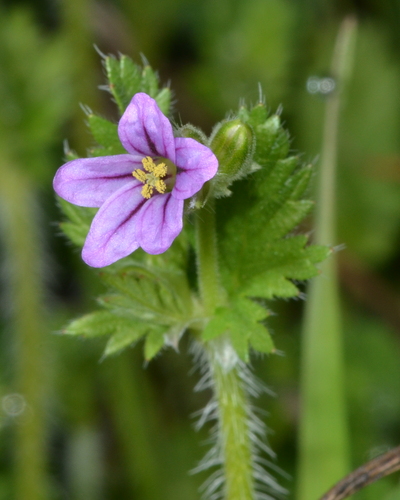
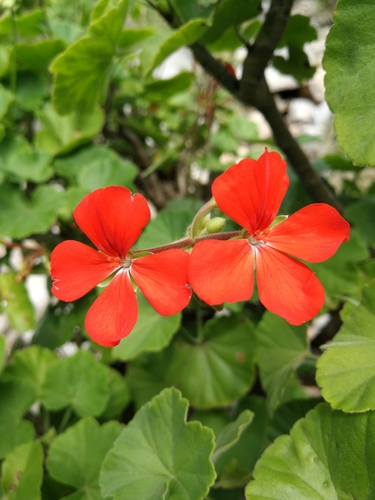
Pelargonium inquinans (L.) L'Hér. is a small shrub in the wild that reaches around 2 m in height, with a branched growth habit. Young succulent twigs become woody as the plant ages, and all branches are covered in red glandular hairs. Its evergreen leaves grow from long petioles and are orbicular in shape, similar to the leaves of Pelargonium × hortorum but lacking dark markings. Each leaf is cut into 5 to 7 crenate lobes, and covered on both sides in a viscous pubescence that gives the leaf surface a cottony appearance. When touched, the leaves leave a brown rust-colored stain on fingers. The plant produces scarlet red flowers, which sometimes appear pink or white. Flowers are arranged in groups of 10 to 20 in pseudo-umbels, and have bilateral zygomorphic symmetry. The two upper petals may be slightly smaller than the three lower petals. Both stamens and the style protrude out from the flower, and the filaments of the seven fertile stamens are fused together along most of their length. In its native South Africa, the plant can flower year-round. Its pericardial fruit is made up of 5 capsules, each ending in a long, hairy, twisted curl when fully mature. This scarlet-flowered pelargonium is distributed across South Africa, growing in the Eastern Cape areas of Uitenhage, Albany, and Caffirland, and south of Kwazulu-Natal. It grows on clay soils, similar to Pelargonium × hortorum. Indigenous people use its crushed leaves to treat headache and influenza, and also use the leaves as a body deodorant.