About Pelargonium graveolens (Thunb.) L'Hér.
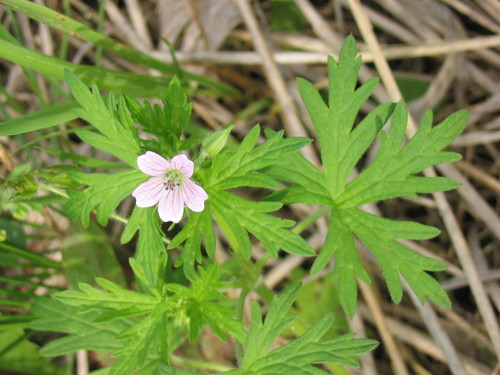
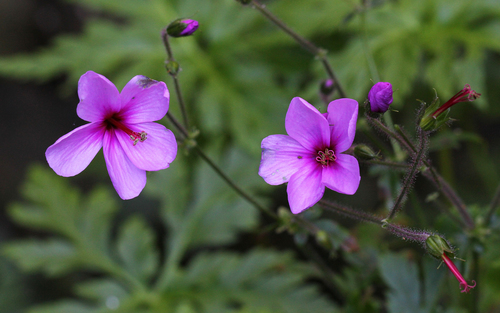
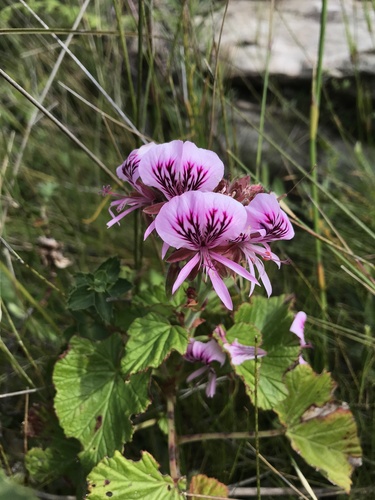
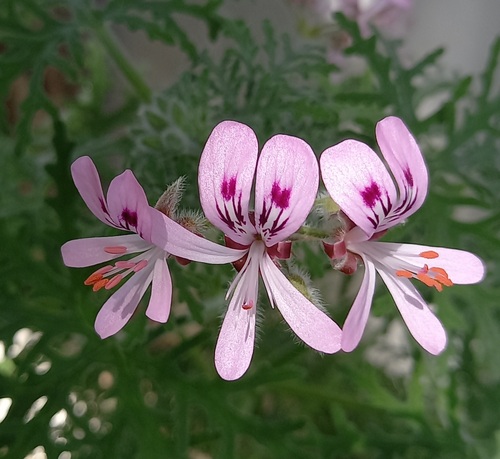
Pelargonium graveolens is an erect, aromatic, multi-branched subshrub that reaches up to 1.5 m in height and 1 m in spread. Its leaves are deeply incised, velvety and soft to the touch due to the presence of glandular hairs. All above-ground parts of the plant are more or less hairy and glandular. Leaves are arranged alternately, and each leaf is divided into a petiole and a leaf blade. The leaf blade is soft, heart-shaped, palmately divided, with blunt lobed to coarsely toothed lobes. The naturally occurring form of the species smells of mint. Scent and leaf shape vary across cultivars: some cultivars have a scent similar to rose petals, while others have little to no scent. Leaf incision also varies: some leaves are deeply incised, while others are only slightly lobed, similar to the leaves of Pelargonium capitatum. Flowers range in color from pale pink to almost white, and bloom from late winter through summer, with peak blooming in spring. This species is native to southern tropical Africa: specifically Mozambique, Zimbabwe, and the South African provinces of Cape Province and Transvaal. It has been cultivated in South Africa and Namibia for at least 200 years, and has been introduced to and now grows in the Canary Islands, Corsica, Costa Rica, Cuba, the Dominican Republic, Haiti, southwestern Mexico, and Puerto Rico. Both the wild species and its cultivated forms are commonly called rose geranium. Pelargoniums are often called geraniums because they belong to the plant family Geraniaceae, and were previously classified within the same genus as true geraniums. The common cultivars P. 'Graveolens' and P. 'Rosat' are very important to the perfume industry. These cultivars are cultivated on a large scale, and their foliage is distilled to extract scented oil. Pelargonium distillates and absolutes, commonly sold as "geranium oil", are marketed for use in aromatherapy and massage therapy. They are also sometimes used to supplement or adulterate more expensive rose oils. As a flavoring ingredient, the flowers and leaves are added to cakes, jams, jellies, ice creams, sorbets, salads, sugars, and teas. Additionally, it is used as a flavoring agent in some pipe tobaccos, and is one of the characteristic "Lakeland scents". In Morocco, rose geranium is called Mâatercha or Ätarcha, and is used as a flavorful herb to complement spearmint tea. It is often added alongside spearmint or other minty herbs to enhance the tea's overall flavor, adding a floral, aromatic note to the brew. In Cyprus, where it is called kiouli, it is used to add flavor and scent to the sugar syrup in apricot preserves known as glyko tou koutaliou hrisomilo.