About Pelargonium cucullatum (L.) L'Hér.
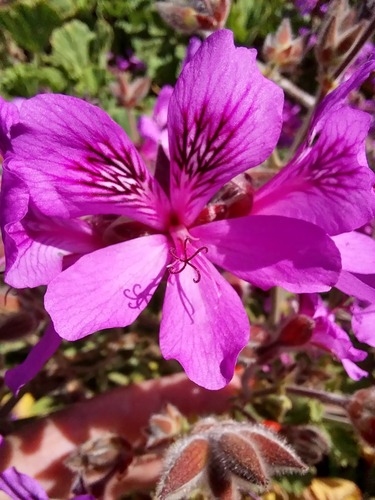
Pelargonium cucullatum is a hairy, upright, branching perennial shrub that reaches 1–2 m (3.3–6.6 ft) in height. It grows from a taproot and produces underground runners, which give rise to intermittent shoots. It releases a fragrance when rubbed. Its branches start out herbaceous and greyish green, eventually becoming woody and brown. Branches are 6–10 mm (0.24–0.39 in) in diameter, and have a sparse to dense covering of long, soft villous hairs, or straight strigose hairs that all point in the same direction, alongside some glandular hairs. The alternate leaves crowd near the ends of branches, and have the same hairy covering as the branches. Each leaf is accompanied by two free, caducous, membranous, light green, ovate to narrowly ovate stipules, 5–10 mm (0.20–0.39 in) long and 3–7 mm (0.12–0.28 in) wide with a pointed tip, positioned to the sides of the leaf petiole. The leaf petiole is mostly 20–55 mm (0.79–2.17 in) long, with a full range of 8–90 mm (0.31–3.54 in), and has a groove on its somewhat flattened upper side. The undivided leaf blade is flat to cup-shaped, with a firm to somewhat succulent texture, and a rounded, broadly triangular to kidney-shaped outline. It measures about 4–5.5 cm long and 5–9 cm (2–3+3⁄5 in) wide, is often somewhat incised, has irregular teeth along its margin (particularly near the base), occasionally has a margin accentuated by a red line or a row of hairs, and has a heart-shaped to wedge-shaped base. Veins are sunken below the upper leaf surface and protrude from the lower leaf surface. The inflorescence is a branched flowering stem that bears up to 4 umbels, each holding mostly 3–9 flowers, and sometimes as few as one or as many as 13 flowers. The flowering stem carries one or two small leaves and two to four green bracts at each branching point. These bracts are oval to broadly oval with a pointed tip, 5–9 mm (0.20–0.35 in) long and 2–4 mm (0.079–0.157 in) wide, ovate to broadly ovate with acute apices, and sparsely pilose to villous, especially on the abaxial side and at the margins. The stems that carry the umbels, called peduncles, are green or red-tinged, covered in many soft hairs and fewer glandular hairs, mostly 3–6 cm (1.2–2.4 in) long, with a full range of 2–7 cm (0.79–2.76 in). Peduncles are sometimes slightly curved when flowers are still in bud, become upright when flowers open, and recurve or nod after flowering. The stems of individual flowers, called pedicels, are green or reddish brown, covered in felty hairs, and 2–7 mm (0.079–0.276 in) long, rarely reaching up to 11 mm (0.43 in). As with all Pelargonium species, the posterior sepal fuses with the pedicel to form a nectary tube (hypanthium); in P. cucullatum, this structure is 5–12 mm (0.20–0.47 in) long, covered in felty hairs, and green or reddish brown. The five sepals are felty hairy, green or reddish brown, 12–20 mm (0.47–0.79 in) long and 2–6 mm (0.079–0.236 in) wide, narrowly elliptic to elliptic with pointed tips. The five petals are dark pink, light pink, or rarely white, 15–32 mm (0.59–1.26 in) long and 6–17 mm (0.24–0.67 in) wide. The two larger upper petals are asymmetrically inverted egg-shaped, with dark purple streaks and a reddish purple tinge at the base that fades into reddish purple patches. The three smaller lower petals are narrowly elliptic to inverted egg-shaped, 15–28 mm (0.59–1.10 in) long and 6–12 mm (0.24–0.47 in) wide, and marked with reddish purple. The 10 filaments are white to pale pink and fused at their base. Filaments vary in length: most often 7 (rarely fewer) carry purple anthers 2–3 mm (0.079–0.118 in) long. Anthers are attached at their center and open via a slit facing the flower center, exposing orange pollen. Filament lengths are as follows: two 12–18 mm (0.47–0.71 in) long, two 10–16 mm (0.39–0.63 in) long, two 8–13 mm (0.31–0.51 in) long, and one 11–15 mm (0.43–0.59 in) long. Three (rarely more) filaments are staminodes that lack anthers, and are 5–10 mm (0.20–0.39 in) long. The reddish purple style is 6–9 mm (0.24–0.35 in) long, with a few long, straight, soft hairs on its lower half, and holds five dark reddish purple stigmas 2–4 mm (0.079–0.157 in) long. Each fruit consists of five mericarps 15–31 mm (0.59–1.22 in) long, with a basal capsule 4–6 mm (0.16–0.24 in) long and a tail 11–25 mm (0.43–0.98 in) long. Each capsule holds a single seed 3–4 mm (0.12–0.16 in) long. All three subspecies of Pelargonium cucullatum grow in fynbos vegetation. Subspecies cucullatum occurs on the east coast of the Cape Peninsula and the Kogelberg, growing in sandy, well-drained soil that receives 400–800 mm (16–31 in) of precipitation per year. The largest population of subspecies tabulare is found on the south and west coast, and the inland of the Cape Peninsula, and it also occurs around Saldanha Bay. Subspecies strigifolium is a montane taxon found from near Caledon in the Kleinrivier Mountains in the east to the Hottentots Holland Mountains in the west, and from Baardskeerdersbos in the south to around Bainskloof in the north. It grows on a variety of soils derived from sandstone, shale, tillite and granite, always at altitudes above about 300 m (980 ft), in areas that receive 600–1,000 mm (24–39 in) of precipitation annually. Wild populations of all three subspecies of Pelargonium cucullatum are stable, and the species is classified as least concern for conservation.