About Pelargonium coronopifolium Jacq.
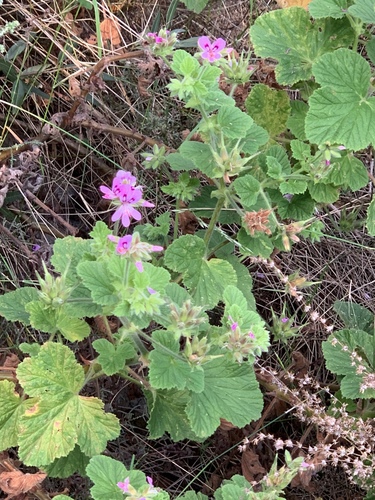
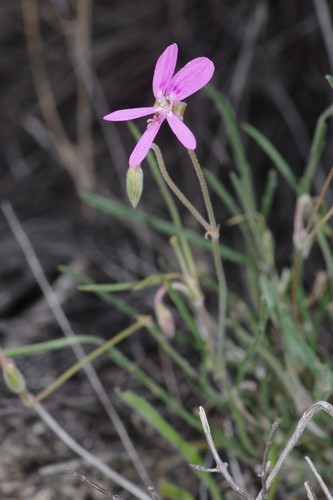
Pelargonium coronopifolium Jacq. is a diploid species with a base chromosome number of 10, making its diploid chromosome count 2n=20. It is an upright, herbaceous subshrub with main stems that can reach up to 40 cm (1+1⁄3 ft) in height. Below the current leaf layer, stems are rough due to retained remains of old leaves and stipules. Individual plants can grow multiple stems from an underground rootstock. All above-ground plant parts are covered in short, stiff hairs that lie flat against the surface, along with fewer glandular hairs; this hair covering does not extend to the pistils, stamens, staminodes, petals, and the inner surface of the sepals.
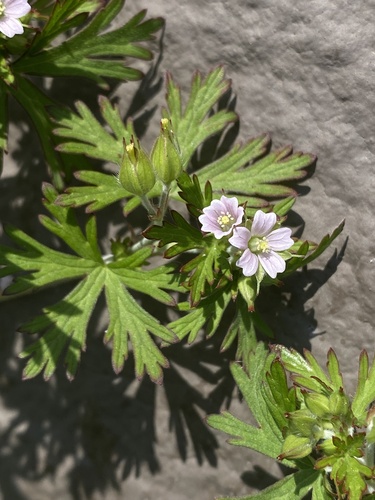
Leaves are green to slightly greyish, with a flat to V-shaped blade that has a linear to narrowly elliptical outline. Blades are usually 3–8 cm (1.2–3.1 in) long, with a full recorded length range of 2–17 cm (0.79–6.69 in), and 1–7 mm (0.039–0.276 in) wide, rarely reaching up to 1 cm (0.39 in) wide. The blade tapers gradually into the petiole, ends in a short sharp tip, and has a margin that is either entire or bears irregular teeth near the tip. The leaf petiole is shorter than the leaf blade, measuring 3–30 mm (0.12–1.18 in) long, rarely up to 5 cm (2.0 in), and has a groove along its upper side. Two reddish-brown, awl-shaped stipules grow at the base of each leaf, 2–10 mm (0.079–0.394 in) long and 1–3 mm (0.039–0.118 in) wide.
Inflorescence stalks are 3–6 cm (1+1⁄5–2+2⁄5 in) long, rarely up to 14 cm (5+3⁄5 in). Each inflorescence stalk bears two or three zygomorphic flowers, sometimes one or four, each on a 2–4 cm (4⁄5–1+3⁄5 in) long flower stalk that can rarely reach 5 cm (2.0 in) long. Each flower has 5 green to reddish-brown sepals that are fused into a tube at the base, which is approximately ¼ as long as the pedicel. The sepals are oval in outline, 4–10 mm (0.16–0.39 in) long, 2–3 mm (0.079–0.118 in) wide, and end in a pointed tip.
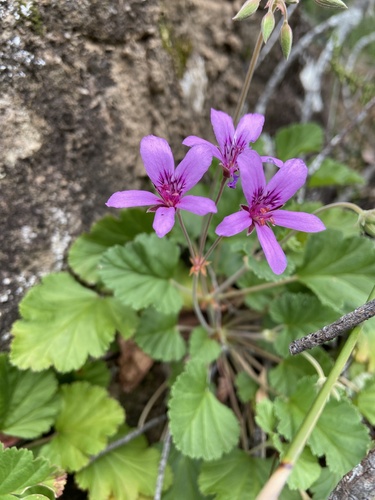
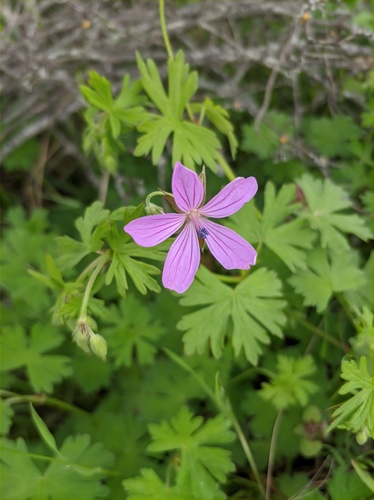
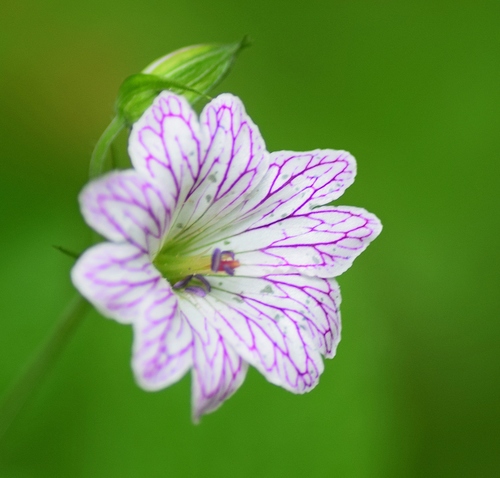
Each flower has 5 petals that can be white, pink, or purple. Two petals that usually point upward are 7–18 mm (0.28–0.71 in) long and 2–7 mm (0.079–0.276 in) wide; they have a teardrop-shaped upper blade with darker markings, and a narrow basal claw with side extensions called ears. Three petals that usually point downward or forward lack markings, have an elliptic outline with a narrow claw, and measure 4–14 mm (0.16–0.55 in) long and 1.5–3 mm (0.059–0.118 in) wide.
Each flower has 2 long, 2 medium, and 1 short fertile stamen, each topped with an anther holding yellow to orange pollen (this pollen color is best observed on buds), plus 5 infertile, hairless, flattened staminodes, two of which are sometimes slightly bent backward. At their base, the filaments of both stamens and staminodes are fused into a column 1.5–2.5 mm (0.059–0.098 in) long. The characteristic storkbill-shaped fruit eventually splits into 5 mericarps. Each mericarp has a 5–6 mm (0.20–0.24 in) long capsule holding one single seed, and a 30–33 mm (1.2–1.3 in) long tail.
Pelargonium coronopifolium is distributed in South Africa's Western Cape province, ranging from the Gifberg through the Cederberg and Kouebokkeveld Mountains to Worcester. It grows in arid fynbos on sandstone slopes, occurring at altitudes from around 150 m (490 ft) west of the Olifants river up to approximately 1,400 m (4,600 ft) in the Cederberg. This species is primarily pollinated by bees.