About Pelagodroma marina (Latham, 1790)
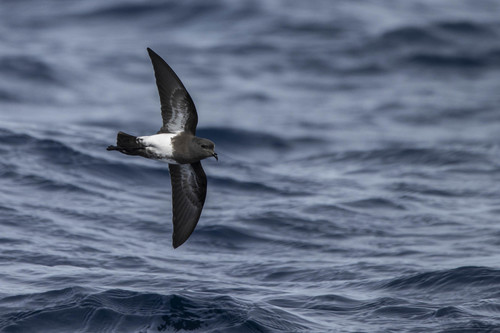
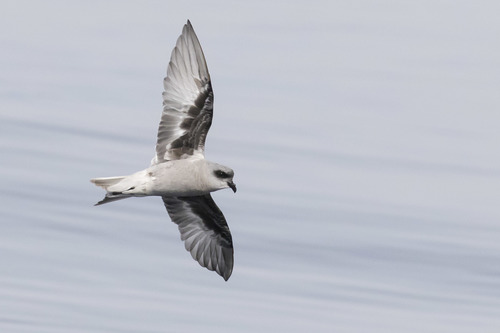
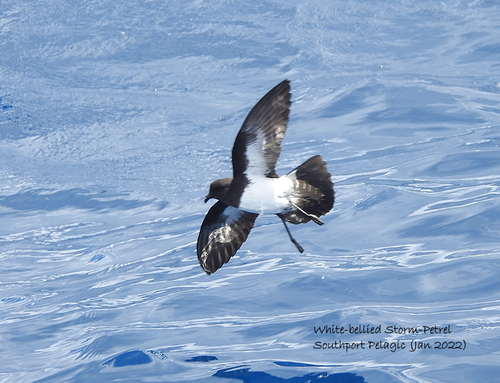
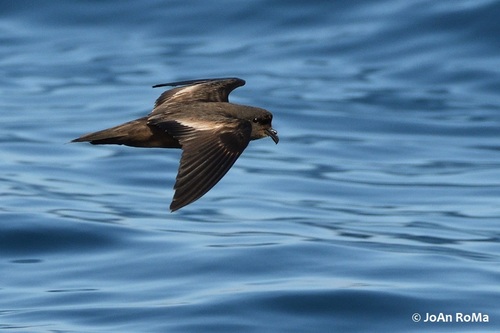
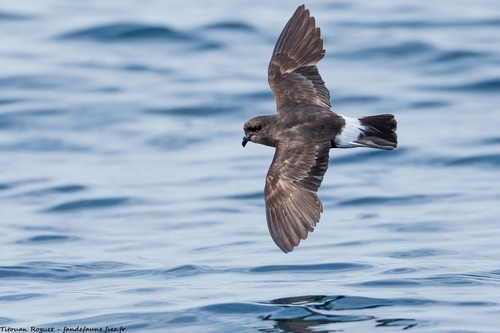
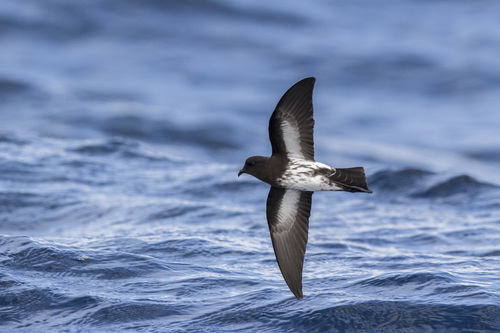
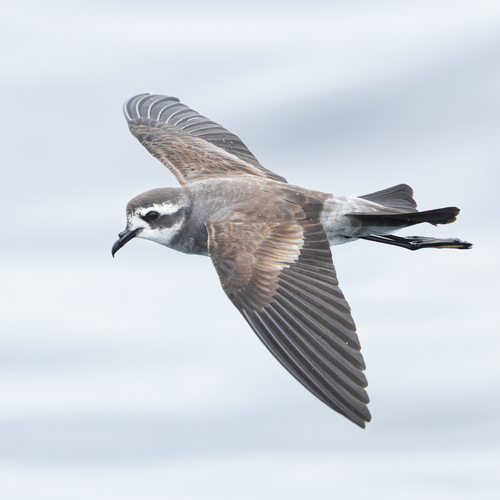
The white-faced storm petrel (Pelagodroma marina) is typically 19 to 21 centimetres (7.5 to 8.3 in) in length, with a 41 to 44 centimetre (16 to 17 in) wingspan, and a body mass of 40 to 70 grams. Key identifying features of this species include a dark bill, dark tarsi, dark toes, and dark claws. It has pale brown to grey colouration on its back, rump, and wings, paired with black flight feathers. Its underparts are white, which distinguishes it from other north Atlantic petrels, and it has a white face marked by a black eye mask, similar to a phalarope. Its distinctive grey-brown dorsal plumage makes it one of the easier petrel species to identify at sea from a distance. Both sexes of this species (also called frigate petrel) have similar plumage with no seasonal variation in plumage. There are only slight size differences between the sexes: females are around 1–3% larger than males in tarsus, wing, and tail lengths, while males have a bill depth roughly 1.7% larger than females. Juveniles are similar to adults, but their fresh plumage typically has larger light fringes and tips on the upperpart feathers, and their overall appearance may be grey or brown depending on their moult stage. The tail fork of juveniles is also often shallower than that of adults, at least for the New Zealand subspecies P. m. maoriana. Different subspecies exhibit subtle morphological differences. The Kermadec Islands subspecies P. m. albiclunis is similar to P. m. dulciae, but is set apart by its white rump and shorter, square tail, which distinguishes it from both P. m. dulciae and P. m. maoriana (both of which have pale grey rumps). P. m. albiclunis also has white upper tail coverts instead of the typical grey found in other subspecies, making it highly distinct. Additionally, P. m. albiclunis is slightly smaller in overall dimensions than P. m. dulciae. Both P. m. albiclunis and P. m. dulciae have square tails, and whiter faces and breast sides, than P. m. maoriana. In contrast, the New Zealand white-faced storm petrel subspecies P. m. maoriana has a forked tail, and is characterized by dark patches on the sides of the breast. It also has shorter culmen, tarsus, and middle toe (with claw) lengths than North Atlantic subspecies such as P. m. dulciae and P. m. albiclunis, and it has a longer tail than the average for other subspecies. The Cape Verde Islands subspecies P. m. eadesi has slightly paler plumage than P. m. hypoleuca, with a paler forehead and paler hindneck. It also has a longer beak, measuring 18–20.5 mm compared to 16–19 mm in P. m. hypoleuca, and whiter neck sides that form an incomplete collar.