About Pelagia noctiluca (Forsskål, 1775)
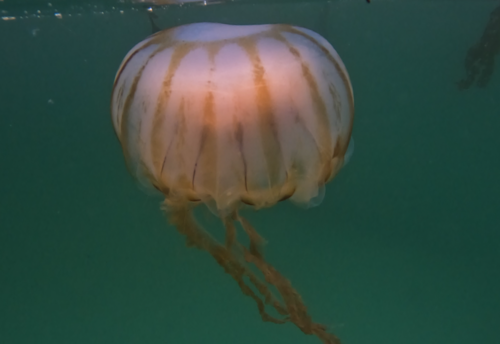
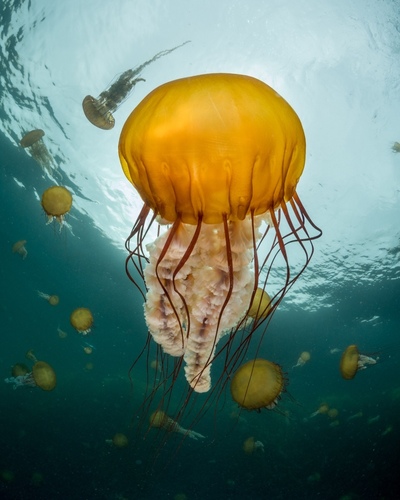
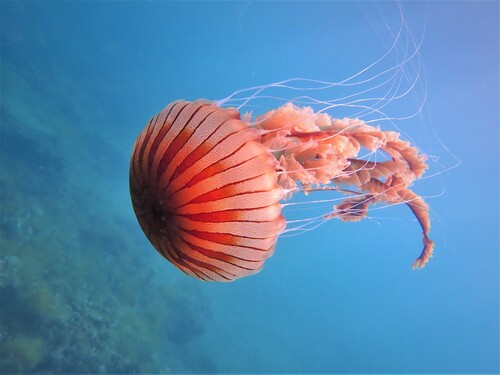
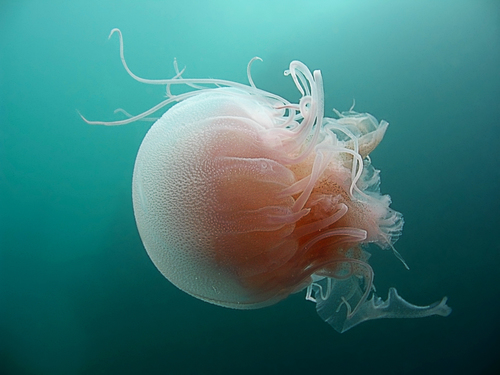
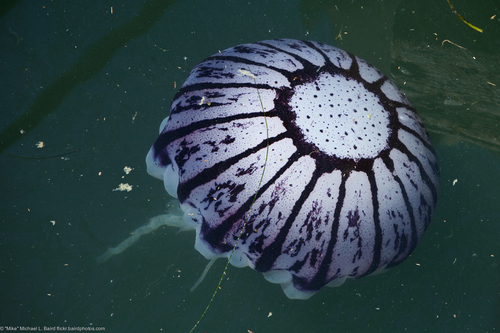
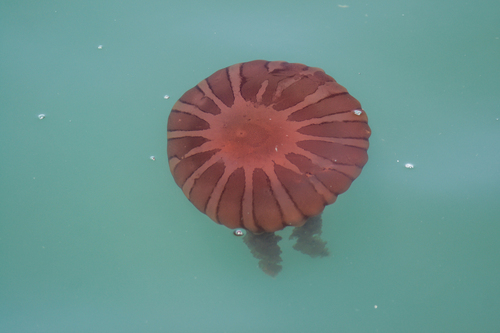
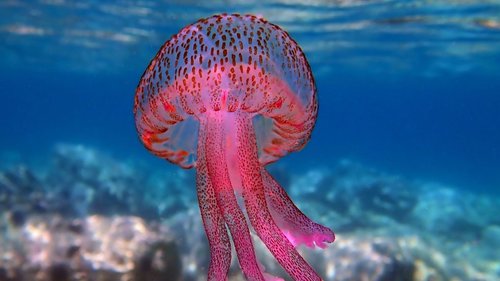
Pelagia noctiluca are fairly small jellyfish, with adult bell diameters measuring 3–12 cm (1.2–4.7 in). Their color varies widely, ranging from mauve, purple, pink, and light brown to yellow. Their bodies are radially symmetrical, with only one body cavity: the gastrovascular cavity. This primitive digestive cavity has just one opening that handles both ingestion and excretion. It has four long oral arms with crenulated margins that form its primary feeding surface, and each adult medusa has eight long tentacles that grow from the umbrella margin. Due to its radial symmetry, the species has no head and no centralized nervous system. Its nervous system is primitive, consisting of a simple net made of naked, largely non-polar neurons. Pelagia noctiluca also lacks specialized gaseous exchange, excretory, and circulatory systems. Like all cnidarians, this species has specialized cells called cnidae, which serve a range of functions including prey capture, defense, locomotion, and attachment. Fully formed cnidae are called cnidocytes. When stimulated, cnidae release nematocyst toxins, which are biological poisons. This species has a well-developed manubrium, a proboscis-like structure that holds the mouth and the four long oral arms. Its mesoglea (the gelatinous body layer) is relatively thick and well developed. Sense organs called rhopalia, characteristic of scyphomedusae, are located in notches around the umbrella margin, alternating with tentacles. Cnidae are present in the epidermis and gastrodermis of the umbrella, as well as on the tentacles. Pelagia noctiluca has eight marginal tentacles that alternate with eight marginal sense organs. Four gonads develop as elongated endodermal proliferations, becoming ribbon-like folds in the interradial sectors of the stomach wall, slightly distal to the rows of gastric filaments. Male and female gonads differ only slightly, with the main difference being the thickness of the follicle. This jellyfish is best documented from the North Atlantic region, ranging from the 4th parallel north (just north of the Equator) to the North Sea and Atlantic Canada, including the Mediterranean Sea and Gulf of Mexico. There are reports of the species from most other tropical and warm temperate seas worldwide, including both the Pacific and Indian Oceans, with its reported southern limit at the 42nd parallel south. Confirmed recorded locations include California (rare occurrence), Hawaii (rare occurrence), northern New Zealand, and all coastal areas around Australia (common occurrence). However, researchers suspect that Pelagia noctiluca as currently defined is a species complex, and records from outside the North Atlantic actually refer to other closely related, currently unrecognized or undescribed species. Even North Atlantic and South Atlantic populations show significant genetic differences, and a comprehensive taxonomic review is needed to resolve this classification issue. In 2014, a second species in the genus Pelagia was described from the Mediterranean, but it was moved to its own genus as Mawia benovici two years later. Pelagia noctiluca has limited swimming ability, so large swarms (called blooms) of this open-ocean species are occasionally carried by wind or currents to inshore areas, and sometimes become stranded on beaches. This also means the species can occasionally appear in waters outside its normal temperature range, with records as far north as the Shetland Islands and the Norwegian deep. It generally lives in water temperatures between 10 and 27 °C (50–81 °F), and stops pulsating below 11 °C (52 °F). It mostly occurs from the surface down to a depth of 150 m (490 ft), but has been recorded as deep as 1,400 m (4,600 ft). The species performs diel vertical migration, staying near the surface at night and moving to deeper water during the day. Local population sizes fluctuate dramatically; the species may go virtually unrecorded in a region for years, then suddenly reappear in huge swarms. On occasion, a swarm can cover tens of square kilometers, include millions of individual Pelagia noctiluca, and reach densities of more than 500 individuals per cubic meter (14 per cubic foot). Pelagia noctiluca is adapted to a pelagic, open-sea lifestyle. Unlike most jellyfish — including all other species in the family Pelagiidae — which have a life cycle that includes both free-swimming stages (planula, ephyra, and medusa) and a bottom-dwelling polyp stage, P. noctiluca has lost the polyp stage entirely. P. noctiluca reproduces sexually: during daylight hours, males release sperm and females release eggs directly into the sea. Three days after fertilization, the egg develops into a planula, which moves only via ciliary action. After one week, planulae develop into tiny ephyrae, and one month later ephyrae develop into sexually mature male or female medusae. There is little to no ephyra growth at temperatures below 10 °C (50 °F), and fewer ephyrae survive below 8 °C (46 °F). Ephyrae reside in the upper mixed layer above the shallow thermocline. Newly developed P. noctiluca medusae have a bell diameter of only around 1 cm (0.4 in). Some individuals reach maturity when their bell reaches 3.5 cm (1.4 in) in diameter, and all individuals are mature by the time their bell reaches 6 cm (2.4 in). In the Mediterranean Sea, P. noctiluca mostly spawns between late summer and early winter, but also spawns at lower levels from spring to early summer. Scientists have found that the abundance and distribution of P. noctiluca early life stages are linked to sea surface chlorophyll concentration. P. noctiluca requires favorable trophic conditions to spawn; if conditions are inadequate, medusae will stop reproducing immediately and lose weight. Large swarms of adults at the ocean surface at certain times of year may be spawning aggregations. This jellyfish typically has a lifespan of around 9 months.