About Peganum harmala L.
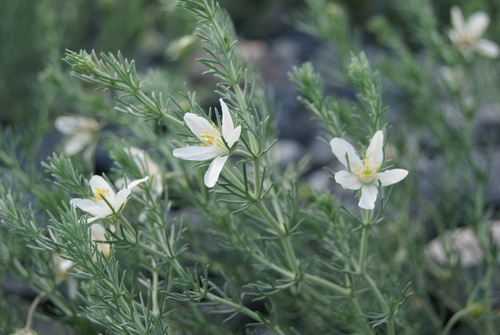
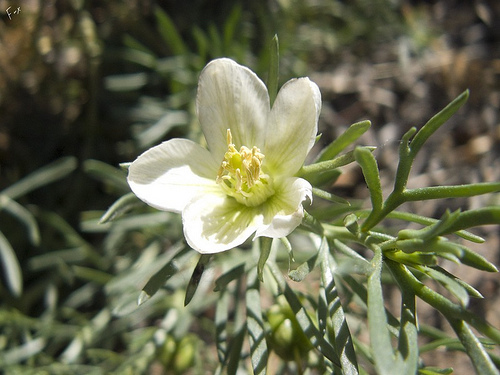
Peganum harmala L., commonly called wild rue, Syrian rue, African rue, esfand, espand, or harmel (among other similar pronunciations and spellings), is a perennial herbaceous plant in the Nitrariaceae family, with a woody underground rootstock. It typically grows in saline soils in temperate desert and Mediterranean regions. Its common English name comes from its resemblance to rue, a plant it is not related to. The seeds contain a high concentration (at least 5.9% by weight) of diverse beta-carboline alkaloids. It has deep roots, a strong scent, finely divided leaves, white flowers that are also rich in alkaloids, and small seed capsules holding numerous dark, oily seeds. It is native to a large region spanning North Africa, southern and eastern Europe, the Middle East, Central Asia, and parts of South and East Asia, and has been introduced to countries including South Africa, Mexico, and France. It grows in dry, often saline or disturbed habitats, and thrives from sea level to high elevations. It is mainly pollinated by insects, especially honey bees, its seeds are mostly dispersed by natural dispersal vectors or human activity, and it hosts a specialized beetle, Thamnurgus pegani, that has been proposed for its biological control. Some scholars link the plant to the sacred plant soma or haoma described in ancient Indo-Iranian texts. It has been documented under many names by classical and medieval sources, with archaeological evidence indicating ritual use dating back to at least the 2nd century BCE. It was first described and illustrated in the 16th century by Rembert Dodoens, and later classified by botanists including Gaspard Bauhin and Carl Linnaeus. Several recognized varieties exist, distinguished by morphological traits and geographic distribution, and lectotype designations have been refined over time to clarify its taxonomy. In the United States, it is banned or regulated as a noxious weed in several states that require its eradication. Internationally, possession and sale of the plant or its psychoactive alkaloids are illegal or controlled in a number of countries, including France, Finland, Canada, and Australia. The plant has been used as a dye, incense, and in traditional medicine. It is toxic to livestock and difficult to eradicate. This species has been added to the Global Register of Introduced and Invasive Species for South Africa, Mexico, France, and Ukraine, although no negative impacts have been reported from any of these countries. Most Ukrainian and other sources consider the plant native to Ukraine. Sources disagree about rare collections in coastal Romania, but many consider it introduced there. As of 2017, at least 7 occurrences have been registered in South Africa, and none in Mexico. As of 2020, it is listed as an introduced plant to South Africa on the South African National Biodiversity Institute's Plants of Southern Africa website. One database records it occurring as a non-native in Hungary. In France, it is considered a former accidental introduction that was once uncommon on the Mediterranean coast's Côte d'Azur, and has very rarely been found elsewhere in France in the past. The Flora Europaea notes a native population on Corsica, but Tela Botanica states the species does not occur on the island, either as a native or introduced plant. It was first planted in the United States in 1928 in New Mexico by a farmer who wanted to manufacture a dye called "Turkish red" from its seeds. From this planting, the plant spread across most of southern New Mexico and the Big Bend region of Texas. It has also spread from east of Los Angeles in California to the southernmost tip of Nevada. Outside of these areas, its distribution in the US is discontinuous and localized. As of 2019, it has been reported in southern Arizona (in at least 3 adjacent counties), northeastern Montana (2 adjacent counties), northern Nevada (Churchill County), Oregon (the town of Prineville in the Oregon High Desert), and possibly Washington. Because it is highly drought tolerant, African rue can displace native saltbushes and grasses growing in the salt-desert shrub lands of the Western U.S. Although its distribution in New Mexico and Texas suggests it has spread to parts of northern Mexico, the species was not included on Mexico's 2004 list of introduced plants. In the United States, it grows in dry areas and can be classified as a halophyte. In Kashmir and Ladakh, it occurs at elevations of 300 to 2400 metres (1000' to 7900'), in China 400 to 3600 metres (1300' to 12,000'), in Turkey 0 to 1500 metres (0' to 5000'), and in Spain 0 to 1200 metres (0' to 4000'). In China, it grows in slightly saline sands near oases and dry grasslands in desert areas. In Spain, it can be found in abandoned fields, rubbish tips, stony slopes, along road verges, ploughed and worked ground, and disturbed, saline scrubland. In Morocco, it grows in steppes, arid coasts, dry uncultivated fields, and amongst ruins. A Moroccan study found it can be used as an indicator species for rangeland degraded from agricultural activities when found growing alongside certain Artemisia species, Noaea mucronata, and Anabasis aphylla. In Israel, it is a common dominant plant alongside Anabasis syriaca and Haloxylon scoparium in a low semi-shrubby steppe ecosystem that is almost devoid of plant cover during dry years, growing on saline, loess-derived soils. In wet years, Leontice leontopetalum and Ixiolirion tataricum grow in this ecosystem. It also grows in Israel in semi-steppe shrublands, Mediterranean woodlands and shrublands, and deserts. Between 800 and 1300 metres (2600' to 4300') elevation on the sandstone slopes of the mountains around Petra, Jordan, there is an open Mediterranean steppe forest dominated by Juniperus phoenicea and Artemisia herba-alba, with occasional Pistacia atlantica and Crataegus aronia trees. Common shrubs in this habitat are Thymelaea hirsuta, Ephedra campylopoda, Ononis natrix, Hammada salicornia, and Anabasis articulata. When this already degraded habitat is further degraded by overgrazing, P. harmala and Noaea mucronata invade the area. It is often found growing with Euphorbia virgata in the foothills of Mount Ararat, Iğdır Province, Turkey. The flowers are pollinated by insects, but little is known about other pollen vectors. A one-year study near St. Katherine in the El-Tur mountains of southern Sinai found P. harmala is exclusively pollinated by domesticated honey bees, Apis mellifera, though it is possible these bees are displacing native bee species. The plant's floral morphology, nectar volume, and nectar composition — high in hexane sugars, containing toxic alkaloids, and with high proline content — suggest adaptation to pollination by short-tongued bees, consistent with this pollination syndrome. The plant is classified as a barochore for seed dispersal. A Mongolian study found its seeds are exclusively dispersed by human activities, although Peganum multisectum, sometimes treated as a variety or synonym of this species, is dispersed solely by water flow. A species of tiny, hairy beetle, Thamnurgus pegani, lives in the stems of P. harmala in Turkey and other areas, and feeds only on this species. When the plant's above-ground parts begin to die off in autumn, adult beetles retreat to overwinter in the soil under the root-crown, or in old larval tunnels in dead stems. When they emerge in spring (May in Turkey), females bore small holes into the newly growing stems to lay their eggs. Hatched larvae bore inward toward the pith of the stem. The beetles infect surrounding tunnel tissue with the fungus Fusarium oxysporum. Infected plant tissue turns blackish, and is used as a food source by adult beetles and their larvae until the beetles are ready to pupate within the stem tunnels. This beetle has been proposed as a candidate for biological control of P. harmala, since a related species, T. euphorbiae, has been approved for use against invasive Euphorbia in the United States. In some regions, P. harmala is a common weed. In China, it is considered a noxious weed that is invasive in overgrazed areas. In the United States, where it is not native, it is officially registered as a noxious weed or similar designation in Arizona, California, Colorado, Nevada, New Mexico, and Oregon. Infestations can be invasive and very difficult to eradicate. It is also known to contaminate agricultural seed. It often causes poisoning in livestock, especially during drought. Consumption by animals causes reduced fertility and abortions. Leaves and seeds are considered poisonous due to the beta-carbolines (including harmalol, harman, harmaline, harmine) and quinazoline derivatives they contain. After human ingestion, side effects can include hallucinations, neurosensory syndromes, bradycardia, nausea, and vomiting. Control is only possible with powerful herbicides. Manual uprooting is nearly impossible, and no biological control methods are currently awaiting approval. The thick, deep-growing rootstock stores starches that help the plant survive defoliation, and the plant's crown is protected below the soil surface. In Iran and neighboring countries including Turkey and Azerbaijan, dried capsules of the plant are strung and hung in homes or vehicles to protect against the evil eye. It is widely used for protection against Djinn in Morocco. Esfand (called isband in Kashmiri) is traditionally burnt during Kashmiri weddings to create an auspicious atmosphere, and is also used for its fragrant smoke and to ward off negative energies at other ceremonial, festive, and household occasions. Burning esfand seeds is also common in Persian cultures to ward off the evil eye, including at Persian weddings. In old Yemenite Jewish custom, P. harmala (African rue) leaves were used to bleach whole wheat kernels to produce clean white flour for Passover unleavened bread. Layers of wheat kernels were alternating with layers of African rue leaves on a floor until all wheat was covered, then left for several days so astringent vapors from the leaves bleached the outer wheat kernels. After bleaching, the wheat was sifted to remove leaf residue and ground into clean white flour. Peganum harmala has been used as an analgesic, emmenagogue, and abortifacient. In one region of India, the root was applied to kill body lice. It is also used as an anthelmintic to expel parasitic worms. Reportedly, ancient Greeks used powdered seeds to eliminate tapeworms and treat recurring fevers, likely malaria. In Rembert Dodoens' 1554 Des Cruydboeks, it notes that in 16th century Europe, this plant was considered a wild type of rue and shared the same medicinal uses as rue, since its identity had merged with rue from ancient Greek and Roman sources. It was considered a stronger, even dangerously potent version of rue. It could be purchased as harmel in apothecaries, and was also known as wild rue or mountain rue. It was used to treat dozens of ailments: when leaves were used in only water it treated women's natural diseases; when juice was drunk with wine and leaves pressed against wounds, it cured bites and stings from rabid dogs, scorpions, bees, wasps, and similar animals. Dodoens also recounts a claim attributed to Pliny that people covered in the plant's sap, or that ate it while sober, would be immune to poison and poisonous animals for a day. Other recorded uses included reducing sperm production, purifying women after childbirth, curing earache, removing spots and blemishes from the skin, and soothing bumps and pain from impacts, among many others. All of these recorded cures use either the plant's juice or leaves; none call for use of the seeds. Peganum harmala seeds have been used as a substitute for Banisteriopsis caapi in ayahuasca analogs, because they contain monoamine oxidase inhibitors that make DMT orally active. It has also been used in Changa, a DMT-infused smoking blend.