About Pedostibes tuberculosus Günther, 1876
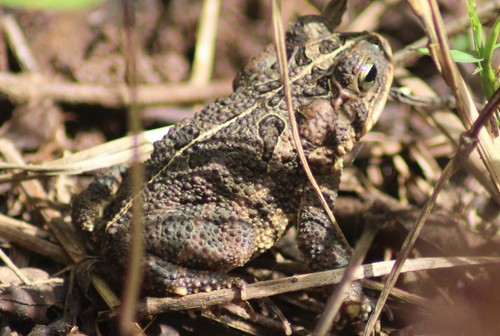
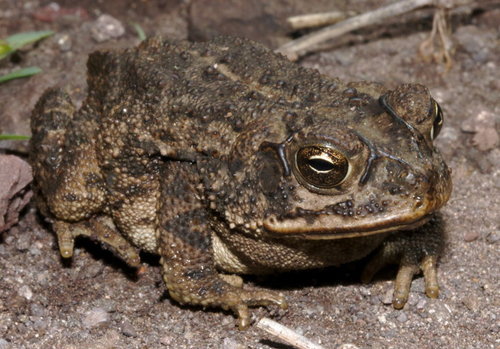
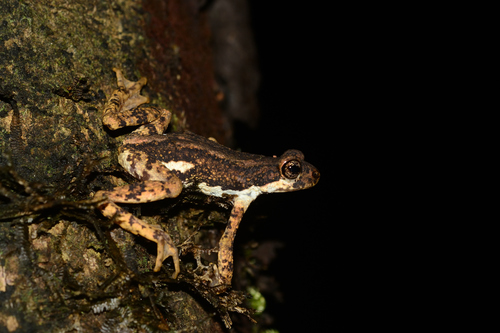
Pedostibes tuberculosus Günther, 1876 is a slender toad with a moderately sized head. It has a pointed snout and vertical lores, and the distance between its eyes matches the width of its upper eyelid. Its tympanum (ear opening) is clearly defined, and measures roughly one-third of the diameter of its eye. Its fingers are moderate in length, depressed, and webbed at the base; the first finger is half the length of the second. Its toes are almost entirely webbed, and both finger and toe tips are dilated into broad, truncated disks that are smaller on the toes. The tubercle near the joint is small, and there are two small, flat metatarsal tubercles, with no tarsal fold. When the hind limb is held straight against the body, the metatarsal tubercles reach to a point between the eye and the tip of the snout. The skin on its upper body is rough and tubercular, with the largest tubercles arranged along each side of the back. Its upper body is brownish-grey, with darker sides; a white band runs from below the eye to the axil, and a second white longitudinal band is located in the lumbar region. Its underside is marked with dark spots. Males have a subgular vocal sac, and females are larger than males. Adult toads reach 3.6–3.85 cm (1.4 inches) in snout-to-vent length. The species' call is described as "shirrrr shirr shirr shirr", has a dominant frequency of 3780 Hz, with each call lasting 3 to 7 seconds and containing 3 to 10 pulses. This species is associated with tree habitats, though adults are found among leaf litter and climb into trees at night. It occurs in forests of the Western Ghats at elevations between 250 m and over 1000 m, often alongside streams. It has been recorded from multiple protected areas: Konya Wildlife Sanctuary, Cotigao Wildlife Sanctuary, Indira Gandhi National Park, Kalakad-Mundanthurai Tiger Reserve, Ponmudi Hills National Park, and Silent Valley National Park. Breeding occurs at the start of monsoon rains, and tadpoles develop in streams. Tadpoles of this species have body suckers; scientists hypothesize they feed on stream-bottom plants, though their diet has not been directly observed. The youngest tadpoles are translucent except for their yolk sac; as they mature, they turn brown, and sometimes develop silver markings.