About Pediomelum tenuiflorum (Pursh) A.N.Egan
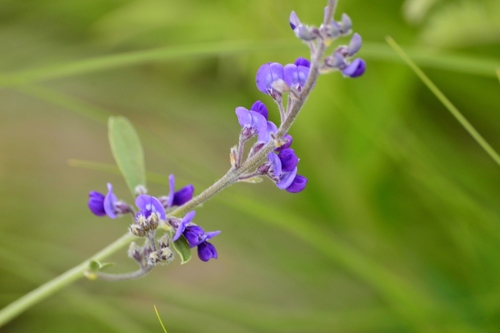
Pediomelum tenuiflorum is a much-branched herbaceous perennial plant. It typically grows 40 to 100 centimeters (1.5 to 3.5 ft) tall, and may reach up to 1.2 meters (4 ft) in height. Its stems sprout from an underground caudex that sits atop a deep taproot. Stems may grow straight upward, or grow outward a distance before curving upward. Slender stems have eight or more long internodes, and are covered in dense to sparse rigid hairs that lie flat against the stem surface, giving the stems a gray-green appearance. The leaves are compound, with three to five leaflets each 6 to 40 millimeters long. Lower leaves are usually palmately compound with five leaflets, while higher leaves most often have three leaflets, and occasionally four. Leaves remain on the plant when flowering begins. Short racemes are 1 to 5.9 centimeters long, and hold between seven and twenty-one indigo-colored pea flowers, each 4.5 to 6 millimeters long. After pollination, the plant produces smooth seed pods with visible glands, each holding a single seed. The pods are 7 to 9 millimeters long and often asymmetrical. When seeds ripen, the upper portion of the plant dries, detaches from the base, and can be blown by wind like a tumbleweed. It resembles alfalfa, but has fewer and smaller flowers. Pediomelum tenuiflorum grows primarily in the north-central United States, with its range extending to the Rocky Mountain states, southwest into Arizona, and into northern Mexico. In the Midwest, it grows throughout Kansas, across most of Missouri, and through much of Nebraska. It is less common in Illinois, and only found in widely scattered locations in Wisconsin, Iowa, Minnesota, South Dakota, and North Dakota. In Montana and Wyoming, it grows east of the Rocky Mountains; in Colorado, it grows mostly east of the Rocky Mountains, with populations also present in a few western counties. It is found in almost all of New Mexico and Arizona, and only in southern Utah. Its range covers most of Oklahoma and many areas of Texas. The USDA only records it from three counties in Indiana, one county in Kentucky, and one county in Mississippi. In Mexico, it is found only in three states: Chihuahua, Sonora, and Nuevo León. This hardy plant prefers semi-desert, sandy habitats, scrubland, and woodland, and is drought resistant thanks to its long taproot. The flowers of Pediomelum tenuiflorum attract bees, including the species Svastra obliqua, Colletes willistoni, and Calliopsis andreniformis. The leaf beetle Luperosoma parallelum, and grasshoppers including Melanoplus femurrubrum, Melanoplus foedus, and Melanoplus packardii, feed on the plant’s leaves. The larvae of the moth Schinia jaguarina feed on its seed pods. Pediomelum tenuiflorum has a number of traditional uses. Its root is edible raw or cooked; it can also be ground to thicken soups, or mixed with cereals to make bread. The plant is used as an ingredient in an alcoholic Agave-derived drink. In traditional medicine, it is used to treat headaches, flu, and tuberculosis, through preparations including root-infused drinks and smoked leaves. Stems can be woven into garlands to use as a sun hat on hot days, and used as a fumigant to repel mosquitoes. The Zuni people apply a poultice of moistened leaves to the body for purification.