About Pediomelum esculentum (Pursh) Rydb.
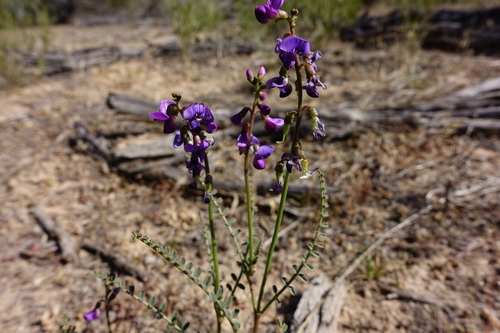
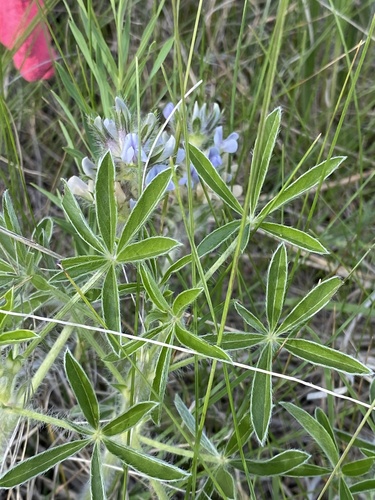
Pediomelum esculentum, commonly called the prairie turnip, grows across the Great Plains: its range extends from Manitoba south to Texas, and from Wisconsin west to Montana. It thrives in full sun on well-drained, rocky or sandy soil, and is most often found in high, dry locations, near rivers, or in steppe habitat. Its relative scarcity today, compared to its historic abundance, is likely due to widespread conversion of native prairie to farmland or managed grassland. This is a perennial herb that lives 3 to over 6 years. In spring, several densely hairy stems emerge from the ground, growing up to 30 cm (12 in) tall. These stems bear palmately compound leaves divided into five leaflets. In early summer, the plant produces many blue or purple flowers arranged in terminal clusters 5 to 10 cm (2 to 4 in) long. After flowering, the plant develops flattened, slender-tipped pods. Tubers are harvested while the plant is in flower; flowers and flower stalks break off and disappear quickly after flowering, making the plant hard to locate after this stage. The plant grows from one or more sturdy brown roots that form rounded, spindle-shaped tubers 7 to 10 cm (4 in) below the soil surface; each tuber measures 4 to 10 cm (1.5 to 4 in) long. Iowa Indians call this plant Tipsina, the Lakota name for the plant is timpsila, and the name of Topeka, Kansas' capital city, is thought to mean "good place to dig prairie turnips" in the Kansa language and other southern Siouan languages. As a food, the prairie turnip has been variously described as a delicacy, tolerably good eating, or tasteless and insipid. Native Americans traditionally use it as food in multiple ways: it is eaten raw, boiled, or roasted in embers. It can also be dried, crushed into powder, and made into soup. Large quantities of prairie turnips were historically stored in buffalo skin bags for winter use. A well-liked, palatable pudding is made by boiling dried prairie turnip root flour together with serviceberries (Amelanchier alnifolia). Modern cooks often use prairie turnip flour as a secret ingredient in Native American frybread recipes. The root can also be peeled and eaten raw or cooked on its own.