About Pedicularis sylvatica L.
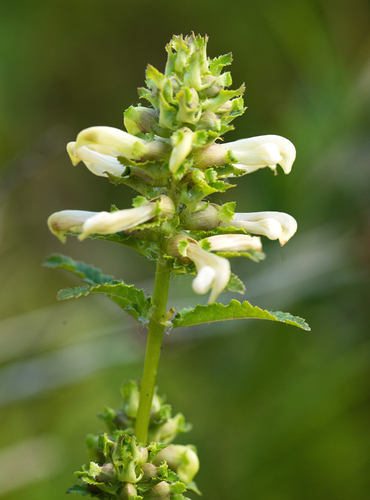
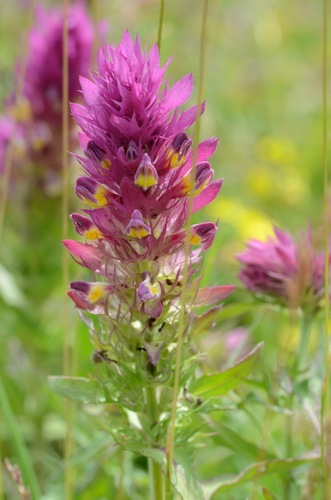
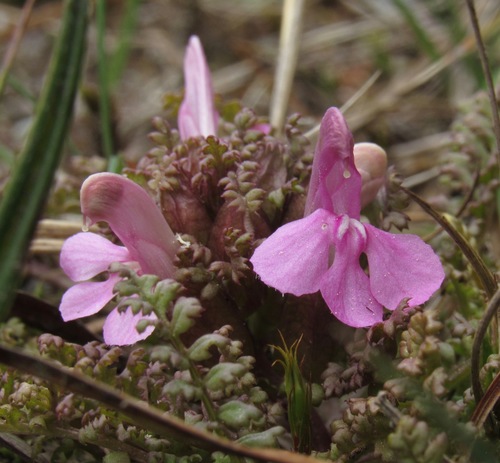
Pedicularis sylvatica L., commonly known as common lousewort, is a compact biennial herb. It has a semi-erect stem that grows up to 15 cm (6 in) tall. Its leaves are opposite, attached with short stalks, rather thick, and often tinged pink or purple. The small leaf blades are triangular-lanceolate to linear, with pinnate lobes and toothed margins. The inflorescence is a raceme, with usually four to six flowers open at a time. Each bilaterally symmetrical flower has a large, rounded, five-angled pinkish calyx; the four calyx lobes are tipped with teeth that are easily seen before the flower opens. The flower itself is pinkish-purple with white markings in the throat, and reaches up to 2.5 cm (1 in) in length. The five petals are fused into a tube; the upper lip curves into a hood, with two teeth at the tip, while the lower lip is divided into three lobes. This species can be distinguished from the related marsh lousewort (Pedicularis palustris) by being smaller and less erect, and by having two small teeth at the tip of the upper lip, rather than four. Common lousewort is found across most of Europe, excluding southeastern Europe. In the British Isles, it grows on damp acidic soils in Scotland, Ireland, Wales, northern and southwestern England, and in scattered locations elsewhere in England, at altitudes up to approximately 915 m (3,000 ft). Its typical habitats include moorland, wet flushes in mountainous areas, grassy heathland, lakesides, and the drier parts of marshes and bogs. The common name originates from an old historical belief that livestock that ate this plant would become infested with lice as a result. Like other members of its genus, common lousewort is semi-parasitic: it supplements its own resources by connecting its roots to the roots of nearby plants and extracting water and nutrients for its own use.