About Pedicularis centranthera A.Gray
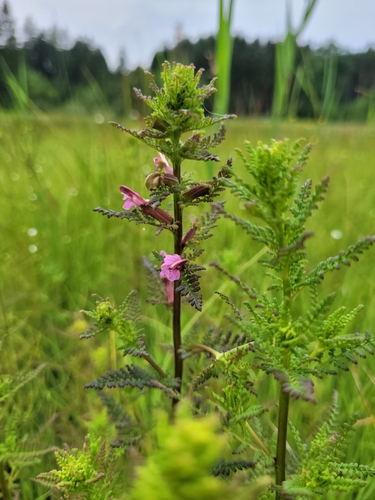
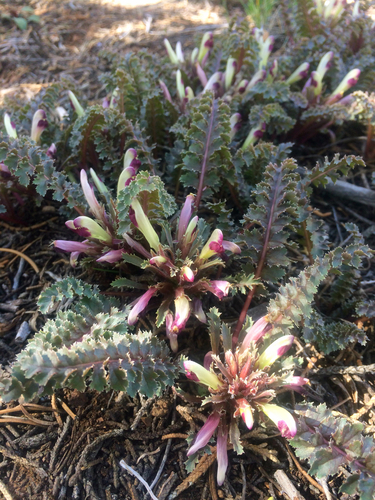
Commonly known as dwarf lousewort, Pedicularis centranthera A.Gray is a perennial plant with a tuberous root. Its leaves form a rosette at ground level, and most are 6 to 15 centimeters long when including the leaf stem, though they can occasionally grow up to 30 centimeters. The leaf stems are short, measuring only 2 to 10 millimeters. Lower leaves are narrow and grass-like, with no divisions or teeth. Upper leaves are pinnatifid, meaning they are divided in a feather-like arrangement. The divisions of these upper leaves are egg-shaped, with toothed edges and a wrinkled texture. The inflorescence is a short raceme that holds many long, protruding, club-shaped flowers. Each flower can be longer than 4 centimeters, and it is white or pale purple, with dark purple tips on the wide ends of its upper and lower lips. The flower sepals are shorter than the petals and covered in hairs. The fruit is a capsule roughly one centimeter long, which holds seeds that have net-like surfaces. This species is native to the western United States, where it occurs in Arizona, California, Colorado, Nevada, New Mexico, and Utah. Within California, it grows only in the northeast of the state, in the Warner Mountains and the Modoc Plateau. In Oregon, it has only been reported in Lake and Harney counties, located in the southwest of the state. It is found across the western two-thirds of Nevada and southern Utah. It has been recorded in many counties of Arizona, five counties in northwestern New Mexico, and five counties in western Colorado. It grows in association with pinyon–juniper woodlands, ponderosa pine forests, and other yellow pine forest types.