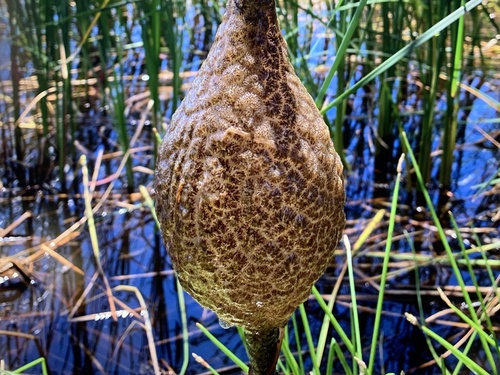
About Pectinatella magnifica (Leidy, 1851)
Pectinatella magnifica, commonly called the magnificent bryozoan, belongs to the phylum Bryozoa and the order Plumatellida. This species exists as colonies of bound-together individual organisms, and these colonies can sometimes reach 60 centimeters, or 2 feet, in diameter. The individual organisms, called zooids, feed using a structure called a lophophore. Cilia on the lophophore's tentacles capture microscopic organic particles from the water and carry these particles to the zooid's mouth. Most populations of Pectinatella magnifica are found in North America, with smaller populations present in Europe. They most often attach to objects, but they can also occur as free-floating colonies. Colonies form a translucent body, with many star-shaped growth patterns across the outer surface. The texture and density of Pectinatella magnifica colonies are similar to gelatin, and colonies break easily into smaller pieces.

