About Pecari tajacu (Linnaeus, 1758)
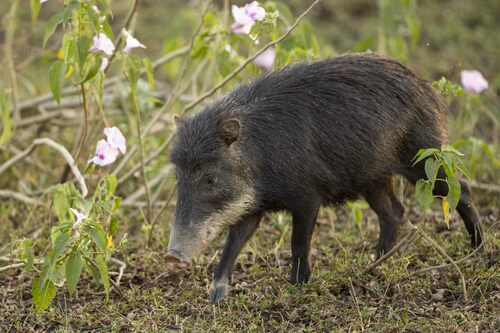
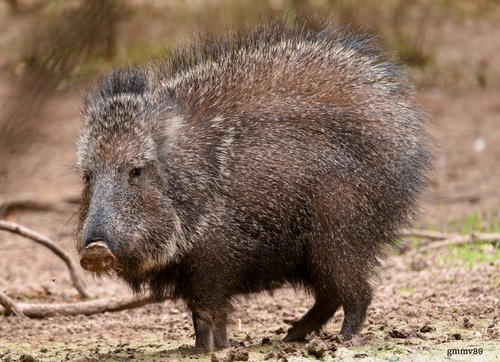
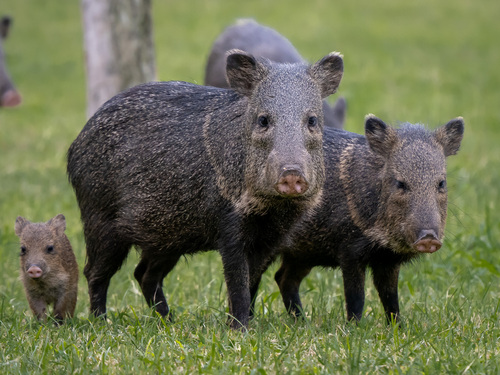
The collared peccary (Pecari tajacu) stands 51–61 cm (20–24 in) tall at the shoulder, measures 1.0–1.5 m (3 ft 3 in – 4 ft 11 in) in total length, and weighs 16 to 27 kg (35 to 60 lb). Its dental formula is 2/3, 1/1, 3/3, 3/3. It has small tusks that point toward the ground when the animal is upright, slender legs paired with a robust or stocky body, and a tail that is usually hidden by its coarse fur. A musk gland sits on the collared peccary’s back, several inches above its tail. This gland automatically releases a skunk-like scent when the peccary raises its hairs in alarm, which alerts other members of its herd. Collared peccaries also rub this scent on rocks and tree stumps to mark territory, and rub scent on each other to aid individual identification. Collared peccaries are generally diurnal and live in groups that can reach up to 50 individuals, with an average group size of 6 to 9 animals. They sleep in burrows, most often located under bushes or in large tree root systems; they may also shelter in caves, abandoned mines, old desert tunnels, or among logs, felled trees and abandoned timber. They are not exclusively diurnal: in central Arizona, they are often more active at night to avoid daytime heat. The collared peccary is widespread across most of tropical and subtropical Americas, with a range extending from the Southwestern United States to northern Argentina. After being extirpated from Uruguay 100 years prior, it was reintroduced there in 2017. Trinidad is the only Caribbean island where the collared peccary is native. Until recently, the species was also found on nearby Tobago, but it is now extremely rare if not completely extirpated there, due to human overhunting. This is an adaptable species that can live in deserts, xeric shrublands, tropical and subtropical grasslands, savannas, shrublands, flooded grasslands and savannas, tropical and subtropical dry broadleaf forests, and a number of other habitats. It also occurs in human-modified landscapes, only needing sufficient cover to survive. It can be found in cities and agricultural land across its range, where it feeds on garden plants; established populations are notably present in the suburbs of Phoenix and Tucson, Arizona. Collared peccaries are most often classified as herbivores. Their typical diet includes cactus, mesquite beans, fruits, berries, seeds, roots, tubers, bulbs, palm nuts, grasses, other green vegetation, fungi, and insects. They will also opportunistically eat eggs, snakes, fish, frogs, lizards, dead birds, and rodents when available. Despite this varied opportunistic feeding, agaves and prickly pears are the main components of their diet. In areas near human settlements, they also consume cultivated crops and ornamental plants, including tulip bulbs. The main predators of the collared peccary are cougars (Puma concolor), Mexican wolves (Canis lupus baileyi), coyotes (Canis latrans), jaguars (Panthera onca), and bobcats (Lynx rufus). While collared peccaries usually ignore humans and flee to safety when encountered, wounded or cornered individuals will defend themselves with their tusks. When alarmed, a collared peccary can release its skunk-like musk or give a sharp bark. Amazonian peoples including the Shipibos sometimes raise and tame juvenile collared peccaries when they encounter them. The collared peccary’s meat is relatively dry and suitable for cooking, though opinions on its flavor vary.