About Pearsonothuria graeffei (Semper, 1868)
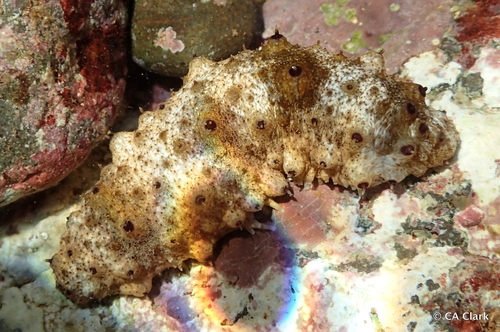
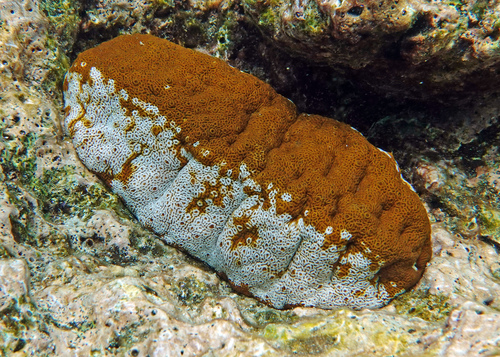
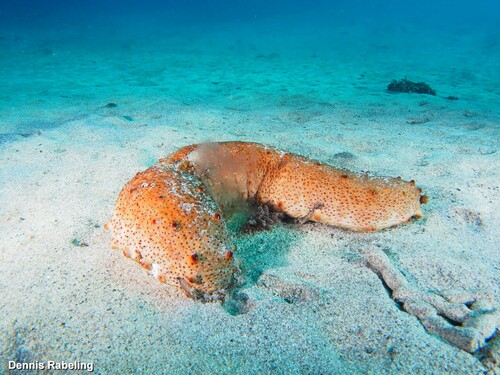
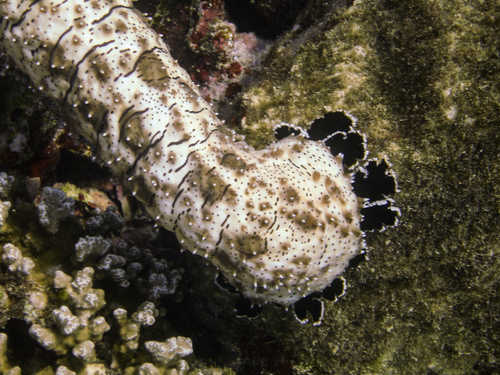
Pearsonothuria graeffei is a roughly cylindrical, thin-walled sea cucumber that reaches about 30 centimetres (12 inches) in length. Its mouth, located at one end of the body, is surrounded by a ring of up to 24 leaf-like, paddle-shaped tentacles. These tentacles have black stalks, are black on the upper surface, and white underneath. The anus is positioned at the opposite end of the body, and several rows of tube feet run along the underside of the body. Adult individuals are pale brown and white, marked with black speckles and small thorn-like protuberances. In contrast, juvenile Pearsonothuria graeffei are brightly coloured, with a white and blue or black base colour and a small number of large, yellow, thorn-like projections. This colouration makes juvenile Pearsonothuria graeffei closely resemble the sea slug Phyllidia varicosa, whose bright colouration warns predators of its toxicity. When juvenile sea cucumbers grow larger than the sea slug Phyllidia varicosa, their appearance begins to change, and the mimicry is no longer effective. Pearsonothuria graeffei occurs in tropical regions of the Indo-Pacific Ocean. Its range extends from the east coast of Africa to the Philippines, Indonesia, and the South Pacific. It lives on the seabed and on coral reefs at depths of up to around 25 metres (82 feet).