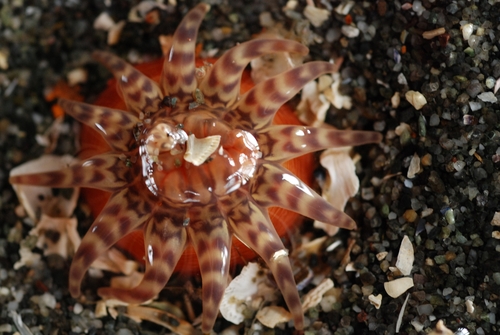
About Peachia quinquecapitata McMurrich, 1913
Peachia quinquecapitata buries its elongated column in sand, with twelve tentacles fanned out on the sand surface. Its oral disc is red, and its translucent tentacles have chevron-patterned bands of buff and brown. Like all species in the genus Peachia, this anemone has a conchula — an enlarged structure on the lip around its mouth — which is split into five lobes in this species. This species is found in shallow seas of the Pacific Northwest region of the United States, including Puget Sound. Laboratory studies have investigated the life cycle of Peachia quinquecapitata. Researchers induced spawning by altering light levels. The species produces eggs with a diameter of 120 μm, which develop into planula larvae after fertilization. In laboratory conditions, only larvae that were ingested by the medusa Clytia gregaria (formerly classified as Phialidium gregarium) continued to develop. Initially, these larvae feed on food particles inside the jellyfish's gastrovascular cavity. After 11 days, they develop parasitic habits and start feeding on their host's gonads, later moving to feed on other host tissues. A single anemone larva can completely consume an entire gonad in two days. Thirty-one days after becoming parasitic, the larvae develop into juvenile sea anemones with the full adult body plan. At this point, they detach from their host and sink to the sea floor to begin living independently. This parasitism is likely harmful to the jellyfish host, but beneficial for the anemone: it allows the anemone larvae to develop safely in a protected environment, and passively spread to new locations. At Friday Harbor, Washington, the rate of infection in Clytia gregaria jellyfish peaks in spring, reaching 62%.

