About Paxillus involutus (Batsch) Fr.
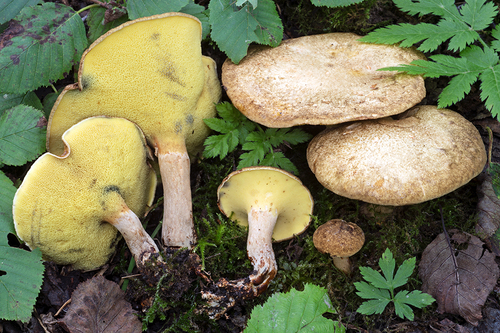
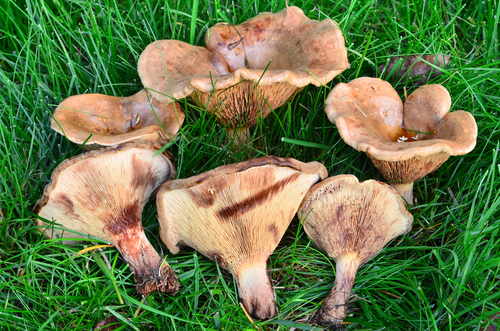
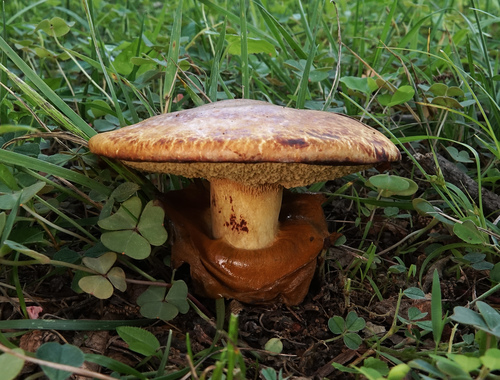
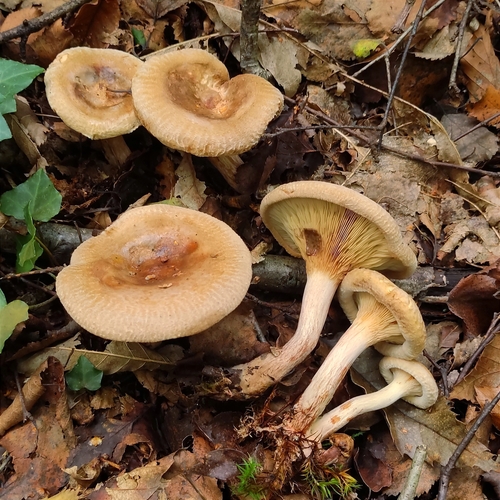
The epigeous (aboveground) fruit body of Paxillus involutus (Batsch) Fr. resembles a brown wooden top and can grow up to 6 cm (2+1⁄4 in) tall. The cap starts convex before becoming more funnel-shaped (infundibuliform) with a depressed center and rolled rim – this feature gives the species its common name. Caps are typically 4–12 cm (1+5⁄8–4+3⁄4 in) wide, reaching a maximum diameter of 15 cm (6 in), and range in colour from reddish-brown, yellowish-brown to olive-brown. The cap surface is downy when young, becomes smooth with age, and turns sticky when wet. Young fruit bodies have their gills protected by the cap and cap margin, a development pattern called pilangiocarpic. The narrow, brownish-yellow gills are decurrent, forked, and can be easily peeled away from the flesh, similar to the pores of boletes. Gills closer to the stipe become more irregular and anastomose, sometimes even resembling the pores of bolete-type fungi. The fungus darkens when bruised, and older specimens may have dark patches. The juicy yellowish flesh has a mild to faintly sour or sharp odor and taste, and has been described as well-flavored when cooked. The short stipe is similar in colour to the cap, measures 3–6 cm tall and 1–3 cm wide, may be crooked, and tapers toward its base. The spore print is brown, and the ellipsoid (oval-shaped) spores measure 7.5–9 by 5–6 μm. The hymenium has cystidia on both the gill edge (cheilocystidia) and gill face (pleurocystidia); these cystidia are slender and filament-like, typically measuring 40–65 by 8–10.5 μm. Paxillus involutus forms ectomycorrhizal relationships with many coniferous and deciduous tree species. Due to its relatively unspecialized nutrient requirements and broad host specificity, it is frequently used in research and seedling inoculation programs. Experiments show this relationship benefits host trees: when P. involutus was grown on red pine (Pinus resinosa) root exudate, the roots showed markedly increased resistance to pathogenic strains of the common soil fungus Fusarium oxysporum, and inoculated seedlings also had increased resistance to Fusarium. This suggests P. involutus may produce antifungal compounds that protect host plants from root rot. Paxillus involutus also acts as a buffer against heavy metal toxicity in host plants by decreasing uptake of certain toxic elements. For example, the fungus lowered cadmium and zinc toxicity to Scots pine (Pinus sylvestris) seedlings: even though cadmium itself inhibits ectomycorrhiza formation in seedlings, colonization by P. involutus reduces transport of cadmium and zinc to plant shoots, alters the ratio of zinc transported to roots and shoots, and causes more cadmium to be retained in seedling roots rather than spread throughout the plant's metabolism. Evidence indicates this detoxification works through cadmium binding to fungal cell walls and accumulation in vacuolar compartments. Additionally, ectomycorrhizal hyphae exposed to copper or cadmium greatly increase production of metallothionein, a low molecular weight protein that binds metals. The presence of Paxillus involutus is associated with far fewer bacteria living on the roots of Pinus sylvestris, with bacteria instead found on the external mycelium. The types of bacteria present also change: a 1997 Finnish study found that bacterial communities under P. sylvestris without this mycorrhiza metabolized organic and amino acids, while communities growing with P. involutus metabolized the sugar fructose. Paxillus involutus benefits from the presence of some soil bacteria. As the fungus grows, it excretes polyphenols, self-toxic waste products that slow its growth, but these compounds are broken down by some bacteria, leading to increased fungal growth. Bacteria also produce compounds such as citric and malic acid that stimulate P. involutus growth. Paxillus involutus is highly abundant and found across the Northern Hemisphere, including Europe and Asia, with records from India, China, Japan, Iran, and eastern Anatolia, Turkey. It is also widely distributed across northern North America, extending north to Alaska, where it has been collected from tundra near Coldfoot in the state's interior. In southwestern Greenland, it has been recorded under the birch species Betula nana, B. pubescens and B. glandulosa. In Europe, it is more common in coniferous woods, but is also closely associated with silver birch (Betula pendula). Within woodland, it prefers wet or boggy ground and avoids calcareous (chalky) soils. It has been recorded growing alongside Boletus badius in Europe, and Leccinum scabrum and Lactarius plumbeus in the Pacific Northwest region of North America. In the Pacific Northwest, it grows in both deciduous and coniferous woodland, and is commonly found under planted paper birch (Betula papyrifera) in urban areas. It is one of a small number of fungal species that thrive in Pinus radiata plantations planted outside the species' natural range. A study of polluted Scots pine forest near Oulu, northern Finland found that P. involutus became more abundant in more polluted areas while other fungal species declined. Pollution came from pulp mill emissions, fertiliser, heating and traffic, and was measured via sulfur levels in pine needles. Throughout its distribution, Paxillus involutus can grow on lawns and old meadows. Fruit bodies are generally terrestrial, though they may grow on woody material around tree stumps. They usually appear in late summer and autumn. In California, mycologist David Arora identified a larger form associated with oak and pine that appears in late autumn and winter, alongside the typical form associated with planted birch that appears in autumn. Several fly and beetle species have been recorded using P. involutus fruit bodies to rear their young. The mushroom can be infected by Hypomyces chrysospermus, or bolete eater, a mould that parasitizes members of Boletales. Infection produces a whitish powder that first appears on the pores, then spreads across the mushroom's surface, turning golden yellow to reddish-brown as it matures. Australian mycologist John Burton Cleland recorded P. involutus growing under introduced larch (Larix), oak, pine, birch and other trees in South Australia in 1934, and it has since been recorded in New South Wales, Victoria (where it was found near Betula and Populus) and Western Australia. It has also been recorded under introduced birch (Betula) and hazel (Corylus) in New Zealand. Mycologist Rolf Singer reported a similar pattern in South America, with the species recorded under introduced trees in Chile. It was likely transported to these countries in the soil of imported European trees. Paxillus involutus was widely eaten in Central and Eastern Europe until World War II, though English mushroom guidebooks did not recommend it. In Poland, it was often consumed after pickling or salting. It was known to be a gastrointestinal irritant when eaten raw but was thought to be safe to eat after cooking. Questions about its toxicity were first raised after German mycologist Julius Schäffer died following eating it in October 1944. Around an hour after Schäffer and his wife ate a meal prepared with the mushrooms, Schäffer developed vomiting, diarrhea, and fever. His condition worsened, he was admitted to hospital the next day, he developed kidney failure, and died after 17 days. In the mid-1980s, Swiss physician René Flammer discovered an antigen within the mushroom that triggers an autoimmune reaction that causes the body's immune cells to recognize its own red blood cells as foreign and attack them. Despite this discovery, guidebooks did not firmly warn against eating P. involutus until 1990, and one Italian guidebook still recommended it as late as 1998. The relatively rare immunohemolytic syndrome develops after repeated ingestion of Paxillus mushrooms. It most commonly occurs when a person has eaten the mushroom for a long time, sometimes for many years, and has had mild gastrointestinal symptoms from previous consumption. The Paxillus syndrome is better classified as a hypersensitivity reaction rather than a direct toxic reaction, because it is caused not by an intrinsically poisonous substance but by an antigen from the mushroom. The antigen's structure remains unknown, but it stimulates the production of IgG antibodies in blood serum. In subsequent meals, antigen-antibody complexes form; these complexes attach to the surface of blood cells and eventually cause their breakdown. Poisoning symptoms develop quickly, starting with vomiting, diarrhea, abdominal pain, and associated low blood volume. Shortly after these initial symptoms appear, hemolysis develops, leading to reduced urine output, hemoglobin in the urine, complete lack of urine production, and anemia. Medical testing looks for increasing levels of bilirubin and free hemoglobin, and falling levels of haptoglobins. Hemolysis can lead to multiple complications including acute kidney injury, shock, acute respiratory failure, and disseminated intravascular coagulation. These complications can cause significant morbidity, and fatalities have been reported. There is no specific antidote for Paxillus involutus poisoning, only supportive treatment that includes monitoring complete blood count, renal function, blood pressure, and fluid and electrolyte balance, and correcting any abnormalities. Corticosteroids may be a useful addition to treatment, as they protect blood cells from hemolysis and reduce complications. Plasmapheresis removes circulating immune complexes from the blood that cause hemolysis, and may improve outcomes. Hemodialysis can also be used for patients with impaired kidney function or kidney failure. Paxillus involutus also contains compounds that appear to damage chromosomes; it is unclear whether these have carcinogenic or mutagenic potential. Two identified compounds are the phenols involutone and involutin; involutin causes the brown discolouration seen when the mushroom is bruised. Despite the documented poisonings, Paxillus involutus is still consumed in parts of Poland, Russia, and Ukraine, where deaths from poisoning occur every year.