About Pawsonia saxicola (Brady & Robertson, 1871)
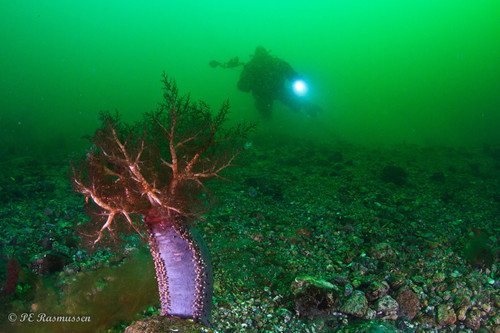
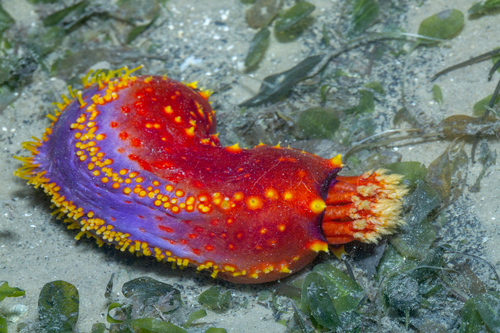
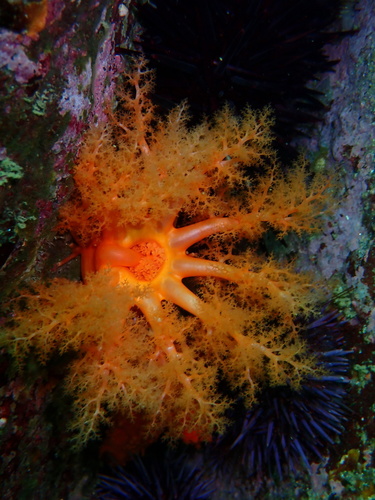
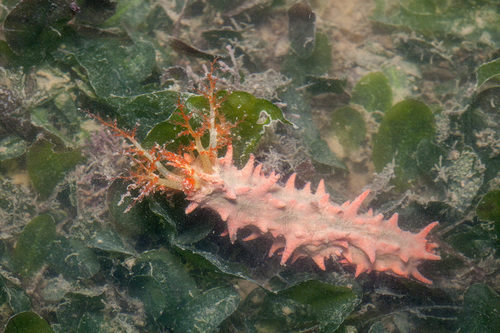
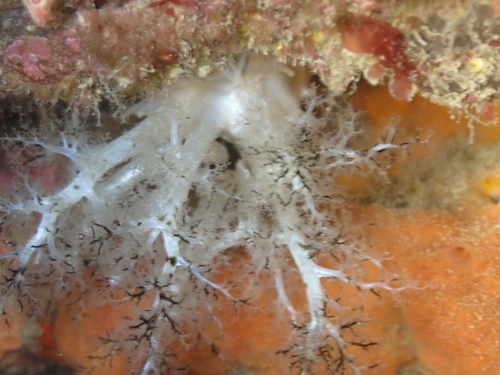
Pawsonia saxicola is a sea cucumber that has a solid, cylindrical body and can reach a length of 150 mm (6 in). Its mouth is located at the anterior end, and is surrounded by a ring of ten branching, black and white mottled feeding tentacles, which can grow up to 100 mm (4 in) long. The body cuticle is smooth and bears five longitudinal rows of tube feet. The ventral rows are double and clearly visible, while the dorsal rows are mostly replaced by low button-shaped protuberances, except in the area near the mouth. The cuticle contains star-shaped calcareous spicules. This species can be confused with Aslia lefevrei: both live in crevices with their dark-colored tentacles extended outward. Pawsonia saxicola is white, though it may darken slightly when exposed to light, while Aslia lefevrei is brown. Pawsonia saxicola is native to the northeastern Atlantic Ocean and the Mediterranean Sea. Its range extends from the west and south coasts of the British Isles to the coasts of France, Spain and Portugal, and out to the Azores. It inhabits rocky shores, where it hides in crevices and under rocks, from the lower shore down to approximately 50 m (160 ft) deep. This sea cucumber is a suspension feeder. It eats diatoms, single-celled algae, zooplankton including copepods, ostracods, protozoans, nematodes, jellyfish and larvae, as well as drifting organic particles. Food is collected by its feeding tentacles: each tentacle individually shrinks, bends, and is inserted into the mouth to deliver food. The two ventral tentacles are short and forked, and are used at the mouth to push food particles inside. In some related species, these short tentacles coordinate their activity with the longer tentacles, but this does not happen in P. saxicola; here the short tentacles appear to act independently.