About Pavona clavus (Dana, 1846)
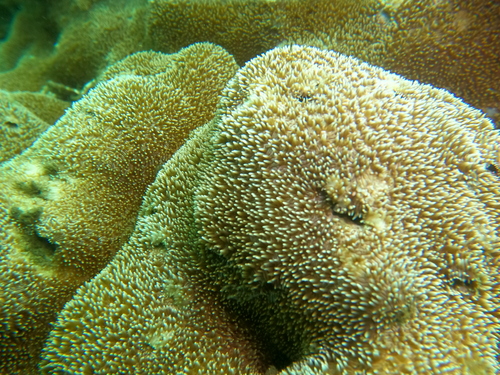
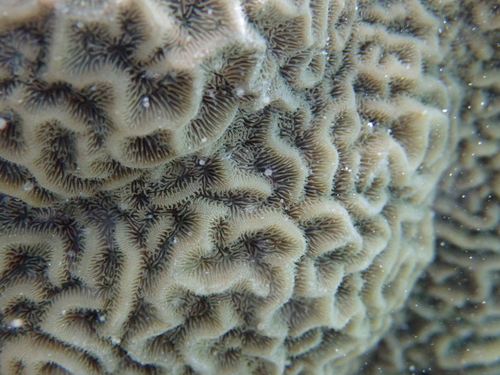
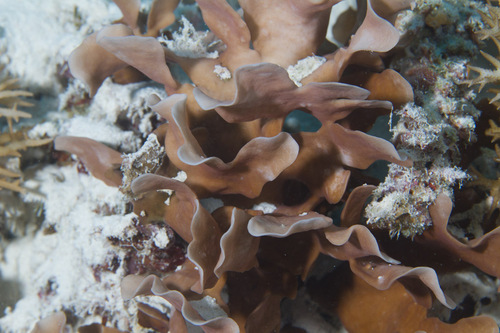
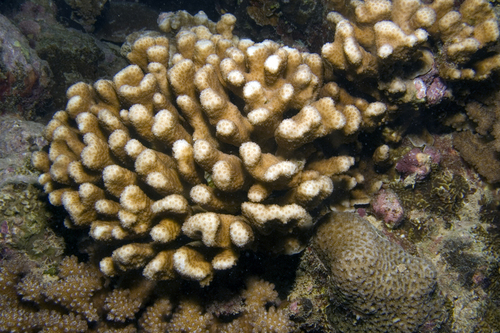
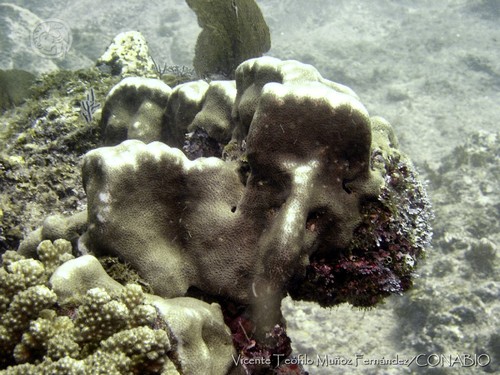
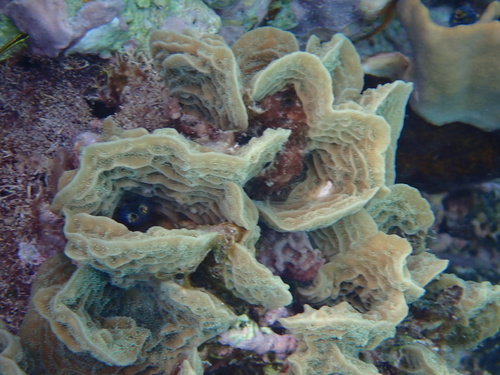
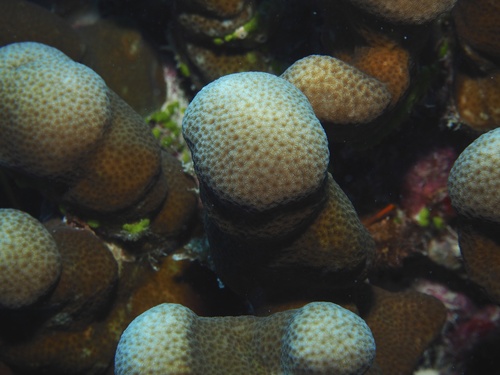
Pavona clavus, first described by Dana in 1846, is a coral that displays colors including cream, yellow, brown, or pale grey. Colonies of this species most often grow into columnar or club-shaped structures, though they may also develop into flattened plates. Its columns are generally smooth and uniform in size, reaching up to 20 cm (7.9 in) tall and 3–5 cm (1.2–2.0 in) in diameter. Columns of Pavona clavus are capable of dividing, but cannot fuse together. Entire colonies can range from 10 cm (3.9 in) to over 10 m (33 ft) across, and may sometimes form large, extensive single-species stands. The corallites of this species are circular and very small, with diameters measuring 2.5–3.5 mm (0.098–0.138 in). They have thick, clearly defined walls, and may be arranged either irregularly, or within short valleys. Flattened colonies of P. clavus can look very similar to colonies of Pavona bipartita, and its corallites resemble those of Pavona duerdeni. Pavona clavus inhabits coral reefs at depths between 2–40 m (6 ft 7 in – 131 ft 3 in). It is most often found on reef slopes and in areas exposed to water currents, and favors protected or semi-protected habitats. It does not occur on very shallow, high-energy reef platforms. This coral has a very wide distribution, with a range spanning from the western Indian Ocean to the eastern Pacific Ocean, and also covering the South China Sea, the Red Sea, and the Gulf of Aden. Its range includes the coasts of eastern Africa and West Asia, specifically the Comoros, Djibouti, Egypt, Eritrea, Jordan, Kenya, Madagascar, the Maldives, Mauritius, Mayotte, Mozambique, Réunion, Saudi Arabia, Seychelles, Somalia, South Africa, Sudan, Tanzania, and Yemen. It is also found across Asia, in Brunei, Cambodia, India, Indonesia, Japan, Myanmar, the Philippines, Singapore, Sri Lanka, Taiwan, Thailand, Timor-Leste, and Vietnam, and throughout Oceania, including American Samoa, Australia, the Cook Islands, the Federated States of Micronesia, Fiji, Guam, Kiribati, the Marshall Islands, Nauru, New Caledonia, Niue, the Northern Mariana Islands, Palau, Papua New Guinea, the Pitcairn Islands, Samoa, Solomon Islands, Tokelau, Tonga, Tuvalu, Vanuatu, and Wallis and Futuna. Its range extends east to western Central America and South America, covering Colombia, Costa Rica, Ecuador, El Salvador, Guatemala, Honduras, Mexico, Nicaragua, and Panama. Pavona clavus is a reef-building coral, with an annual growth rate of 0.9–1.3 cm (0.35–0.51 in). It is a preferred prey item for the crown-of-thorns starfish Acanthaster planci, and is one of only two known host species for the gall crab Opecarcinus cathyae.