About Pavo muticus Linnaeus, 1766
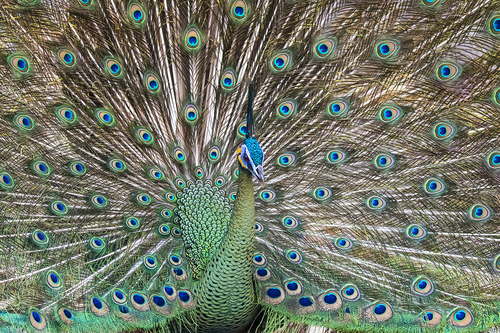
The green peafowl, scientifically named Pavo muticus Linnaeus, 1766, is a large bird. Males measure 1.8–3 m (5 ft 11 in – 9 ft 10 in) in total length including their 1.4–1.6 m (4 ft 7 in – 5 ft 3 in) train; adult females are around half the total length of breeding males, measuring 1–1.1 m (3 ft 3 in – 3 ft 7 in). Their average wingspan is around 1.2 m (3 ft 11 in), and large males can reach a wingspan of 1.6 m (5 ft 3 in). Green peafowl are capable of sustained, though energy-intensive, flight, and are often seen flying. Males vocalize with a loud, frequently repeated ki-wao at their roost sites at dawn and dusk. Females produce an equally loud "AOw-aa" call, with stress on the first syllable, and males may also make a call similar to the female's. This species has long upper-tail covert feathers. In males, these feathers extend up to 2 m (6 ft 7 in) and are decorated with eyespots; in females, the coverts are green, much shorter, and just cover the tail. Outside the breeding season, males moult their tail coverts, or train, so distinguishing sexes during this period is difficult unless the birds are observed at close range. The neck and breast feathers of both sexes are strongly iridescent green and shaped like Chinese dragon scales. In males, the scapular, median, and greater wing coverts are blue; the lesser coverts are green and form a triangle of scaly shoulder feathers when the wing is closed. The secondaries are black, and in some subspecies the tertials are brown and/or faintly patterned with bars. Females have blue lesser coverts, and lack the shoulder wing triangle. Female neck scales also have copper fringes, and females have more barring on the back, primaries, and alula. Both sexes have crest feathers, long legs, heavy wings, and a long-tailed silhouette. The female's crest has slightly wider plumes, while the male's crest is thinner but taller. The facial skin has double whitish-blue stripes, with a yellow-orange crescent next to the ear. The dark triangle below the eye towards the eyebrow is bluish-green in males, and brown in females. From a distance, green peafowl are generally dark-colored birds with pale vermilion- or buff-colored primaries, which are easily visible during their characteristic flight; their flight has been described as a true "flapping" flight, without the gliding typical of many other birds. Historically, green peafowl had a wide distribution across Southeast Asia, ranging from southern China, particularly Yunnan, through eastern and northeastern India, southeastern Bangladesh, and northern Myanmar, extending across Laos, Thailand, Vietnam, Cambodia, Peninsular Malaysia, to the Indonesian island of Java. On Java, the species is now only found in protected areas such as Ujung Kulon National Park and Baluran National Park. Records of green peafowl from northeastern India have been questioned, and old records may refer to feral birds. In 2020, a significant and growing population of around 745 individuals was recorded in Cambodia's Keo Seima Wildlife Sanctuary. Green peafowl inhabit a wide variety of habitats, including primary and secondary tropical and subtropical forest, both evergreen and deciduous. They can also be found in bamboo stands, grasslands, savannas, scrub, and along farmland edges. In Vietnam, their preferred habitat is dry deciduous forest located near water and away from human disturbance. On Java, the species is only found in savanna. Proximity to water appears to be an important habitat requirement for green peafowl. As a forest bird, the green peafowl nests on the ground and lays clutches of three to six eggs. It has often been claimed that green peafowl are polygynous, but males are solitary and do not display in leks. Solitary males are highly territorial and form harems with no pair bonds. However, the polygyny theory conflicts with observations of captive green peafowl left undisturbed by humans, where pairs have been seen to be strongly monogamous. The close physical similarity between males and females also suggests that green peafowl have a different courtship display from Indian peafowl. For this reason, some authors suggest that the groups identified as harems in field observations are actually groups of juvenile birds, and that males are not promiscuous. Green peafowl usually stay on or near the ground in tall grasses and sedges. Family units roost in trees at a height of 10–15 m (33–49 ft).