About Pavo cristatus Linnaeus, 1758
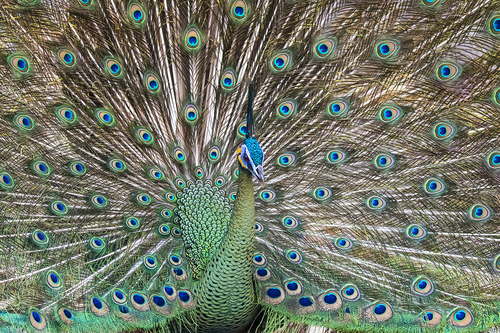
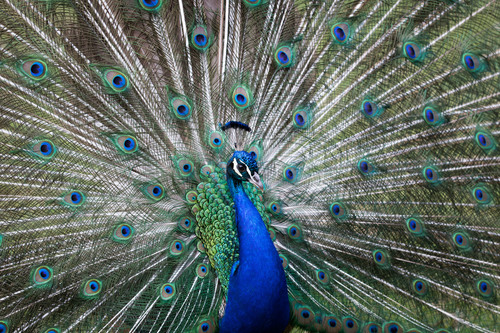
Pavo cristatus (the Indian peafowl) is easily recognizable by its crest size, color, and shape within its native distribution range, and exhibits pronounced sexual dimorphism. Males (peacocks) are larger, with an average bill-to-tail length of 100–120 cm (40–46 in); when measured to the end of a full-grown train, total length reaches 200–230 cm (78–90 in). Males weigh 4.1–5.2 kg (9–11.5 lb), making them among the heaviest birds in the Phasianidae family. The male has a metallic blue crown, short curled blue-greenish head feathers, and a fan-shaped crest with bare black shafts tipped with bluish-green webbing. Bare white skin forms a white stripe above the eye and a crescent-shaped white patch below the eye; greenish feathers cover the lore, chin, and throat. Males have a long blue neck, with scaly bronze-green back feathers marked with black and copper. The scapular region and wings have chestnut-colored primary feathers and black secondaries. The tail is dark brown, while the chest is glossy green, thighs are buff, and the abdomen and tail coverts are blackish-brown. Males are best known for their elongated train extending from the rump, which is made up of elongated upper tail coverts. The overall train is bronze-green, with the outermost longest feathers ending in an elaborate eye-spot. Each eye-spot has a purplish-black heart-shaped nucleus, enclosed by blue, followed by an outer copper rim, and surrounded by alternating green and bronze bands. A small number of outer feathers lack the eye-spot and end in a crescent-shaped black tip. Train feathers do not contain colored pigments; their color comes from the feather's micro-structure and related optical phenomena. Males have a spur on the leg above the hind toe. Male train feathers and the tarsal spur do not begin developing until the bird's second year of life, and trains do not reach full development until the bird is four years old. Male Indian peafowl moult their train feathers annually, usually starting at the end of the monsoon in August or September, with full growth completed by February to March. Moult of flight feathers may occur spread out across the year. Females (peahens) are smaller, measuring around 38 cm (15 in) in length and weighing 2.7–4.1 kg (6–9 lb). The peahen has a rufous-brown head with a crest that has chestnut-colored tips edged with green. The upper body is brownish with pale mottling, while the primaries, secondaries, and tail are dark brown. The lower neck is metallic green; breast feathers are dark brown with green gloss, and underparts are whitish. Both sexes have dark brown eyes, brown beaks, and brown legs. Young males resemble females, and also have chestnut-colored primaries. Indian peafowl are resident breeders native to the Indian subcontinent, found across most of India and Sri Lanka. In India, their range extends across the country from the Indus valley in the northwest to Assam in the northeast, and from the Himalayas in the north to the southern tip of the country. The only area within this range where they are not found is the Sunderbans marshlands in East India. In northern India, they occur up to 1,500 m (5,000 ft) elevation, and in southern mountain areas they occur up to 1,800 m (6,000 ft). In Sri Lanka, Indian peafowl mostly inhabit drier lowland areas. They generally occupy forests, small hills, and bushy areas near water sources, and also live on cultivable lands; they exist in a semi-domesticated state around human habitations. The species has been introduced to many other parts of the world, and has become feral in some of these areas. It was reportedly introduced to Europe by Alexander the Great, though it may have been introduced earlier, and had reached Athens by 450 BCE. The first whole-genome sequencing of the Indian peafowl identified 15,970 protein-coding sequences, and found that the species has less repetitive DNA (8.62%) than the chicken genome (9.45%). Genetic studies suggest the species' population experienced at least two bottleneck events: one four million years ago, and another 450,000 years ago. These events caused a severe reduction in the species' effective population size. Indian peafowl forage on the ground in small groups called musters, which usually contain one peacock and three to five peahens. After the breeding season, flocks tend to consist only of females and young. They forage in open areas in the early morning, and rest under cover during the hottest part of the day. They are often observed dust-bathing at dusk. At night, they roost on tall trees, though they may sometimes use rocks or buildings instead. Birds typically arrive at their roosting sites at dusk, and call frequently before settling into their roosting positions. Despite its large size, the Indian peafowl can fly. However, it flies very rarely, and usually escapes disturbance by running on foot through undergrowth. When it does take flight, it maintains flight with regular, slower wingbeats rather than gliding.