About Paulownia tomentosa (Thunb.) Steud.
Paulownia tomentosa (Thunb.) Steud. is a tree that reaches 10–25 m (33–82 ft) in height. It bears large heart-shaped to five-lobed leaves 15–40 cm (6–16 in) across, arranged in opposite pairs along the stem. On young growth, leaves may grow in whorls of three and are much larger than leaves on more mature growth. Leaves on stump shoots can reach an especially remarkable size: leaves 98 centimetres (39 in) wide, and almost as long, have been recorded. Its leaves can be mistaken for the leaves of catalpa trees.
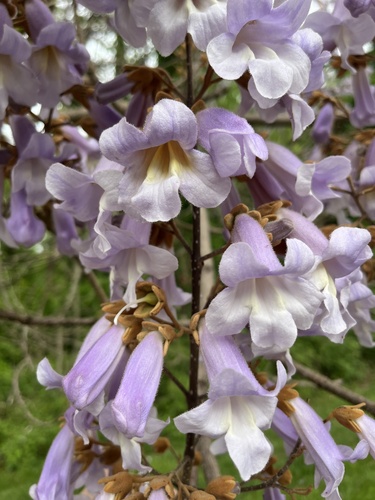
The tree produces very fragrant, large violet-blue flowers before its leaves emerge in early spring. Flowers grow in panicles 10–30 centimetres (4–12 in) long, with a tubular purple corolla 4–6 centimetres (1+1⁄2–2+1⁄4 in) long that resembles a foxglove flower. Its fruit is a dry, egg-shaped capsule 3–4 centimetres (1+1⁄8–1+5⁄8 in) long that holds numerous tiny, winged seeds which disperse via wind and water. Pollarded trees do not produce flowers, because flowers only form on mature wood.
Paulownia tomentosa requires full sun for healthy growth. It is tolerant of pollution and can grow in many different soil types. It can even grow from small cracks in pavements and walls. It can survive wildfires, because its roots can regenerate new, very fast-growing stems. It is drought-resistant and thrives in barren soil, and is particularly suited to cold and arid regions. Its main trunk is short, and its growth rate is relatively slow once it reaches maturity.
P. tomentosa is native to much of central and eastern China, and to the Korean peninsula; the Flora of China considers the Korean population to be non-native. In China, it occurs naturally in the provinces of Anhui, Gansu, Hebei, Henan, Hubei, Hunan, Jiangsu, Jiangxi, Liaoning, Shaanxi, Shanxi, and Sichuan. It has an introduced range that includes Japan.
Paulownia tomentosa is cultivated as an ornamental tree for parks and gardens, and has received the Royal Horticultural Society's Award of Garden Merit. Due to its high tolerance and flexible growth, it acts ecologically as a pioneer plant. Its nitrogen-rich leaves make good fodder, and its roots help prevent soil erosion. Over time, Paulownia tomentosa is succeeded by taller trees that shade it out, as it cannot thrive in shaded conditions.
Gardeners exploit the characteristic large leaf size of young growth by pollarding the tree, which encourages vigorous new growth each year and produces massive leaves up to 60 centimetres (24 in) across. These large leaves are popular in modern gardening styles that use large-foliaged and "architectural" plants.
Before the invention of polystyrene packaging, the soft, lightweight seeds of P. tomentosa were commonly used as packing material by Chinese porcelain exporters in the 19th century. Packing cases often leaked or burst open during transit, scattering seeds along rail routes. The large number of seeds released from packing, combined with deliberate planting for ornamental use, has led to the species being considered invasive in regions with climates suitable for its growth, most notably Japan and the eastern United States.
In Japan, there is a traditional custom of planting P. tomentosa seeds when a couple has a daughter. By the time the daughter reaches her late teens or early adulthood when she is ready to marry, the tree has reached maturity; the tree is then felled and carved into a tansu dresser to use as a wedding gift.
The timber of P. tomentosa is also used to make musical instruments. The species has been proposed for use in carbon capture projects: it has large leaves that readily absorb pollutants, and also has value for timber and ornamental aesthetics, which has increased interest in its use for carbon capture. Inaccurate citation has led to widespread claims that P. tomentosa uses C4 carbon fixation, but this species does not meet the experimental criteria required to confirm it uses C4 photosynthesis.

