About Patiriella regularis (Verrill, 1867)
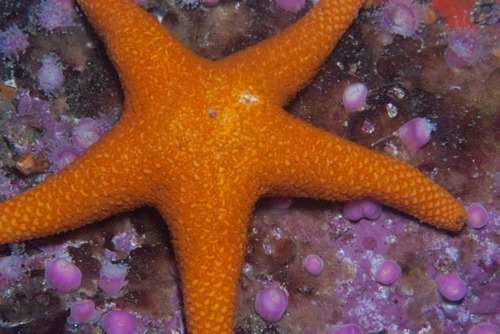
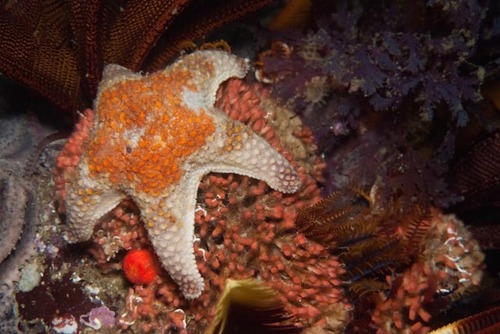
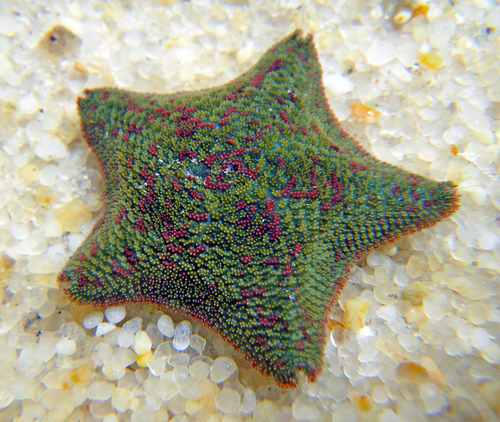
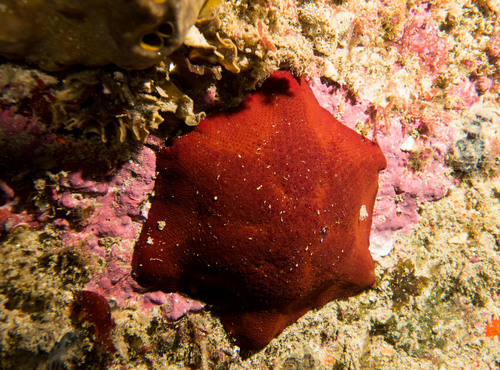
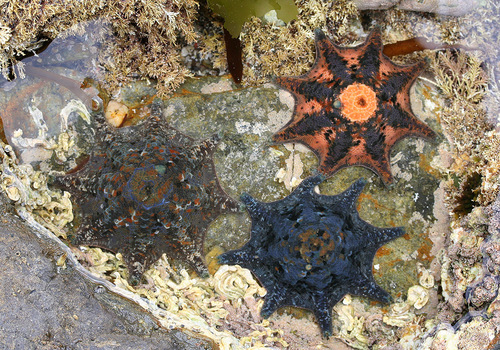
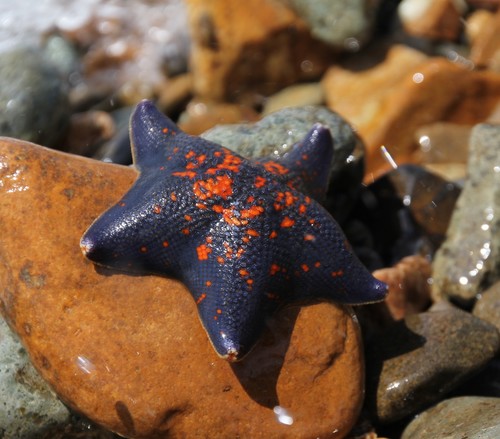
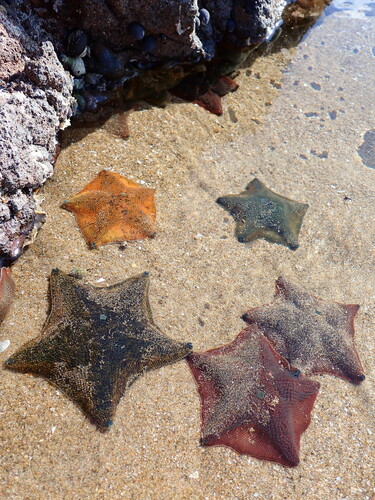
Patiriella regularis (Verrill, 1867) is a spinulosan asterinid starfish with a generally pentagonal shape. Most individuals have five short arms, but 2% of the population has 4, 6, 7, or 8 arms. It has an arm spread of up to 60 mm (2.4 in), and can grow to a maximum diameter of 10 cm (3.9 in), though size varies greatly across the species. Individual Patiriella regularis vary widely in color: blues, greens, and browns are the most common, but oranges, reds, and mottled individuals also occur. Two distinct forms of this species have been identified, differing most noticeably in the arrangement of plates along the ray crests.
Patiriella regularis is native to New Zealand, where it is the most common asteroid species and dominates most suitable habitats. It is found across the full length of New Zealand, from North Cape to Stewart Island, and is abundant in many New Zealand harbours, including Otago Harbour and Whangateau Harbour at opposite ends of the country. It is frequently found in New Zealand's Fiordland, specifically throughout Doubtful Sound and Milford Sound, and also occurs in the Kermadec Islands, a subtropical island group 1000 km northeast of the North Island. The species has spread to Southern Australia and Tasmania, likely via 19th-century mussel exports; established populations in Tasmania are close to being classified as invasive due to their impacts on native local fauna.
This species inhabits shallow coastal waters, occurring on rocky reefs and in sandy areas close to shorelines, intertidal cobble fields, and shallow to moderately deep rock pools. It lives across a wide range of substrates, with a slight preference for shell gravel. It can also be found on rocky substrates, sandy bottoms, on and among boulders, and on crushed shell, among other habitats. It is common in shallow depths within the low salinity layer (LSL), which occurs between less than 1 m and 12 m depth and typically supports lower species diversity than areas below the LSL.
Patiriella regularis follows an annual reproductive cycle, and can reproduce both asexually via fission and sexually: sexual reproduction occurs when males and females release eggs and sperm into the water for external fertilization. Reproductive success depends on environmental conditions favorable to offspring survival, most notably food abundance in the habitat. When food is scarce, stored food reserves in the pyloric caeca are low, leading to poor gonad development.
The reproductive cycle of female Patiriella regularis is divided into five stages: recovery, growing, maturing, partly-spawned, and spent. These stages are distinguished by the number of oocytes at each development stage, the presence or absence of degenerating octets, and the abundance of somatic cells. The female cycle follows a sequence of oogenesis, gonad activation, gamete spawning, gonadal activity regression, and a resting period. Oogenesis is the process that produces an ovum from a primordial germ cell, involving cell growth and organelle synthesis. Patiriella regularis is oviparous, meaning it deposits eggs that hatch outside the parent's body. Spawned eggs of this species are around 150 µm in size. Because oviparous gametes must contain all the energy and nutrients the future embryo needs (unlike viviparous organisms that nourish embryos via the mother), nutrients accumulate as yolk proteins in the oocyte during oogenesis, the key event of the reproductive cycle for this nutrient storage.
Ovarian activity peaks in Southern Hemisphere summer, from December to January, then gradually decreases from late January through March. Ovarian activity reaches its lowest point of 5% at the end of March, remains stable through austral autumn, rises gradually through winter, and then almost doubles between spring and summer. Ovarian activity correlates with photoperiod and water temperature: as day length and water temperature increase, ovarian activity also increases. Spawning occurs just after the longest day of the Southern Hemisphere, towards the end of December. Starfish gather in groups before spawning to increase the chance of fertilization, a behavior that improves reproductive success.
The larval stage of Patiriella regularis matches the typical form of most asteroids, with indirect development through the bipinnaria and brachiolaria larval stages. Bipinnaria is a bilaterally symmetrical starfish larva with two cilia bands (one in front of the mouth and one behind the mouth) that are used for feeding and movement respectively. The brachiolaria is the second larval stage for asteroids, characterized by three short arms and movement driven by external cilia. Shade is an important environmental cue that triggers metamorphosis from the larval stage to the adult starfish, a process that takes 5–6 days to complete. On average, the full cycle from egg to mature starfish takes two months, though the duration depends on environmental conditions such as water temperature.
Patiriella regularis has no specific cultural uses, but it plays an important role in aquatic ecosystems and can be used as an indicator of water quality.