About Patersonia fragilis (Labill.) Asch. & Graebn.
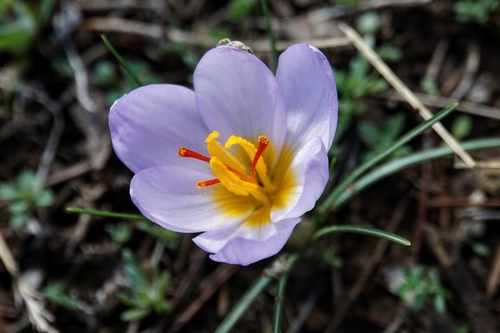
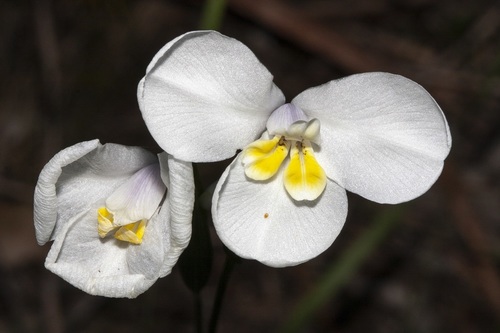
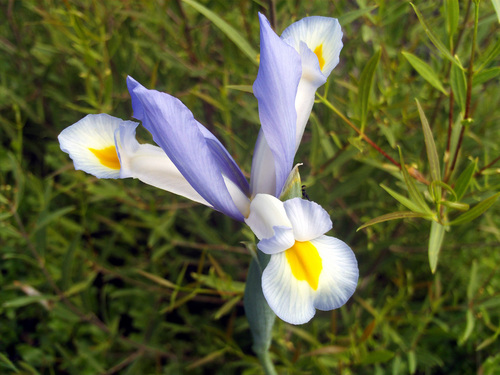
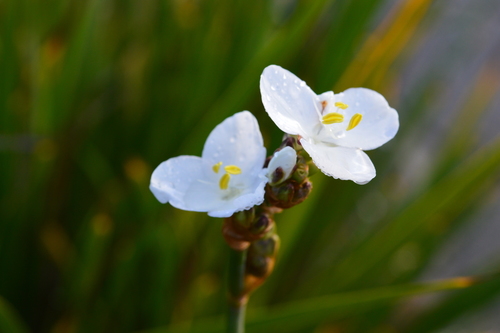
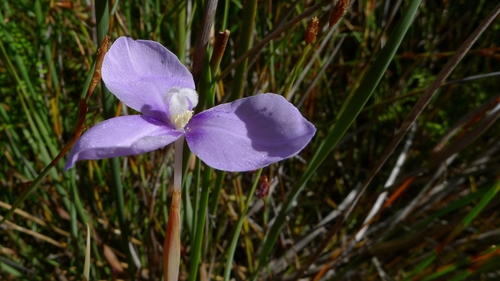
Patersonia fragilis (Labill.) Asch. & Graebn., commonly known as swamp iris, is a tufted or clump-forming perennial herb that typically reaches a height of 30–50 cm (12–20 in). Each shoot produces three to six narrowly linear leaves, that measure 220–550 mm (8.7–21.7 in) long and 1–3 mm (0.039–0.118 in) wide. The leaves are biconvex to circular in cross-section, glabrous, pale green to glaucous, and often end in a sharply-pointed tip. The glabrous, striated flowering scape is 40–250 mm (1.6–9.8 in) long, with a smaller leaf clasping its base; in some coastal areas, the flowering scape may be shorter than 80 mm (3.1 in). The sheath that encloses the flowers is lance-shaped, 25–45 mm (0.98–1.77 in) long, and coloured green to pale brown. Its petal-like sepals are pale violet to blue-violet, egg-shaped with the narrower end oriented toward the base, 12–23 mm (0.47–0.91 in) long and 10–14 mm (0.39–0.55 in) wide, with a thickened midvein. The stamens have filaments 2–3 mm (0.079–0.118 in) long that are joined for most of their length, and the anthers are a similar length to the filaments. Flowering occurs from August to December, and the fruit is a cylindrical capsule 25–30 mm (0.98–1.18 in) long that contains black seeds about 2.5 mm (0.098 in) long. Leaf colour, leaf width, and flower characteristics of this species vary even within a single location. This species is endemic to eastern Australia, where it occurs from Kangaroo Island in the south-east of South Australia, through southern Victoria, northern and eastern Tasmania, the Southern Tablelands of New South Wales, to south-eastern Queensland. It grows in heath habitats, including wet heathland and wallum heathland. A localised population of P. fragilis was found during a recent botanical survey on the Nelson Bay River. The population grows within wet heathland, which is one of several surrounding vegetation communities that also include Western Wet Scrub and Eucalyptus nitida Wet Forest. This wet heathland community is dominated by Swamp Heath (Sprengelia incarnata), which survives even on dry ground, and grows to a maximum height of 1.5 metres. The heathland where P. fragilis grows is often characterised by open, empty ground, with a general absence of large shrubs and trees. Though the diversity of associated species in this wet heathland is limited, P. fragilis commonly grows alongside Leptocarpus tenax, Selaginella uglinosa, Melaleuca squamea, and Xyris sp. P. fragilis reproduces via bee pollination. According to a study by Faegri and van der Pijl, unlike zygomorphic yellow flowers, purple zygomorphic flowers less commonly attract bees. This difference is tied to the nectar guides unique to yellow flowers, which outline a path for bees to squeeze through to reach nectar. As a flowering plant, P. fragilis follows the standard process of pollination and fertilisation to continue its life cycle. For horticultural use, Patersonia fragilis can be propagated from seed, but requires constantly damp soil that matches its natural habitat. It can grow in either full sun or light shade, and can only tolerate dry conditions for less than one week.