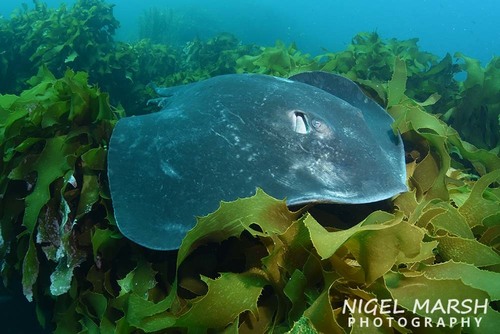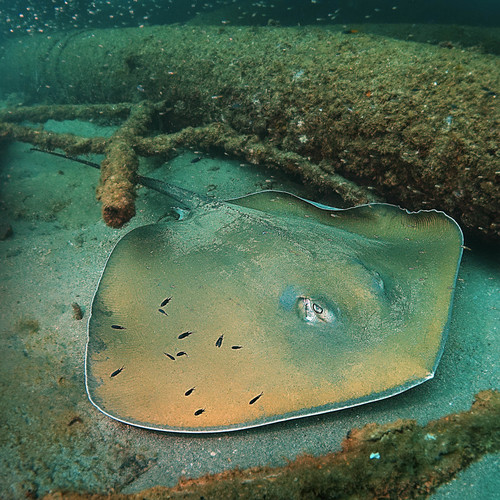
About Pateobatis jenkinsii (Annandale, 1909)
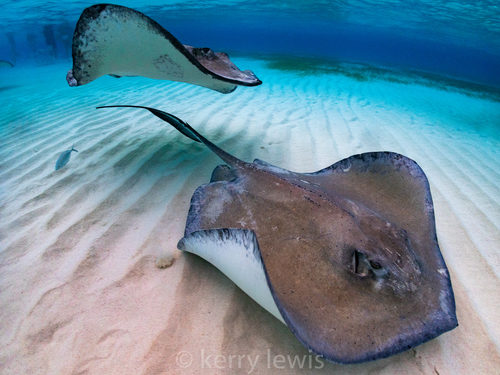
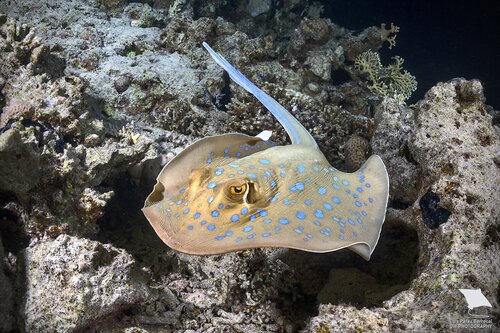
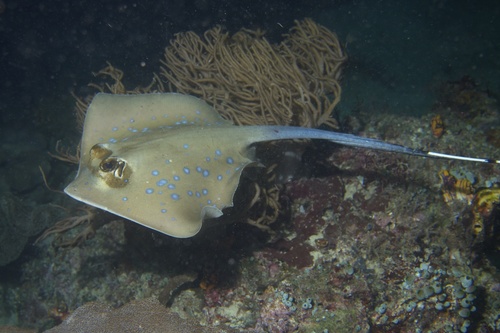
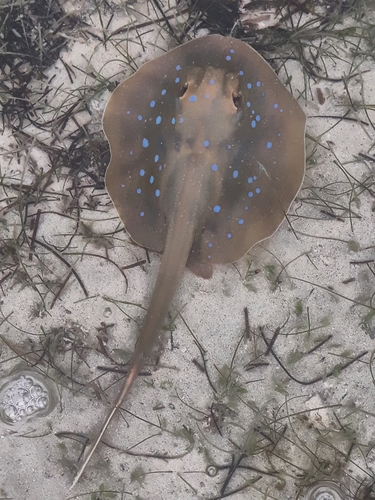
This species is commonly known as the Jenkins' whipray, with the scientific name Pateobatis jenkinsii (Annandale, 1909). The Jenkins' whipray has a diamond-shaped, thick-centered pectoral fin disc that is 1.1 to 1.2 times wider than it is long, with broadly rounded outer disc corners. The anterior disc margins are nearly straight, converging at a very obtuse angle at the snout, which has a barely protruding tip. Its eyes are medium-sized, and larger spiracles sit directly behind the eyes. Between the long, thin nostrils, there is a short, broad curtain of skin with a finely fringed posterior margin. The mouth is wide and gently curved, with four nipple-shaped papillae on its floor; the inner pair of papillae is shorter than the outer pair. The pelvic fins are small and narrow. The cylindrical, tapering tail has no fin folds and is slightly longer than the disc width. One to three serrated stinging spines grow on the top of the tail, about one-quarter of the total tail length away from the tail base. The upper surface of the disc has a granular texture, and carries a broad central band of closely spaced, flattened heart-shaped dermal denticles. This band starts between the eyes, reaches its widest point at the 'shoulders', and extends to cover the entire tail. One or more rows of large, spear-like thorns also run along the dorsal midline, from the center of the disc to the base of the sting. Except for a possible spotted variant, this species is uniformly yellowish brown on its upper surface. The disc margin and underside are white, and the tail is gray past the sting. It can grow up to 1.5 m (4.9 ft) across the disc and 3.0 m (9.8 ft) in total length. The Jenkins' whipray is rather common, with a wide but patchy distribution across tropical Indo-Pacific waters. It is found off southeastern Africa (including Madagascar), the Socotra Islands near Yemen, South and Southeast Asia (including the Philippines), New Guinea, and northern Australia from Ningaloo Reef to the Gulf of Carpentaria. This bottom-dwelling species generally lives close to shore in water less than 50 m (160 ft) deep, though it has been recorded as deep as 100 m (330 ft) off northwestern Australia. It prefers sandy or silty bottoms, often in lagoons, and is known to enter brackish water. Jenkins' whiprays may be encountered alone or in groups, and there is some evidence of sex-based segregation. Small teleost fish make up a large part of its diet, and it also eats crustaceans. One individual has been observed swimming alongside a smalleye stingray (Dasyatis microps) off Tofo, Mozambique. Documented parasites of this species include the tapeworms Dollfusiella ocallaghani, Parachristianella baverstocki, P. indonesiensis, and Pterobothrium platycephalum. Like other stingrays, the Jenkins' whipray reproduces via aplacental viviparity: developing embryos are first nourished by yolk, and later receive histotroph ('uterine milk') produced by the mother. Newborn Jenkins' whiprays measure 20–27 cm (7.9–10.6 in) across the disc, and males reach sexual maturity when their disc is 75–85 cm (30–33 in) across.