About Pateobatis fai (Jordan & Seale, 1906)
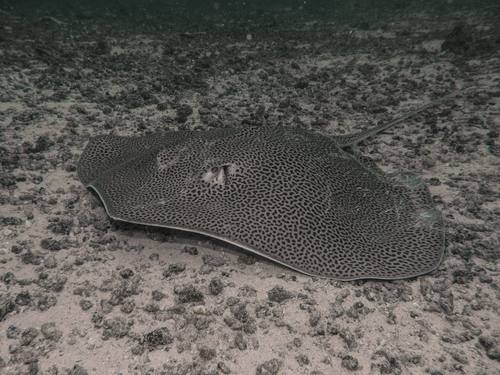
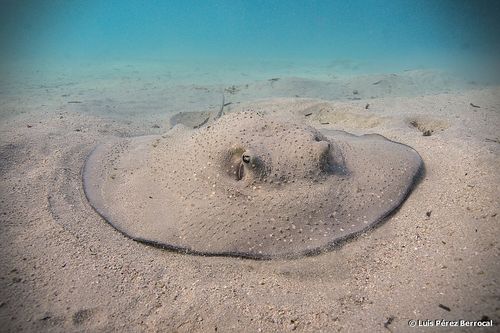
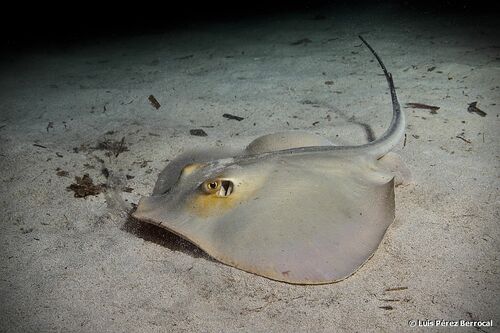
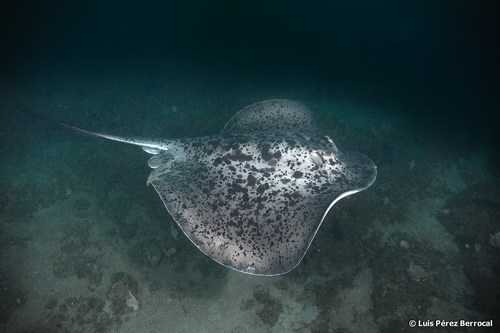
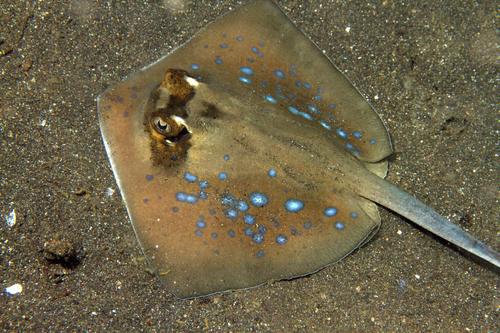
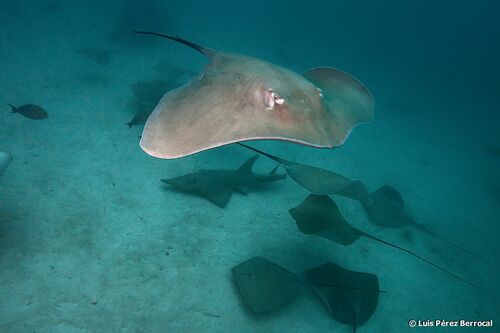
The pink whipray, scientifically Pateobatis fai (Jordan & Seale, 1906), has a diamond-shaped pectoral fin disc that is thick at its center, and measures approximately 1.1 to 1.2 times wider than it is long. The outer corners of the disc are angular. Its snout forms a very obtuse angle, with its tip barely protruding. Small, widely spaced eyes are followed by larger spiracles. Between the long, thin nostrils sits a short, broad curtain of skin with a finely fringed posterior margin. The mouth is fairly small and surrounded by prominent furrows; the lower jaw has a small indentation at its center. Two large central and two tiny lateral papillae are present on the floor of the mouth. Teeth are small and arranged into pavement-like structures. Five pairs of gill slits are located underneath the disc. Pelvic fins are small and narrow. The tail is extremely long and thin, measuring at least twice the length of the disc when intact. It has no fin folds, and usually carries a single serrated stinging spine. Adult pink whiprays have small, rounded dermal denticles covering the central upper surface of the disc, starting in front of the eyes and extending to cover the entire tail; small, sharp thorns also run along the disc and tail midline, reaching their highest density at the base of the tail. Juveniles either have smooth skin, or a sparser covering of flat, heart-shaped denticles. This species is a uniform grayish to brownish pink on its upper surface, turning dark gray to black on the tail beyond the stinging spine, and is uniformly light on its underside. It can grow to at least 1.8 m (5.9 ft) across the disc and over 5 m (16 ft) in total length, with a maximum recorded weight of 19 kg (42 lb).
The exact range of the pink whipray remains unclear, because it has often been confused with the Jenkins' whipray. It is thought to be common across tropical Indo-Pacific waters, and probably occurs along the entire periphery of the Indian Ocean from South Africa to northern Australia; it has been present in the Red Sea since 2014. Its range extends into the Pacific Ocean, reaching north to the Philippines, the Ryukyu Islands, and Iriomote, and east to multiple islands including Micronesia, the Marquesas Islands, and Samoa. While this species has been recorded as deep as 200 m (660 ft), it is most commonly found from the intertidal zone down to a depth of 70 m (230 ft). This bottom-dwelling ray prefers sandy flats, lagoons, and other soft-bottomed habitats, often close to cays and atolls near coral reefs. It tends to occur closer to shore during the warm season. Genetic and telemetry studies of Polynesian islands show that individual pink whiprays usually stay within their local area, with very little movement between different islands.
Small to large groups of pink whiprays have been observed over sandy flats and coral reefs in Shark Bay, the Great Barrier Reef, and the Caroline Islands. When resting, up to ten individuals may pile on top of one another, and the groups sometimes mix with other ray species. On Ningaloo Reef, pink whiprays have been observed "riding" on larger ray species. The pink whipray feeds mainly on decapod crustaceans, but also consumes cephalopods and teleost fishes. In Shark Bay, penaeid prawns are the overwhelmingly dominant prey for pink whiprays of all sizes. At Rangiroa Atoll in French Polynesia, large feeding aggregations form in shallow water at night. At Moorea, by contrast, this species tends to be a solitary forager with a large home range. Like other stingrays, the pink whipray is aplacental viviparous: the mother provides her developing embryos with nutrient-rich histotroph, called "uterine milk", through specialized uterine structures. Newborn pink whiprays measure 55–60 cm (22–24 in) across the disc, and Shark Bay may act as a nursery area for this species. Males reach sexual maturity when they are 1.1–1.2 m (3.6–3.9 ft) across the disc, while the maturation size for females has not been documented. Known parasites of the pink whipray include the monogeneans Heterocotyle capricornensis, Monocotyle helicophallus, M. spiremae, M. youngi, Merizocotyle australensis, Neoentobdella parvitesticulata, and Trimusculotrema heronensis, the tapeworm Prochristianella spinulifera, and the isopod Gnathia grandilaris.