About Patella ferruginea Gmelin, 1791
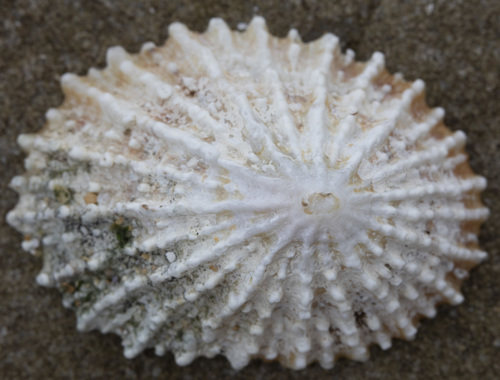
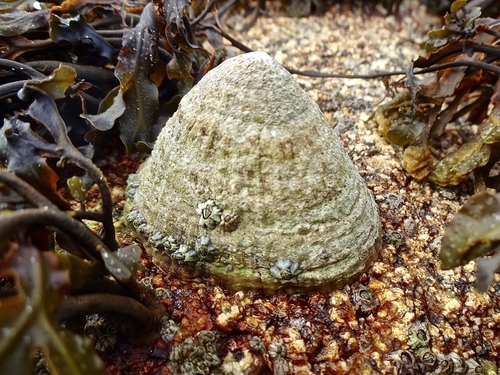
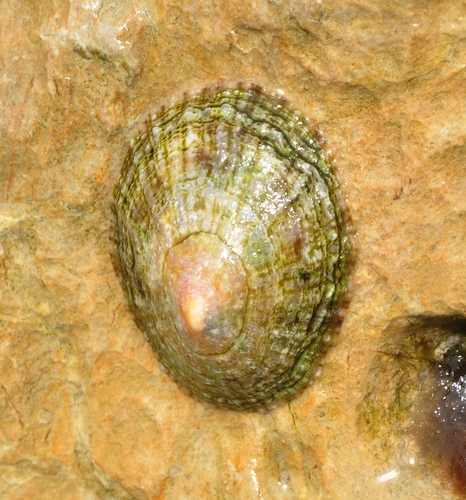
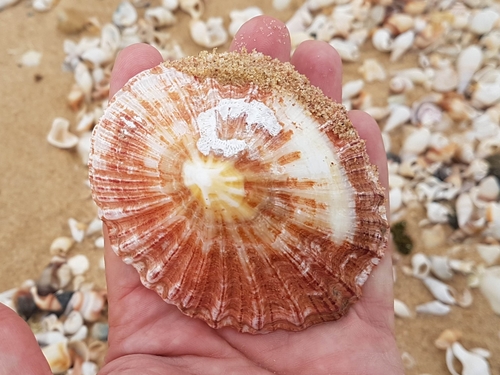
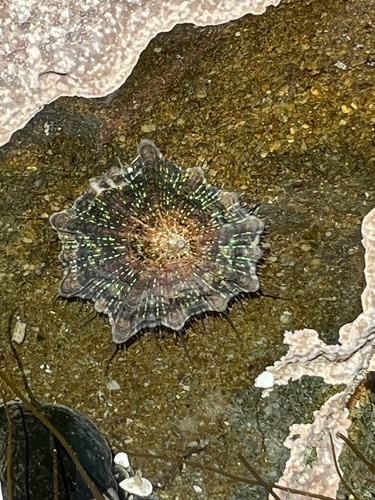
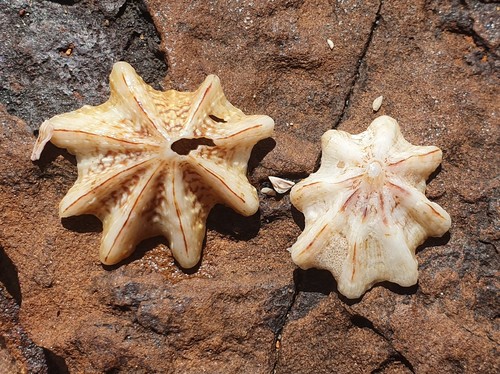
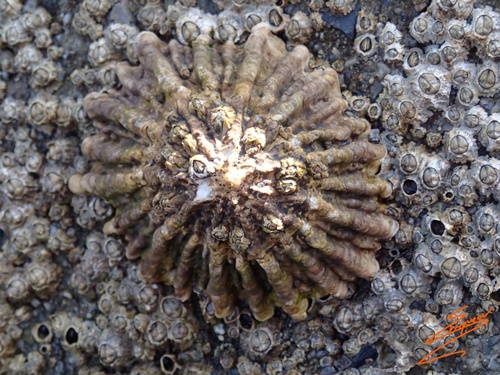
Patella ferruginea Gmelin, 1791 is a distinctive large limpet with a thick, heavy shell. Its diameter can exceed 100 mm (4 in), though most individuals barely grow past 70 mm. The robust, cone-shaped shell has 30 to 50 broad ridges and a wavy margin; the ribs are irregular and sometimes nodular. The shell is often worn smooth or covered by epibiotic organisms such as algae and barnacles. Its external surface is cream-coloured or rusty brown, while the internal surface is marbled white with a dark muscle scar. The muscular foot is yellowish-orange with dark grey sides, and the tentacles are black. Juveniles have flattened whitish shells marked with dark concentric bands, and only a small number of broad ribs that give them a star-shaped outline. This limpet is endemic, meaning it is restricted to the Mediterranean Sea. Past archaeological evidence of large shell middens created by Paleolithic and Neolithic hunter-gatherers shows it once had a wide range across the western Mediterranean. Today, it is only found at a small number of locations in northwestern Africa, including Al Hoceima National Park, plus scattered sites in southern Spain, Gibraltar, Sardinia, Corsica, and some islets in the central Mediterranean. It inhabits rocky surfaces in the intertidal zone. Spain classifies Patella ferruginea as an endangered species, and it is the first invertebrate, as well as the first marine species, that Spain has developed a national conservation strategy for. This limpet occurs in the mid-littoral zone, at the lower edge of the zone occupied by the barnacle Chthamalus stellatus, and above the zone formed by red algae where the gastropod mollusc Dendropoma petraeum lives. At night and when submerged, it moves to graze on the film of cyanobacteria and young algae that grows on rocks, and returns to the same homing site every time the tide recedes. This homing spot is visible because a ring of coralline algae develops under the edge of the limpet's shell. Patella ferruginea is preyed on by the crabs Eriphia verrucosa and Pachygrapsus marmoratus, and the dog winkle Stramonita haemastoma. Breeding occurs in autumn, around the time of year when the first storms arrive, and gametes are released directly into the sea. The larvae are planktonic for a period before settling in habitats similar to those occupied by adult limpets. Patella ferruginea appears to be a protandrous hermaphrodite: all smaller individuals are male, and the share of females among larger individuals increases as body size grows. There is some evidence, however, that individuals can change sex in either direction.