About Patanga succincta (Johannson, 1763)
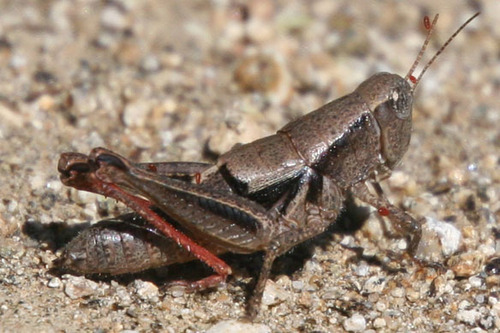
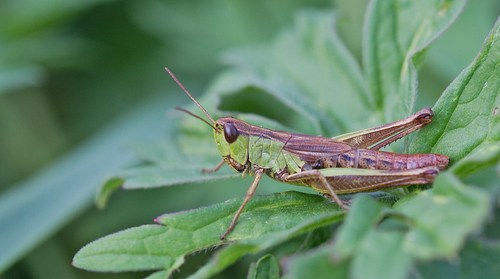
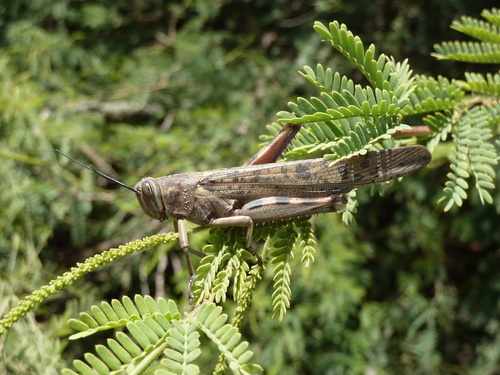
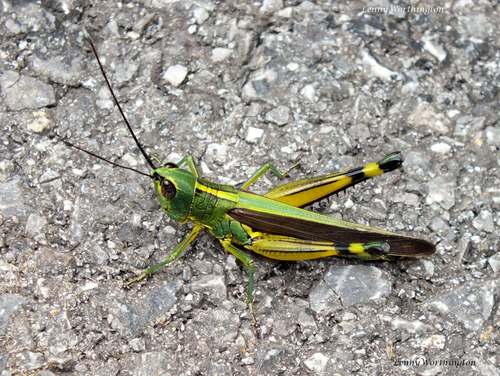
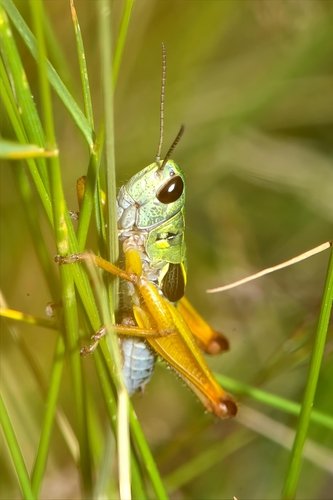
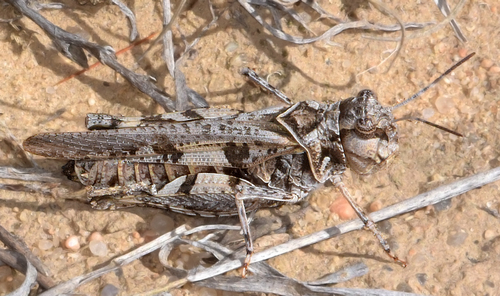
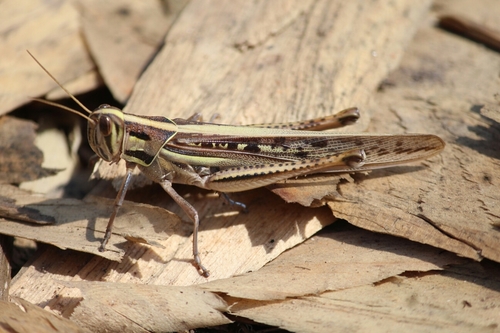
This species is commonly known as the Bombay locust, with the scientific name Patanga succincta (Johannson, 1763). Newly hatched nymphs are green with black spots. After several growth and moulting cycles, their colour becomes more variable: some are solid plain green, while others are orange-brown, or green with a black spot at the base of each wingpad. Immature adults are initially pale brown, with a yellowish stripe along their back, a dark prothorax, and two pale lateral bands on the prothorax. After six to eight weeks, their overall colour darkens and shifts to a rosy red shade, which is most visible on the hind wings. When locusts reach maturity the following year, they turn dark brown. The Bombay locust occurs in India, Southwest Asia and Southeast Asia. Its full range stretches from India and Pakistan to Thailand, Malaysia, Vietnam, Japan, the Philippines and Indonesia. Its usual breeding habitat consists of grassy plains and rough, tussocky grassland with shrubs and scattered trees, at elevations up to around 1,500 metres (4,900 ft). Swarms of this locust were once common in India, but no swarms have been recorded there since 1927. This is thought to result from land use change, as most of the grassland breeding areas the species used are now under cultivation. In other parts of its range where it does not form swarms, it has become an important local pest after forest clearance. After reaching adulthood, the Bombay locust enters diapause that lasts through the entire cool dry season. When the rainy season arrives, the insect matures and begins breeding. For example, in southern Japan, diapause lasts from June to March. Longer daylight hours in spring are confirmed to be the trigger that prompts the shift to reproductive maturity. Breeding occurs in June and July in India, August and September in Malaysia, and March and April in Thailand. Females lay between one and four egg pods, each holding up to 150 eggs, in soft soil. Eggs hatch between 4 and 8 weeks after laying, varying by location. Nymphs go through approximately seven developmental stages over several months before becoming immature adults. There is only one generation per year. In Thailand, young nymphs feed on short grasses, but after around the third moult they move into crops such as maize. In the morning, they feed in full sun at the top of the plant. By midday, they move down to cooler, shadier areas of the plant. In the evening, they move upward again and gather on the sunny, west-facing side of the plant. Immature adults from non-swarming populations gather on a few nearby maize plants, and will fly a short distance to a new location if disturbed. After maize is harvested, they move back to grassland.