About Patagioenas maculosa (Temminck, 1813)
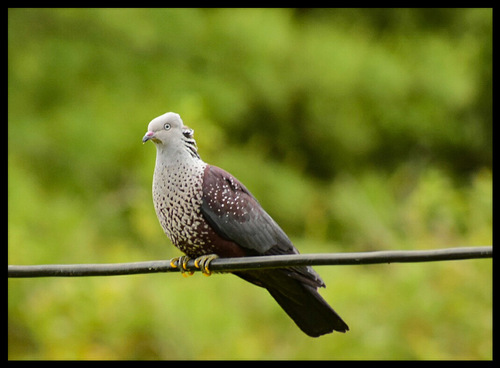
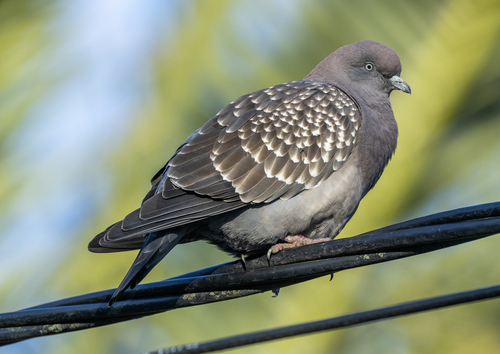
Patagioenas maculosa, commonly called the spot-winged pigeon, has two recognized subspecies that differ significantly in their plumage. The nominate subspecies, P. m. maculosa, measures 32 to 33 cm (13 to 13 in) long and weighs 308 to 347 g (10.9 to 12.2 oz). In adult males of the nominate subspecies, the forehead, crown, nape, hindneck, and breast are mostly dull purplish pink, while the rest of the head and underparts are gray. The upper back and wing coverts are dark brown and marked with creamy white spots. The wings are mostly black on the upper surface and pale gray on the lower surface. The lower back and rump are bluish gray, and the tail is dark gray. Adult females are similar to males, but the coloring of the head and neck is generally duller. Juveniles are also similar to adults, but their entire plumage is duller, with a drab gray head and breast. The second subspecies, P. m. albipennis, is slightly larger than the nominate, measuring 33 to 34 cm (13 to 13 in) long. In adult P. m. albipennis, the head, neck, rump, and entire underparts are blue-gray with a purplish wash that is most pronounced in males. The upper back and wing coverts are gray-brown. The folded wing displays a conspicuous white band that contrasts with the otherwise dark wing. Like the nominate subspecies, juvenile P. m. albipennis are a duller version of the adult plumage. In terms of distribution and habitat, P. m. maculosa occurs in southeastern Bolivia, extending south and east through Paraguay, southern Brazil, and Uruguay to south-central Argentina. It inhabits arid to semi-arid open woodland and scrub, up to an elevation of 1,000 m (3,300 ft), and avoids towns. P. m. albipennis is found from central Peru south to western and central Bolivia, extreme northwestern Argentina, and far northern Chile. It also inhabits arid to semi-arid open woodland and scrub, but generally occurs at elevations between 2,000 and 4,300 m (6,600 and 14,100 ft), and is locally common in towns.