About Patagioenas flavirostris (Wagler, 1831)
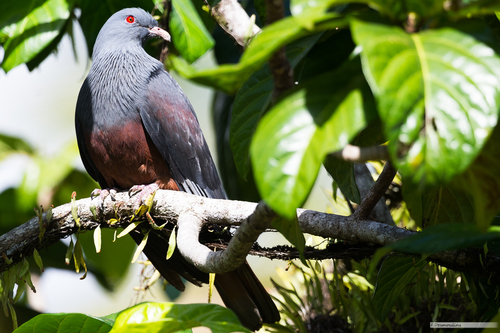
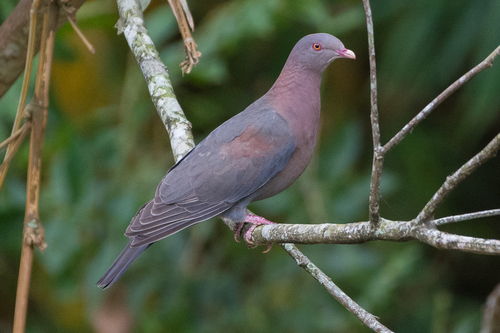
Red-billed pigeons (scientific name Patagioenas flavirostris) have mostly dark, slate-gray plumage. Their heads, necks, and wing coverts are more maroon, though this color is sometimes described as purple. They have pale red eyes surrounded by an orange orbital ring, and a red bill with a yellow tip. Unlike many related pigeon species, they do not have iridescent collar plumage. A blue-gray belly and blue-gray tail coverts, combined with a back that is less brown than in related species, distinguish this species from others such as the Ruddy Pigeon and Short-billed Pigeon. The only clear difference between adult males and females is that females have duller colored head and neck plumage. Juvenile red-billed pigeons are usually even more dull in overall color than adults; they have dark, dusky shoulders, and a browner mantle and wings. This is a mid-to-large sized pigeon species, with adults reaching between 30 and 37 cm (12–15 in) in length, and weighing 230–425 g (8.1–15.0 oz). The species has a very distinctive call: it is a long, high-pitched vocalization that starts with a coooo, followed by three cuk-c'-c'-coo notes, and the entire call ascends in pitch. When the birds take off from a perch, their wings produce a noticeable clapping sound. Red-billed pigeons are common across dry forests, primarily in coastal Mexico and Central America. They are most common in the Rio Grande region, but remain an uncommon sight there during the summer. Individuals are sometimes found in Southern Texas, where the species has a declining population. Across almost all of the species' range, it is rare to see red-billed pigeons during the winter. Four subspecies of red-billed pigeon are recognized, with distinct ranges: restricta is found in western Mexico, from central-western Sonora to Sinaloa, described by van Rossem in 1930; madrensis is found on Tres Marías Island off the coast of central-western Mexico, described by Nelson in 1898; flavirostris is found from the lower Rio Grande Valley in Texas, through southeastern Sonora, the Sierra Madre in Chihuahua, and San Luis Potosí, south to Nicaragua and east to Costa Rica, originally described by Wagler in 1831; minima is found in the lowlands of Costa Rica around the Gulf of Nicoya, described by Carriker in 1910. The habitat of red-billed pigeons can vary, but they are most often found in dry woods and along riverside wetland areas.