About Patagioenas fasciata (Say, 1822)
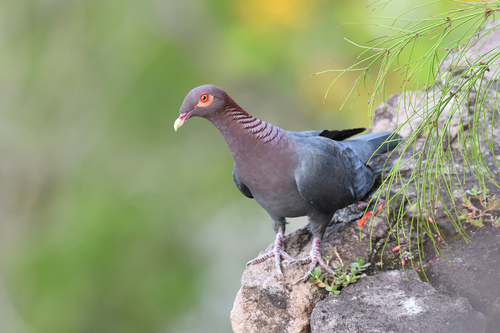
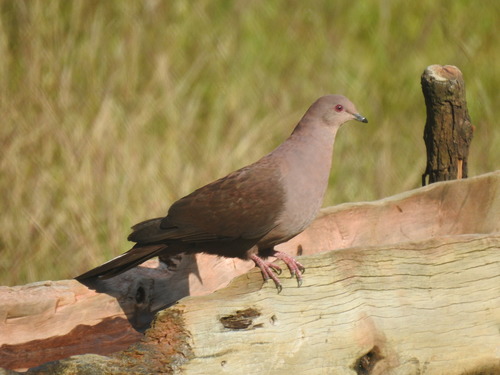
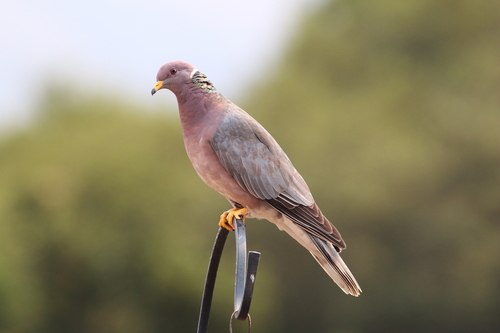
The band-tailed pigeon, Patagioenas fasciata, is one of the largest pigeon species native to the Americas. It measures 33 to 40 cm (13 to 16 in) in length and weighs 226–460 g (8.0–16.2 oz), with males averaging slightly larger than females, though there is substantial overlap in size between the sexes. While it is sometimes called the largest North American pigeon, the closely related red-billed pigeon (P. flavirostris) reaches a similar size, weighing 268–424 g (9.5–15.0 oz). Band-tailed pigeons have pointed wings with thick bases, and a wingspan of 66 cm (26 in). Their overall plumage is gray, and is darker on the upper parts of the body. The head and underparts have a faint pink tint, which is most noticeable in adult males, while the belly is nearly white. The distal half of the tail is pale (this trait is absent in the Baja California subspecies), with a darker gray band at the tail base, which gives the species its common English name. The bill and feet are yellow, which are reliable identification markers when the bird can be observed at close range. Adult birds have green iridescent plumage on the back of the neck, next to a thin white collar on the nape. Juvenile birds have pale edges to their upper body feathers, which creates a scaly appearance, and lack both the white collar and neck iridescence. Unlike most other bird species, band-tailed pigeons roam continuously throughout the year and do not maintain a single fixed home range. They are usually found at higher elevations, in coniferous forests, oak woodlands, and scrublands. Their range extends from British Columbia, Washington, Oregon, California, and southern Arizona southward through higher elevation areas of Mexico and Central America, and continues along the Andes Mountains to northern Argentina. They live primarily in damp forests and conifer-oak woodlands of western mountains and coasts. Band-tailed pigeons are nomadic feeders that adjust their diet with the seasons, and will travel up to 5 km (3 miles) from their nests to reach feeding sites. As forest birds, they forage both on the ground and in tree canopies. Their diet is centered on acorns, but they also eat berries, seeds, flowers, leaves, and even insects. When food is scarce, they move closer to urban areas, and can be found in suburbs, forested parks, orchards, and even residential backyards. This species is relatively quiet for a pigeon. Its call is low-pitched and owl-like, most often a two-syllable note that rises then falls (described as huu-ooh), with even spacing between calls. It also produces a range of harsh squawking sounds in different contexts. They are swift and agile fliers, an adaptation that lets them navigate through dense high treetops and branches. When flying, they produce a distinctive "wing whistle", a sound also made by many other pigeon species. Band-tailed pigeons form pairs to build nests; the female constructs a simple platform nest from twigs in trees, and nests are often placed close together to form small breeding colonies. The clutch usually contains only one egg, occasionally two, with roughly 8% of clutches holding two eggs. The eggs hatch after approximately three weeks of incubation, which is shared by both parents. Adult band-tailed pigeons can raise multiple broods in a single year, and young typically leave the nest 25 to 30 days after hatching. Breeding pairs may start a new brood before the young from their previous brood have fledged, and newly fledged young can be found at any time of year. In North America, most young fledge between June and November. Both adult parents begin producing crop milk a few days before their eggs hatch. Crop milk is a nutrient-dense substance produced by pigeons and doves in the crop, an expanded section of the lower esophagus. The crop milk of band-tailed pigeons is unique: it is more solid and yellowish than mammalian milk, and contains very high levels of fats, proteins, antioxidants, and immune-enhancing compounds. Adult pigeons feed their hatchlings by regurgitating crop milk directly into the hatchlings' mouths for the first few weeks of life, up to around 30 days. After this period, the parents stop producing crop milk and begin feeding the young softened regular food, which is also delivered by regurgitation. Outside of the breeding season, band-tailed pigeons form flocks that can number up to 300 birds, and often become nomadic, moving to follow acorn crops or travel to lower altitudes or other areas outside their breeding range. They regularly gather at and drink from mineral springs, though the reason for this behavior is not yet fully understood.