About Pataecus fronto Richardson, 1844
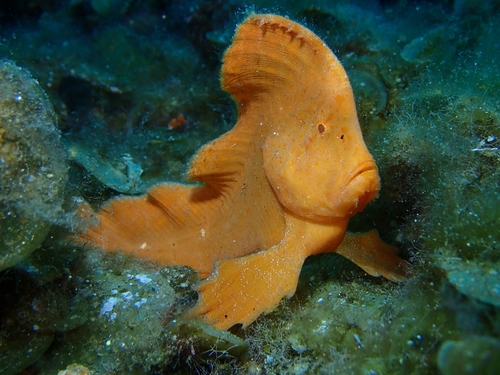
Pataecus fronto, commonly called the Red Indian fish, has an elongated, highly compressed body that is deepest near the head. It has a wedge shape, with the narrowest point at the caudal peduncle. Its relatively small eyes sit high on the head, and it has an oblique mouth with tiny teeth on the jaws. The upper section of the operculum has two low diagonal ridges, and the head has no spines. Its skin is smooth and lacks scales. The long dorsal fin begins on the head, in front of the eyes, and starts with a short spine. The longest spines of the dorsal fin are towards the front, and they decrease in size closer to the tail. The dorsal fin holds between 22 and 25 spines and 14 to 17 soft rays; the anal fin holds between 9 and 11 spines and 4 to 7 soft rays. The dorsal fin connects to the rounded caudal fin. The large pectoral fins are positioned low on the body, and this species has no pelvic fins. It reaches a maximum total length of 35 cm (14 in). Its base body color can be scarlet, brick red, or orange. Infrequently, individuals are pale, or have black spots, white spots, or both, most often on the dorsal portion of the body. The Red Indian fish is endemic to the waters off southern Australia. On the east coast, its range extends from Maroochydore in southern Queensland to Barragga Bay in southern New South Wales. On the southern and western coasts, its range extends from Gulf St Vincent in South Australia to Shark Bay in Western Australia. This is a demersal fish that is only infrequently recorded in South Australia, which suggests it may prefer deeper reefs in this area. It lives among sponge communities on coastal reefs and in estuaries, at depths down to 80 m (260 ft). In New South Wales, scuba divers often encounter this species at shallow depths. It is mostly found inside bays or harbours, and is almost always only found on the northern side of the inlet. When encountered, it is typically found on the northern side of rocks or sponges. It is rarely seen on the southern side of inlets or even rocks. Very little is known about the life of the Red Indian fish from birth until it reaches nearly adult size. Few, if any, photographs exist of very small specimens.

