About Pastor roseus (Linnaeus, 1758)
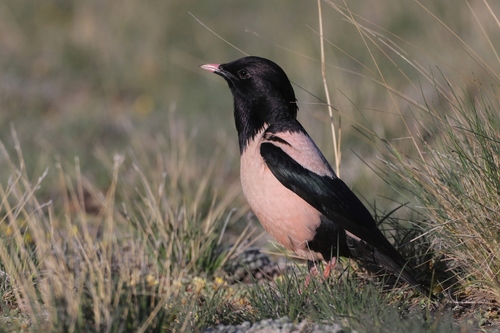
Adult rosy starlings (Pastor roseus) are highly distinctive, with pink bodies, pale orange legs and bills, and glossy black heads, wings, and tails. Breeding-season males have elongated head feathers that form a wispy crest, which becomes fluffier and more prominent when the bird is excited. In winter, males have shorter crests; the edges of their black plumage feathers fade as the feather edges erode, so their winter plumage is comparatively dull. Females differ from males by having a short crest and lacking the sharp color separation between pink and black plumage. Juvenile rosy starlings can be told apart from common starlings (Sturnus vulgaris) by their noticeably paler plumage and short yellow bill. Young birds moult into a muted, non-crested version of adult plumage in autumn. Females do not develop full adult plumage until they are nearly one year old, while males do not acquire full adult plumage until they are nearly two years old. In their second year, males grow plumage very similar to adult females, but can be distinguished by longer crests and noticeably paler feather edges than female juvenile birds. This species breeds across the steppes, semi-deserts, and deserts of Central Asia and Southeast Europe. Its breeding range stretches from northwestern Mongolia through Dzungarei, Xinjiang, Kazakhstan, Kyrgyzstan, Tajikistan, Uzbekistan, and Turkmenistan to southern Russia, Ukraine, Azerbaijan, and Armenia, with its southern limit reaching northern Afghanistan and Iran. Irregular, rare breeding has also been recorded outside this core range, in Romania. It is a strong long-distance migrant that winters in India and tropical Asia. During the Indian winter, rosy starlings often outnumber local starlings and mynas. This species occupies steppe and open agricultural land. In years when grasshoppers and other insects are abundant, the species irrupts well beyond its core range, with large numbers reaching France, the United Kingdom, and Ireland. For Afghanistan, rosy starlings are summer visitors in the northwestern part of the country, passage migrants through the rest of Afghanistan, and regular winter visitors in India. Rosy starlings are highly gregarious, and often form large, noisy flocks that can occasionally become pests for cereal crop and orchard growers; the birds are strongly attracted to flowering trees. However, they are very beneficial to farmers because they prey on pest species such as locusts and grasshoppers, keeping pest populations in check. They breed in dense colonies during a very short breeding season timed to coincide with the peak abundance of grasshoppers between May and June. The rosy starling feeds mainly on fruits, berries, flower nectar, cereal grains, and insects. Recorded preferred foods are as follows: fruits and berries include many species of Ficus, Lantana spp., Ziziphus oenopolia, Bridelia montana, Streblus asper, grapes, mulberries (Morus), dates, Salvadora persica, Capparis aphylla, and chillies; flower-nectar comes from Salmalia persica, Bombax insigne, Erythrina indica, Erythrina suberosa, Butea monosperma, and Careya arborea; cereal grains consumed are jowar and bajra; insects eaten are largely locusts and grasshoppers, plus beetles from the families Lucanidae, Elateridae, Tenebrionidae, Buprestidae, Scarabaeidae, and Curculionidae.