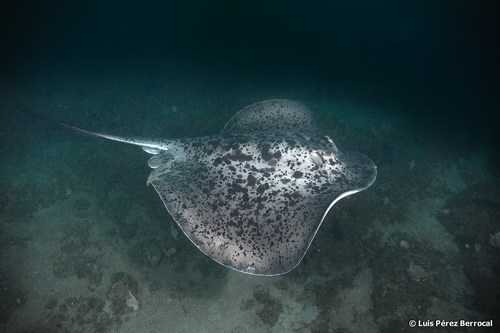
About Pastinachus sephen (Forsskål, 1775)
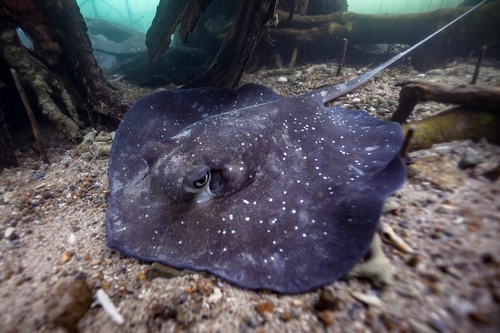
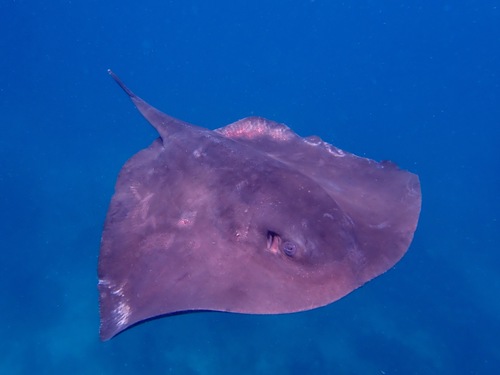
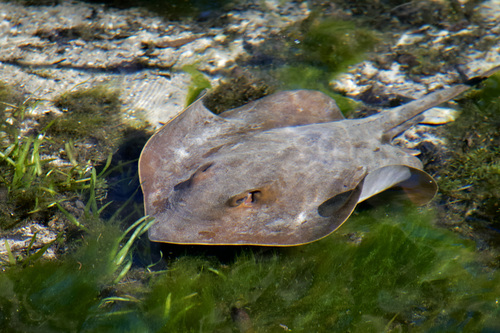
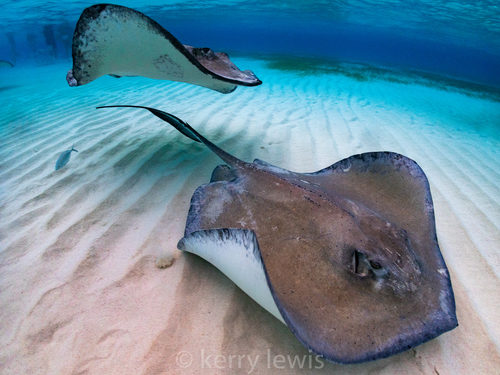
The cowtail stingray, Pastinachus sephen, has a very thick pectoral fin disk with nearly straight front margins and rounded tips. The disk measures 1.1 to 1.3 times as long as it is wide. Its snout is broadly rounded and blunt, its eyes are very small and widely spaced, and its mouth is narrow. Each jaw holds 20 rows of distinctive hexagonal, high-crowned teeth, and there are five papillae on the floor of the mouth. The cowtail stingray’s tail is broad at the base, ends in a fine filamentous tip, and has a single venomous spine positioned far behind the pelvic fins. It has no upper tail fold, while its tall ventral tail fold is 2 to 3 times the height of the tail and does not extend to the tail tip. A wide band of fine dermal denticles covers the upper surface of the disk from close to the snout tip to the upper tail, excluding the outermost disk margins. Newborn cowtail stingrays are completely smooth at birth, but develop denticles rapidly afterwards. Juveniles have four circular tubercles at the center of the disk, which often become less distinct in adults. The species is uniform grayish brown to black on its upper side, and mostly white on its underside; the tail fold and tail tip are black. Fully grown individuals can reach 3 meters (9.8 feet) in total length, 1.8 meters (5.9 feet) across the disk, and weigh up to 250 kg (550 lb). The cowtail stingray has a broad distribution across tropical Indo-Pacific waters, ranging from South Africa and the Red Sea east to Japan and Australia, including Melanesia and Micronesia. It is amphidromous and known to enter estuaries and rivers. It is the most frequently reported freshwater stingray in Southeast Asia, with one recorded individual found in the Ganges River 2,200 km (1,400 mi) from the sea. It typically inhabits sandy bottoms in coastal waters and on coral reefs, to depths of 60 meters (200 feet). Cowtail stingrays are solitary foragers that feed on bony fishes (including leiognathids, Nemipterus, and soles), crustaceans, polychaete worms, sipunculids, and molluscs. This species is preyed on by multiple species of hammerhead and requiem sharks, as well as by the Indo-Pacific bottlenose dolphin (Tursiops aduncus). When threatened, cowtail stingrays consistently flee at a 45° angle away from the predator; this path lets them maximize distance gained while still keeping the predator in their field of vision. Like other stingrays, cowtail stingrays reproduce through ovoviviparity: embryos are sustained in late development by histotroph, also called "uterine milk", delivered via specialized structures. Females give birth to live young that measure at least 18 cm (7.1 in) across the disk. In the Strait of Malacca, single young have been recorded year-round, and juveniles have more pointed snouts than adults. Adults are sometimes accompanied by remoras or trevallies. Documented parasites of the cowtail stingray include Dendromonocotyle ardea, Decacotyle tetrakordyle, and Pterobdella amara. Observations of cowtail stingrays in Shark Bay, Australia show that the species enters shallow sandy flats during high tide to rest for a minimum of four hours. They often form small groups while resting, particularly when visibility is low such as in turbid water or under low light conditions. Most resting groups have three individuals, though larger groups of up to nine do occur rarely. Groups arrange themselves in a "rosette" formation with all tails pointing outward. This behavior is thought to be an anti-predator adaptation: the close circular arrangement lets all individuals spot predators approaching from any direction. The rosette also orients the rays' tails, which hold mechanoreceptors that act as a secondary warning system, toward potential threats. When a threat is detected, all group members flee at the same time, making it harder for a predator to target any single individual. Cowtail stingrays also prefer to form mixed-species resting groups with reticulate whiprays (Himantura uarnak), likely because the longer tails of whiprays let them detect predators more effectively.