About Passiflora mixta L.fil.
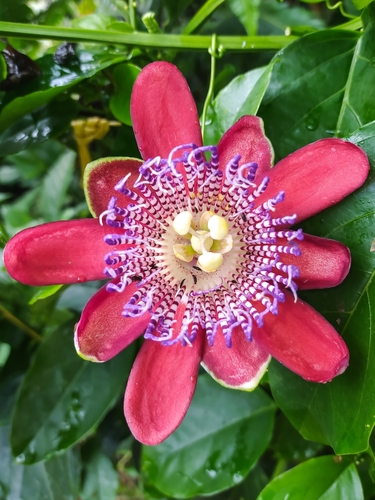
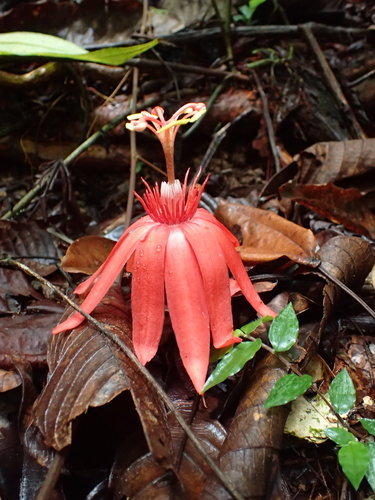
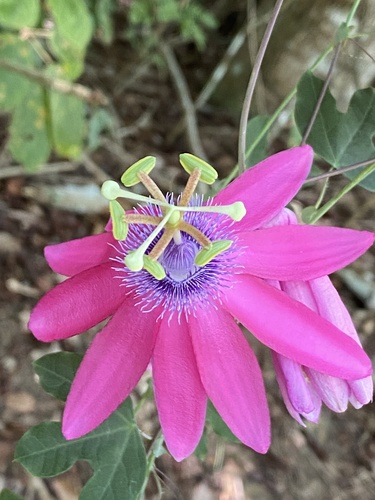
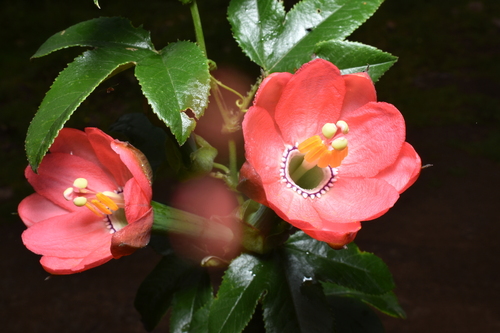
Passiflora mixta L.fil. can be recognized by its large pink flowers and trilobate coriaceous leaves; its flowers are tubular and protrude from branches. It has a hairy, elongated bract, and a 7–15 cm (2.8–5.9 in) long hypanthium (flower tube) that holds a narrow nectar chamber. Its ovaries, anthers, and stigmas sit anterior to the hypanthium, near the androgynophore. This species produces half-pendant, horizontal, or erect flowers that stay open for 3 to 5 days, and can also produce fruits. It is a wild, collected species that serves as an important genetic resource for banana passionfruit breeding. Its stem is sub-five-angular. Leaf pubescence is absent from the upper leaf surface, and ranges from absent to sparsely dense on the lower leaf surface. Its stipules are moderate to large, 6–20 mm long and 12–30 mm (0.47–1.18 in) wide, shaped reniform, with dentate or serrate edges, and are persistent. Peduncles are robust with variable length, and produce half-pendant, horizontal, or erect flowers. Bracts are joined along half their length or more. The corolla color ranges from pale pink to deep red, and is bell-shaped (campanulate). The ratio of floral tube length to sepal length is 1.6:2.6, and the nectar chamber is slightly broader than the floral tube. When mature, the pericarp is most often green, and occasionally turns yellow; arils are scarce, and range from grey to orange in color.
Passiflora mixta is distributed from Venezuela to Bolivia, and has become naturalized in Africa and New Zealand. It grows only in highland areas between 1,700 and 3,700 m (5,600 and 12,100 ft) above sea level. It can tolerate habitat disturbance, and is more common in drier environments and at lower altitudes than other Tacsonia species. It grows along forest edges and habitat margins. This Passiflora species is pollinated by the sword-billed hummingbird (Ensifera ensifera), the only living species in its genus. The sword-billed hummingbird lives throughout the northern Andes, and is distinguished by its extremely long beak that is longer than the bird's entire body. This long beak lets the hummingbird reach nectar at the bottom of Passiflora mixta's long corolla tubes.