About Passiflora incarnata L.
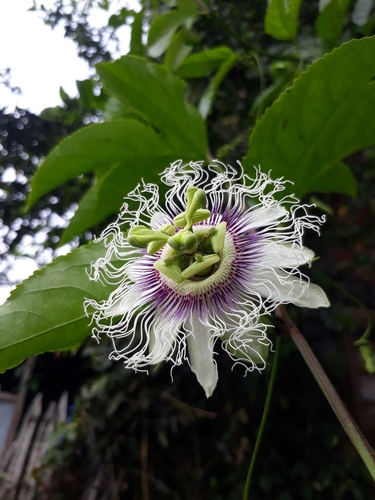
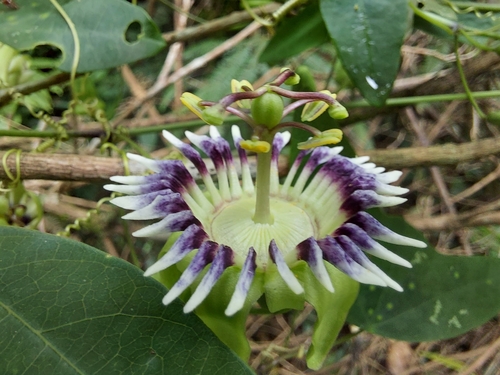
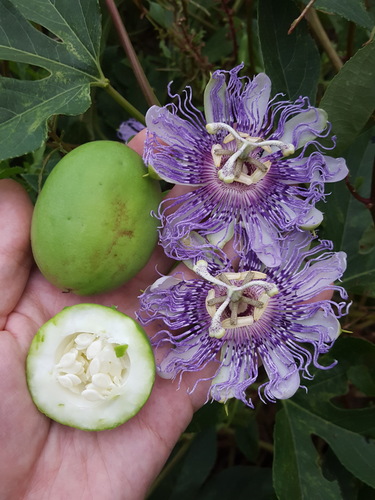
Passiflora incarnata L., commonly called maypop, has stems that are either smooth or pubescent, long and trailing, and grow with many tendrils. Its leaves are alternate, typically palmately three-lobed (occasionally five-lobed), and measure 6–15 centimetres (2.4–5.9 in). Two distinct nectar-secreting glands are located at the base of the leaf blade on the petiole. Its flowers have five bluish-white petals, with a white and purple corona (a structure of fine appendages between the petals and stamens) arranged in a large ring above the petals and sepals. Flowers bloom starting in July, are self-sterile, and are pollinated by insects including bumblebees and carpenter bees. The fleshy fruit, also called a maypop, is an oval yellowish berry about the size of a hen egg; it starts green, and turns yellow-green to yellow-orange as it matures. Like other passifloras, the pulp is gelatinous and surrounds the seeds: the pulp starts white and turns dull yellow when ripe, and the black seeds are approximately 5 mm in size. Like other passifloras, P. incarnata is a larval food source for many lepidoptera species, including the zebra longwing, Gulf fritillary, crimson-patched longwing, Julia, Plebeian sphinx, and variegated fritillary. Passionflowers including this species are the exclusive larval host plant for the Gulf fritillary, and a non-exclusive host for the variegated fritillary butterfly. Wildlife very often favors its fruit. Unripe green egg-shaped fruits may pop when stepped on; alongside this, the plant's common name maypop also comes from its roots being able to stay dormant underground through most of the winter, with the rest of the plant "popping" out of the ground by May unharmed by snow. This species grows in thickets, disturbed areas, near riverbanks, near unmowed pastures, alongside roadsides, and alongside railroads. It grows best in areas with abundant sunlight, and does not grow in shady areas under forest canopies. It is an aggressive wild vine native to the southeastern United States, ranging north and west into the central United States to reach Illinois, Indiana, and Ohio. In favorable weather, its vines can cover a thicket floor within days. The Cherokee people of the Tennessee region call this plant ocoee; the Ocoee River and Ocoee Valley are named after this plant, which is the state wildflower of Tennessee. The local Tennessee salamander Desmognathus ocoee also takes its name from the Cherokee word for P. incarnata. For thousands of years, maypop was a staple food and medicinal plant for the Cherokee, and it remains a respected part of their heritage today. Regarding safety, a 2013 literature review found that this herb has a good safety profile. One study found that daily intake of 800 mg of dried alcoholic extract, taken over 8 weeks to treat anxiety, appeared to be safe. Passionflower is used as a natural flavoring agent in food manufacturing, and is generally recognized as a safe (GRAS) substance in the United States. P. incarnata is also listed in the European Register of Feed additives as an approved animal feed additive. P. incarnata is easy to cultivate, and is a common low-maintenance garden plant within its native range that can be trained to grow along fences and arbors. It requires at least half a day of direct sunlight, and grows best in well-drained soils, though it can tolerate occasionally wet and acidic soils. It has high drought tolerance. It can be planted year-round in USDA hardiness zones 6–11, and should be spaced 36–60 inches (91.44 – 152.4 cm) apart. Plants take one to two years after planting to begin bearing fruit. Each flower only lives for about one day, and fruit takes two to three months to develop after flowering. Harvest yields depend on vine size and plant age, with one reported yield of 10–20 fruits per vine. Seeds can be collected in fall after the fruit begins to shrivel. Common cultivation issues include infestation by nematodes and caterpillars. Its flowers are well-adapted to pollination by carpenter bees, and may also attract hummingbirds. As bees and hummingbirds collect nectar, pollen-covered anthers brush against the bee's back or the hummingbird's face, transferring pollen to the central sticky stigma. P. incarnata can potentially become an agricultural weed. The genus Passiflora, when introduced for agricultural purposes, has been reported to be an important weed in some regions of the world. The United States Department of Agriculture notes that P. incarnata is classified as a weed in the publications Weeds of Kentucky and adjacent states: a field guide and Weeds of the United States and Canada. Regular removal of suckers via mechanical control is recommended to prevent the spread of maypop. Training vines onto trellises and fences is also recommended to limit uncontrolled propagation. Historically, this plant has been used as an herbal medicine. Passionflower is included in pharmacopeias including the European Pharmacopoeia and British Pharmacopoeia, which reference its dried aerial parts. In North and South America, tea made from its roots is used as a tonic. The U.S. Food and Drug Administration withdrew approval for marketing of this plant as a medicinal product because manufacturers did not submit evidence confirming its safety and effectiveness. For culinary use, P. incarnata produces edible fruits that can be used to make jams, jellies, and desserts. Its juice is a popular flavoring for drinks, and can be used as a fresh substitute for the commercially grown South American related species Passiflora edulis, which has a similar fruit size. Ripe fruit can be eaten by hand, with a mildly sweet-tart taste similar to apricot and a pleasant scent when fully ripe. The fruits of Passiflora species are aromatic and sweet, making them well-liked for fresh consumption and use as a flavoring. Each fruit contains many seeds, with each seed surrounded by an aril that holds edible juice; this juice can be eaten fresh or used to flavor processed food products.