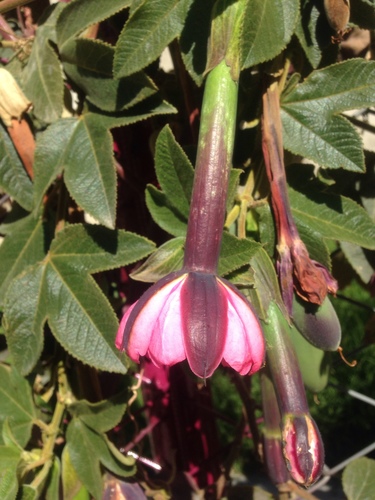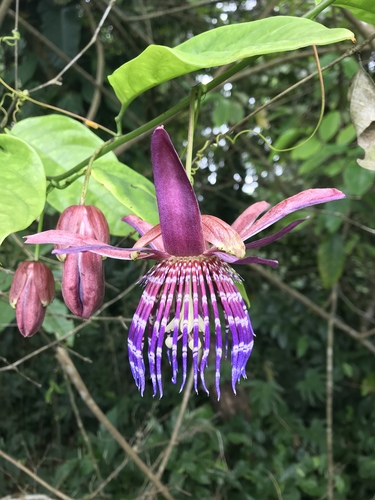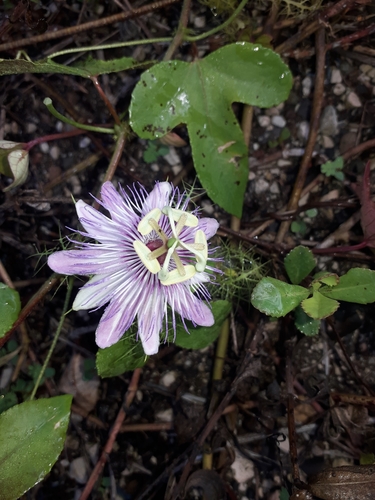
About Passiflora ciliata Dryand. ex Aiton
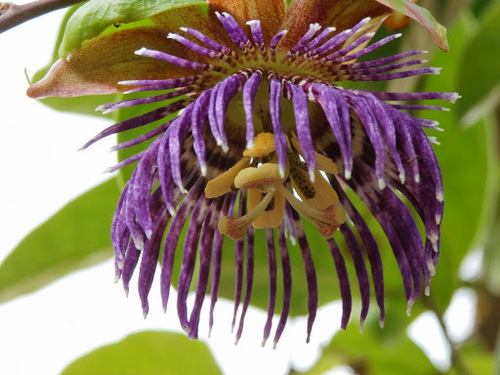
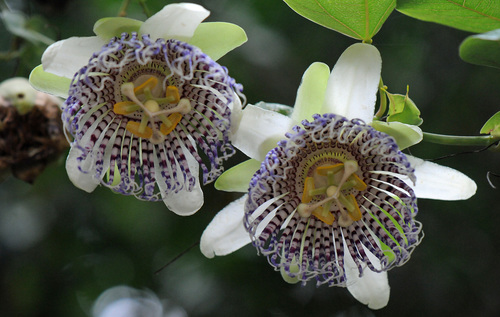
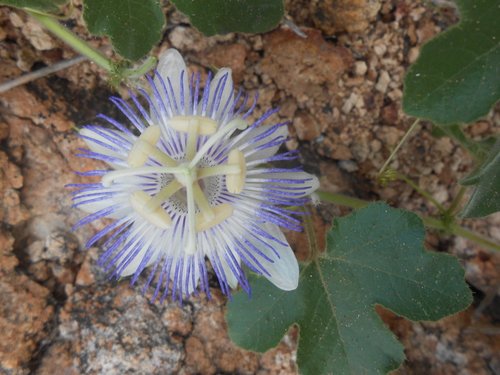
This entry covers the characteristics, distribution, ecology, human uses and safety of the Passiflora genus, with the focal species being Passiflora ciliata Dryand. ex Aiton. Most members of the Passiflora genus are tendril-bearing vines, though some grow as shrubs or trees. Plants in this genus may be woody or herbaceous. Their flowers are regular, typically showy, and feature a distinctive corona, which can have up to eight concentric series in some species like P. xiikzodz and P. alata. A defining trait of the genus is the androgynophore, a central column that holds both stamens and pistil; this column can be very long in some species such as P. coactilis. Except for a small number of Southeast Asian species, Passiflora flowers are pentamerous, and mature into indehiscent fruits that hold many seeds. Fruit size varies by species and cultivar, ranging from 5 to 20 centimetres (2 to 8 inches) in length and 2.5 to 5 centimetres (1 to 2 inches) across. Unlike other genera in the Passifloraceae family, which have more Old World species such as the genus Adenia, Passiflora is largely distributed across the neotropics. The vast majority of Passiflora species are native to the United States and Latin America, though additional species occur in Southeast Asia and Oceania. New species are still being formally described: for example, P. xishuangbannaensis was only added to scientific knowledge in 2005, and P. pardifolia in 2006. Some Passiflora species have become naturalized outside their native ranges; blue passion flower (P. caerulea) now grows wild in Spain, while purple passionfruit (P. edulis) and its yellow relative flavicarpa have been introduced as commercial crops across many tropical regions. Passion flowers have floral structures adapted for biotic pollination. Known pollinators include bumblebees, carpenter bees such as Xylocopa sonorina, wasps, bats, and hummingbirds, particularly hermit hummingbirds like Phaethornis. Some Passiflora species are also capable of self-pollination. The genus often has high pollinator specificity, which has driven frequent coevolution. A well-known example is the sword-billed hummingbird (Ensifera ensifera): its extremely elongated bill makes it the only pollinator of 37 high Andean Passiflora species in the supersection Tacsonia. Leaves of Passiflora are a food source for the larvae of many Lepidoptera species, most notably numerous butterfly species in the tribe Heliconiini, which exclusively feed on Passiflora. Passiflora has evolved a range of defensive adaptations against herbivory, including varied leaf shapes to disguise the plant, colored nubs that mimic butterfly eggs to deter Heliconius butterflies from laying eggs on what appears to be an already occupied leaf, extrafloral nectaries, trichomes, variegation, and chemical defenses. These adaptations, paired with matching adaptations in the butterflies that feed on them, were an important foundation for the development of coevolutionary theory. Recent research finds that Passiflora plants both grow faster and have stronger defenses when growing in high-nitrogen soils. In low-nitrogen environments, Passiflora prioritizes growth over defense, leaving them more vulnerable to herbivores. Lepidoptera larvae confirmed to feed on Passiflora include multiple Heliconiinae longwing butterflies: Heliconius cydno (the cydno longwing, one of the few heliconians that feeds on multiple Passiflora species), Agraulis vanillae (the gulf fritillary, which feeds on several species including Passiflora lutea, Passiflora affinis, stinking passion flower P. foetida, and maypop P. incarnata), Heliconius sara (the American Sara longwing), Heliconius erato (the red postman), Cethosia cyane (the Asian leopard lacewing), Heliconius melpomene (the postman butterfly, which prefers P. menispermifolia and P. oerstedii), Heliconius charithonia (the zebra longwing, which feeds on yellow passion flower, two-flowered passion flower P. biflora, and corky-stemmed passion flower P. suberosa), Dryadula phaetusa (the banded orange, which feeds on P. tetrastylis), and Dryas iulia (the Julia butterfly, which feeds on yellow passion flower and P. affinis). Other confirmed feeders include the swift moth Cibyra serta, and Acraea terpsicore (the tawny coster, which feeds on Passiflora edulis, Passiflora foetida and Passiflora subpeltata). The generally high specificity of Passiflora for both pollinators and herbivores may have driven the genus' extreme morphological variation. Passiflora is thought to have among the highest leaf diversity of any plant genus, with leaf shapes ranging from unlobed to five-lobed often occurring on the same individual plant. Coevolution is a major driver of speciation in Passiflora, and may be responsible for the evolutionary radiation of clades such as Tacsonia. The bracts of stinking passion flower (P. foetida) are covered in hairs that secrete a sticky fluid. Small insects often become stuck in this fluid, and are digested into nutrient-rich paste by proteases and acid phosphatases. Since the insects this plant kills are rarely major pests, it is considered a protocarnivorous plant. Some Passiflora species are invasive outside their native ranges. Banana passion flower, also called banana poka (P. tarminiana), originally native to Central Brazil, is an invasive weed particularly on the Hawaiian Islands. It is spread by feral pigs that eat its fruits, and overgrows and smothers stands of native endemic vegetation, most often along roadsides. Blue passion flower (P. caerulea) is an invasive species in Spain, where it is considered likely to threaten local ecosystems. On the other hand, some Passiflora species are endangered due to unsustainable logging and other forms of habitat destruction. For example, the Chilean passion flower (P. pinnatistipula) is a rare vine that grows in the Tropical Andes from Venezuela southward, at altitudes between 2,500 and 3,800 metres (8,200 and 12,500 feet), as well as in coastal central Chile. In its Chilean range, it only occurs in a few tens of square kilometres of coastal fog forest near Zapallar. Unlike other Tacsonia group species such as banana passion flower and P. mixta, which have elongated floral tubes and bright red to rose-colored petals, P. pinnatistipula produces a round fruit. Notable pathogens of Passiflora, some of which are economically significant, include several sac fungi in the genus Septoria (including S. passiflorae), an undescribed proteobacterium referred to as "Pseudomonas tomato" pv. passiflorae, the Potyvirus passionfruit woodiness virus, and the Carlavirus Passiflora latent virus. Passion flower products are not recommended for use during pregnancy, as they may induce uterine contractions. Consuming passion flower products may cause side effects including drowsiness, nausea, dizziness, abnormal heart rhythms, asthma, or rhinitis. Passiflora incarnata (maypop) leaves and roots have a long history of use as traditional medicine by Native Americans in North America, and this use was later adopted by European colonists. Fresh or dried maypop leaves are used to prepare a tea that is used as a sedative. Dried passionflower powder or extract is sold as a dietary supplement. There is insufficient clinical evidence to support the use of passionflower to treat any medical condition. In the United States, passionflower is classified as generally recognized as safe for use as a food ingredient.