About Passerina versicolor (Bonaparte, 1838)
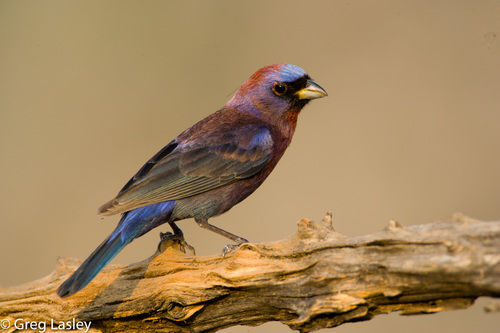
The varied bunting, scientifically named Passerina versicolor, is a species of songbird that belongs to the cardinal family, Cardinalidae. Its breeding range extends from southern Arizona, southern New Mexico, and southern Texas in the United States, southward through Mexico all the way to Oaxaca. Small, separated disjunct populations also live in the Mexican state of Chiapas and in southeastern Guatemala. This is a stocky bird with a short tail and a rounded bill. It measures 11 to 14 centimeters (4.3 to 5.5 inches) in length, has a wingspan of 21 centimeters (8.3 inches), and weighs between 11 and 13 grams (0.39 to 0.46 ounces). Breeding males are purple-red, with a bright red patch on the back of the neck; this plumage becomes browner during the fall. Females are a plain, uniform light brown. They resemble female indigo buntings, but do not have streaked markings on their breast. Varied buntings live in deserts and dry xeric shrublands, and they show a preference for thorny brush thickets, thorn forests, scrubby woodlands, and overgrown clearings. They forage for insects, fruit, and seeds on the ground. Varied buntings weave open-cup nests made from grass and spider webs into the outer branches of thorny shrubs, most often located near water. Females lay between two and five bluish-white to bluish-green eggs, which they incubate for approximately fourteen days. After hatching, the young birds are fully feathered 10 days later, and are ready to leave the nest a few days after that.