About Passerina leclancherii Lafresnaye, 1840
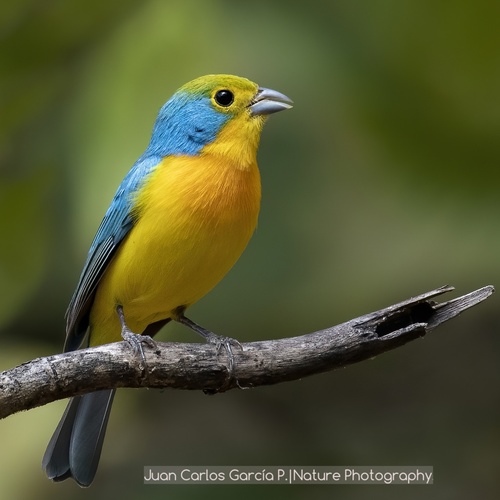
Passerina leclancherii, commonly called the orange-breasted bunting, grows to a length of approximately 12.5 cm (5 in), and is slightly smaller than the closely related rose-bellied bunting (Passerina rositae) which shares its natural range. The adult male has a pale green crown, turquoise blue nape and upper body that is often tinged with green, and a turquoise tail. Its lores, eye-ring and underparts are canary yellow, deepening to golden-orange on the breast. The adult female has greyish-green upper parts and yellow underparts. This species has dark brown irises, with grey beaks and legs. Its song is a somewhat plaintive warble, slower and less drawn out than the songs of other members of the Passerina genus. The orange-breasted bunting is endemic to Mexico. Its range extends from the Pacific coast of southern Nayarit, Jalisco, Michoacán and Guerrero to western Chiapas, and inland to western Puebla, covering an area of approximately 276,000 km² (107,000 mi²). It inhabits tropical dry forest, arid scrubland, thorny thickets, bushy deciduous woodland, clearings and woodland edges, at altitudes up to about 900 m (3,000 ft). It has a patchy distribution, and does not occur in some areas of apparently suitable habitat. It is more abundant in secondary growth than in undisturbed forest. The species was introduced to the Hawaiian island of Oahu in 1941, but did not become established, and was extirpated by 1952. When foraging, these birds form small groups or forage in pairs. The specific diet of this species has not been studied, but buntings in the Passerina genus are generally seed-eaters, and also eat some fruit and invertebrates. Captive orange-breasted buntings will consume white millet, hemp seed, thistle seed, hard sweet apples, ant cocoons and mealworms. Breeding occurs during the wet season in May and June. The nest is cup-shaped, built from rootlets, grasses and dry leaves with a softer lining, and constructed in a low bush or thick scrub. The clutch contains three or four bluish-white or greenish-white eggs.