About Passerina cyanea (Linnaeus, 1766)
The indigo bunting, Passerina cyanea, is a small songbird roughly the size of a small sparrow. It measures 11.5–15 cm (4.5–5.9 in) in length, with a wingspan of 18–23 cm (7.1–9.1 in). Its body mass averages 14.5 g (0.51 oz), with a recorded range of 11.2–21.4 g (0.40–0.75 oz).
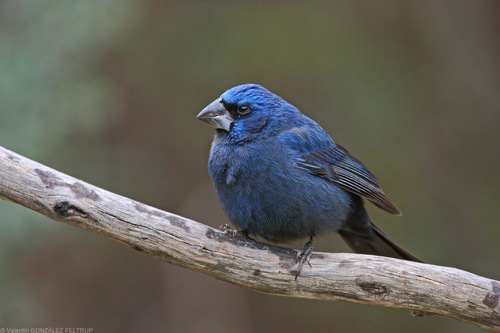
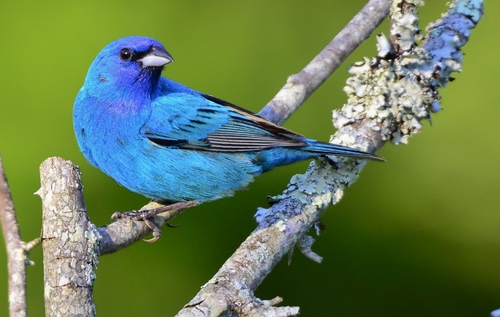
In the breeding season, adult males are mostly vibrant cerulean blue, with only the head colored indigo. Their wings and tail are black with cerulean blue edges. In fall and winter plumage, male feathers have brown edges that overlap the blue body and head feathers, making the bird appear mostly brown overall. Adult females are brown on the upperparts and lighter brown on the underparts, with indistinct wing bars and faint dark streaks on the underside. Immature indigo buntings resemble females in coloration, though immature males may show hints of blue on the tail and shoulders and have darker streaks on the underside.
The indigo bunting has a short, conical beak. In adult females, the beak is light brown with a blue tinge; in adult males, the upper half of the beak is brownish-black and the lower half is light blue. The feet and legs are black or gray.
First-year and adult males can be told apart through close observation of the skull and its degree of ossification. Juvenile skulls have a single layer that is slightly pinkish and gives under pressure, while adult skulls have a double layer that is more resistant to pressure. First-year birds also typically have a fleshy yellow gape at the corner of the mouth, which is visible in all months except October and November. When comparing males and females that both have brown molt, longer wings and higher weight usually indicate the bird is a male.
Data collected by Charles H. Blake from banding experiments in Hillsborough, North Carolina gives the indigo bunting a weighted annual survival rate of 0.585. Working with a pool of 25 captured and observed indigo buntings, Blake determined that approximately two out of twenty-five indigo buntings should live to six years of age. Using the calculated annual rate for six-year-old birds (2/25 = 0.08), an alternative annual rate of 0.656 was calculated, which is 12% higher than the 0.585 rate, and resulted in a 1 out of 25 statistic. The oldest recorded indigo bunting was at least 13 years and 3 months old. The author notes that little emphasis should be placed on these values, as the sample size of individuals is small, and any single individual can alter the weighted average.
The indigo bunting inhabits brushy forest edges, open deciduous woods, second-growth woodland, and farmland. Population sizes tend to increase when forest is cleared and land is developed into farms. The species' breeding range extends from southern Canada to Maine, south to northern Florida and eastern Texas, and west to southern Nevada. Its winter range starts in southern Florida and central Mexico, stretching south through the West Indies and Central America to northern South America. It has been recorded as a vagrant in Antigua and Barbuda, Barbados, Denmark, Ecuador, Germany, Iceland, Ireland, Netherlands, the Netherlands Antilles, Saint Pierre and Miquelon, Serbia and the United Kingdom.