About Passerina ciris (Linnaeus, 1758)
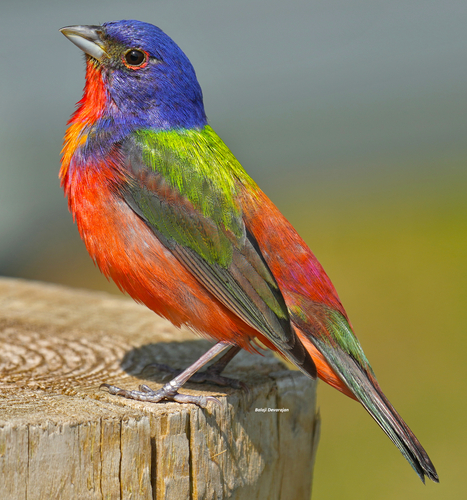
The male painted bunting (Passerina ciris) is often called the most beautiful bird in North America, earning it the nickname "nonpareil", meaning "without equal". Males have a dark blue head, green back, and red rump and underparts, which makes them extremely easy to identify. Even so, they can be hard to spot, because they often hide quietly in thick foliage even while singing. Female and juvenile painted buntings have green and yellow-green plumage that acts as camouflage. When seen clearly, adult females are still distinctive, as their green is brighter and purer than that of other similar songbird species. Adult painted buntings measure 12–14 cm (4.7–5.5 in) in total length, have a wingspan of 21–23 cm (8.3–9.1 in), and weigh 13–19 g (0.46–0.67 oz). In their first autumn, juveniles go through two separate molts, both of which produce plumage that matches that of an adult female. The first molt begins a few days after the juvenile leaves the nest, replacing its initial juvenile plumage with an auxiliary formative plumage. The second molt occurs around a month later, producing the species' formative plumage. Painted bunting eggs are pale blue-white, marked with brown speckles or spots. Clutches hold three to four eggs, or occasionally five, and are laid between March and July. Females build cup-shaped nests, usually in brush or low trees. Nests are most often placed 3 to 6 feet above the ground, though they can be found as high as 12 feet up. Painted buntings live in habitats typical for members of their bird family. They occur in thickets, woodland edges with riparian thickets, shrubbery, and brushy areas. In the eastern part of their range, the species breeds in maritime hammocks and scrub communities. Now, it is also commonly found along roadsides, in suburban areas, and in gardens with dense, shrubby vegetation. Its wintering habitat is typically shrubby edges along the border of tropical forests, or densely vegetated savannas. The species' breeding range is split into two geographically isolated areas. These breeding areas include southern Arizona, southern New Mexico, southern and eastern Texas, Oklahoma, Arkansas, Louisiana, northern Florida, coastal Georgia, the southern coast and inland waterways (such as the Santee River) of South Carolina, and northern Mexico. Painted buntings winter in South Florida, Cuba, the Bahamas, along both coasts of Mexico, and across most of Central America. Occasionally, vagrant individuals can appear further north, including in Washington DC, New York, Pennsylvania, and New Jersey. Every few years, the species has also been recorded as far north as New Brunswick, Canada. Genetic analysis has shown that the species can be split into three main genetic groups based on their breeding grounds: a western group, a central group, and an eastern group.