About Passerina amoena (Say, 1822)
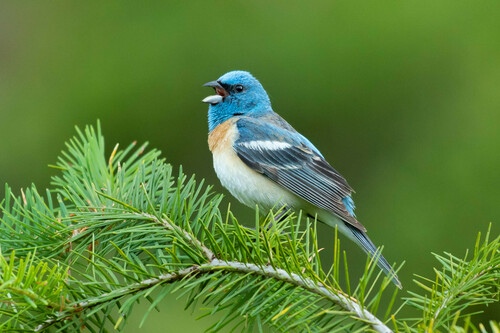
This species has the scientific name Passerina amoena (Say, 1822), commonly known as the lazuli bunting. Adults measure 5.1–5.9 inches (13–15 cm) in length, weigh 0.5–0.6 ounces (13–18 g), and have an average wingspan of 8.7 inches (22 cm). Breeding males are easily identified by their bright blue head and back, which is lighter in shade than the blue of the closely related indigo bunting, along with obvious white wingbars, a light rusty-colored breast, and a white belly. While the male's color pattern can resemble that of eastern and western bluebirds, the lazuli bunting can be quickly distinguished by its smaller overall size, visible wingbars, and the short, conical bill typical of a bunting. Females are overall brown, with grayer plumage on their upperparts and warmer-toned plumage on their underparts. They can be told apart from female indigo buntings by the presence of two thin, pale wingbars and other fine plumage differences. Lazuli buntings breed primarily west of the 100th meridian, ranging from southern Canada in the north down to northern Texas, central New Mexico and Arizona, and southern California in the United States. On the Pacific coast, the species' breeding range extends south into extreme northwestern Baja California. They are migratory, and spend the non-breeding season in southeastern Arizona and Mexico. They occupy brushy areas, and sometimes weedy, well-watered pastures; they may also occur within towns.