About Passer montanus (Linnaeus, 1758)
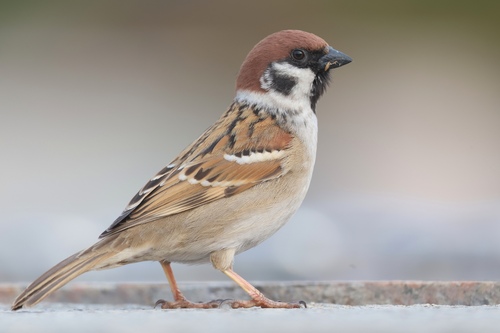
Passer montanus (Linnaeus, 1758), commonly called the tree sparrow, measures 12.5–14 cm (5–5+1⁄2 in) in length, has a wingspan of around 21 cm (8.3 in), and weighs an average of 24 g (0.85 oz). It is roughly 10% smaller than the house sparrow. Adult tree sparrows have rich chestnut crowns and napes, plus a kidney-shaped black ear patch on each pure white cheek. The chin, throat, and the area between the bill and throat are black. Their upperparts are light brown with black streaks, and their brown wings have two distinct narrow white bars. Legs are pale brown. The bill is lead-blue in summer, and turns almost black in winter. Unlike many other species in its genus, the tree sparrow has no plumage differences between males and females. Juveniles resemble adults, but their colouration is generally duller. The species' contrasting face pattern makes it easily identifiable in all plumages. Smaller size and a brown (not grey) crown are additional differences that distinguish tree sparrows from male house sparrows. Both adult and juvenile tree sparrows go through a slow, complete moult in autumn, and gain body mass even as stored fat reserves decrease. This mass increase comes from higher blood volume to support active feather growth, plus higher overall body water content. The tree sparrow does not have a true song. Its vocalisations include an excited series of tschip calls produced by unpaired or courting males. Other monosyllabic chirps are used during social interaction, and the flight call is a harsh teck. One study compared vocalisations of the introduced tree sparrow population in Missouri, USA, to vocalisations of tree sparrows from Germany. It found that US birds had fewer shared syllable types (called memes) and more structural variation within the population than European sparrows, which may stem from the small size of the original founding North American population leading to reduced genetic diversity. The tree sparrow's natural breeding range covers most of temperate Europe and Asia south of approximately 68°N (north of this latitude, summers are too cold, with average July temperatures below 12 °C (54 °F)), and extends through Southeast Asia to Java and Bali. It formerly bred in the Faroes, Malta, and Gozo. In South Asia, it occurs mainly in the temperate zone. Most of the species' extensive range is occupied by sedentary populations, though the northernmost breeding populations migrate south for winter. Small numbers leave southern Europe to winter in North Africa and the Middle East. The eastern subspecies P. m. dilutus reaches coastal Pakistan in winter, and thousands of birds from this subspecies pass through eastern China during autumn. The tree sparrow has been introduced outside its native range, but did not become established in all introduction attempts, possibly due to competition with the house sparrow. It successfully established introduced populations in Sardinia, eastern Indonesia, the Philippines, and Micronesia, but introductions to New Zealand and Bermuda did not succeed. Ship-carried tree sparrows naturally colonised Borneo. The species has occurred as a natural vagrant in Gibraltar, Tunisia, Algeria, Egypt, Israel, the United Arab Emirates, Morocco, and Iceland. In North America, a population of around 15,000 tree sparrows is established around St. Louis, and adjacent parts of Illinois and southeastern Iowa. This population descends from either 20 imported German birds or 12 imported German breeding pairs, released in late April 1870, most likely by members of an acclimatisation society. Within its limited US range of around 22,000 square kilometres (8,500 sq mi), the tree sparrow must compete with the house sparrow in urban centres, so it is mainly found in parks, farms, and rural woods. Researchers have suggested that the tree sparrow's higher neophobia (novelty aversion) compared to house sparrows is one factor limiting the spread of tree sparrows in North America; one study specifically found that captive tree sparrows were less willing to eat novel foods, and habituated more slowly to novel objects, than house sparrows. The American population is sometimes called the "German sparrow" to distinguish it from both native American tree sparrow species and the much more widespread "English" house sparrow. In Australia, the tree sparrow occurs in Melbourne, towns in central and northern Victoria, and some centres in the Riverina region of New South Wales. It is a prohibited species in Western Australia, where it often arrives on ships travelling from Southeast Asia. Despite its scientific name Passer montanus, the tree sparrow is not typically a mountain species. It only reaches elevations of 700 m (2,300 ft) in Switzerland, though it has bred at 1,700 m (5,600 ft) in the northern Caucasus, and as high as 4,270 m (14,010 ft) in Nepal. In Europe, it is frequently found on cliff coastlines, in empty buildings, in pollarded willows along slow water courses, or in open countryside with small isolated patches of woodland. The tree sparrow strongly prefers nest sites near wetland habitats, and avoids breeding on intensively managed mixed farmland. When tree sparrows and larger house sparrows occur in the same area, house sparrows usually breed in urban areas, while the smaller tree sparrows nest in the countryside. Where trees are scarce, such as in Mongolia, both species may use man-made structures for nesting. In Europe, the tree sparrow is a rural bird, but it is an urban bird in eastern Asia. In southern and central Asia, both species in the genus Passer may be found around towns and villages. In parts of the Mediterranean, such as Italy, both tree sparrows and Italian or Spanish sparrows may be found in settlements. In Australia, the tree sparrow is largely an urban bird, while the house sparrow occupies more natural habitats.