About Passer moabiticus Tristram, 1864
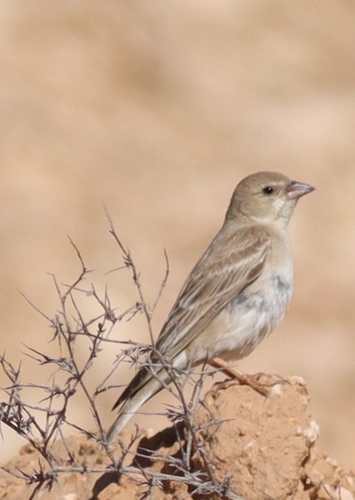
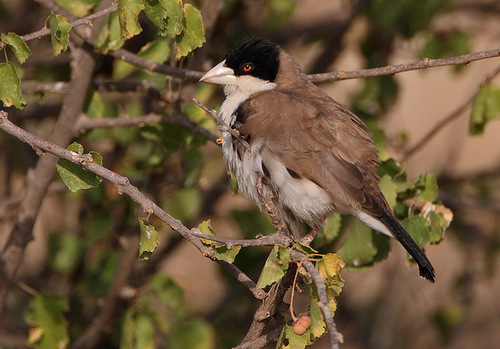
Dead Sea sparrow (Passer moabiticus Tristram, 1864) measures 12–13 cm (4.7–5.1 in) in length, making it one of the smaller species in its family — around 4 cm (1.6 in) shorter than the widespread house sparrow. Like most related species, it is sexually dimorphic: males have brighter, more distinct markings than females. The male has a grey crown, rear neck, and cheeks, plus a small black bib. It has a pale supercilium that fades to buff at the rear, and yellow neck sides. Its upperparts are dark-streaked reddish brown, while its underparts are grey-white. The female resembles a small house sparrow, with a streaked brown back, greyish head, and buff-white underparts. She is paler and has a smaller bill than the house sparrow, and sometimes has yellow coloring on the neck sides. The eastern subspecies P. m. yatii is sandier in overall color, and males of this subspecies have a yellow wash on their underparts. This species' chirping song is similar to the songs of house and Spanish sparrows, but is softer. Its flight call is a high-pitched chi-wit, and the species is often silent. The species has a spotty distribution across the Middle East, occurring mostly in corridors along the Jordan River and Euphrates River, with a range extending from southern Turkey and Cyprus to the southwestern corner of Iran. The subspecies P. m. yatii breeds only in the Sistan region of southwestern Afghanistan and eastern Iran. When scientists first documented this species, they only recorded breeding populations in a restricted area near the Dead Sea, which gave the species its common name; additional populations were later discovered further east, and the species' known range expanded through the second half of the 20th century. The species was first recorded on the island of Cyprus in 1973, and breeding was documented there a few years later. Although habitat changes reduced the size of this Cypriot population soon after breeding was confirmed, it is thought that small numbers still breed in Cyprus. This species is migratory or dispersive outside of its breeding season. The eastern subspecies winters in western Pakistan, but the regular wintering grounds of the western subspecies remain largely unknown. Winter surveys near the western breeding range only find scattered flocks of this species. It is possible that the western subspecies disperses widely in winter, since winter flocks have been found further south and east than their breeding range, including in the United Arab Emirates and Saudi Arabia. Genetic analysis of birds from Israel shows high connectivity between different populations, meaning individual birds move between these populations. Even with this gene flow, there is latitudinal variation in wing length and body mass: individuals in northern Israel have longer wings and are heavier than those in southern Israel, which suggests local adaptation following Bergmann's rule.