About Passer melanurus (Statius Muller, 1776)
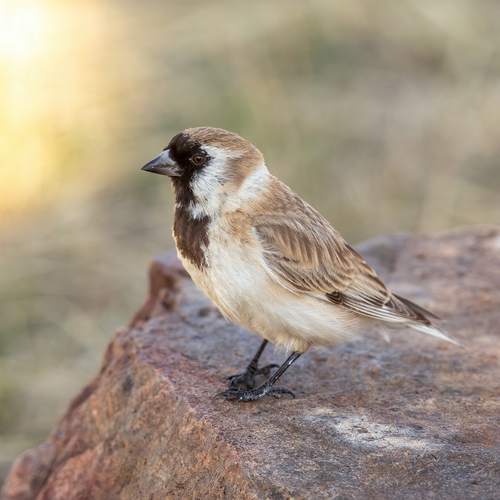
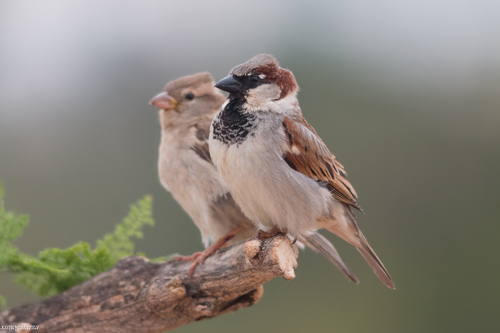
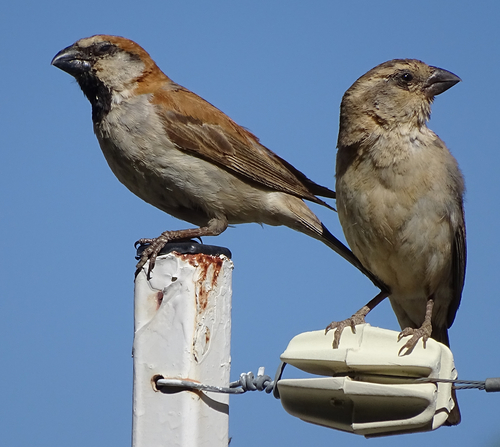
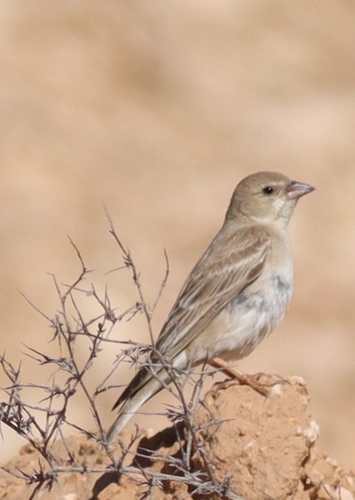
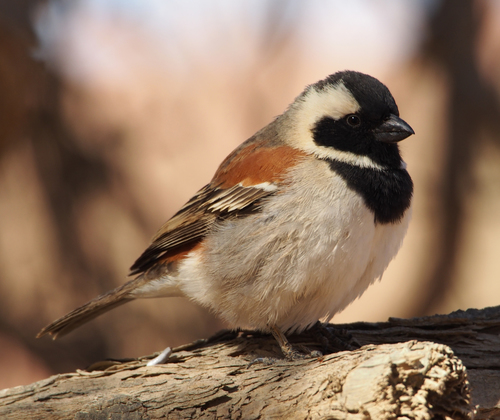
This medium-sized sparrow species, the Cape sparrow, has a striking, distinctive appearance, and measures 14–16 cm (5.5–6.3 in) in length. Adult Cape sparrows weigh between 17 and 38 grams (0.60–1.34 oz). Breeding males have an almost entirely black head, with a broad white mark on each side that curves from behind the eye down to the throat. A narrow black band on the throat connects the black breast bib to the black colouring of the head. The species' underparts are greyish, with darker colouring along the flanks. The back of the breeding male's neck is dark grey, while its back and shoulders are bright chestnut. Males have a white and a black wing bar below their shoulders, and their flight feathers and tail are streaked grey and black. Females share a similar plumage pattern to males, but their colouring is duller. Females have a grey head with a different pattern than males, though they still show a faint version of the males' pale head markings. Juveniles look similar to females, but young males develop black head markings from an early age. Cape sparrow calls are chirps that resemble those of the house sparrow, but are more musical and mellow. The species' basic call, used during flight and social perching, has been transcribed as chissip, chirrup, chreep, or chirrichup. Males use a loud, distinctive call to advertise ownership of their nest, which is written as tweeng or twileeng; this call can be extended into a jerky, repetitive song transcribed as chip cheerup, chip cheerup. The Cape sparrow lives in southern Africa, south of Angola and stretching east as far as Eswatini. The northernmost point of its range is Benguela in Angola, and it occurs in coastal and central Namibia, excluding the driest regions of the Namib Desert. It is present across almost all of South Africa except the far eastern edge, and lives in southern Botswana as well as scattered sites in the Kalahari Basin of central Botswana. In the eastern portion of its range, it breeds at a small number of sites in southeastern Zimbabwe, and has been recorded as a vagrant in Harare, central Zimbabwe. The eastern edge of its range reaches the wet forests of Limpopo and KwaZulu Natal, and extends into the hills of western Eswatini. This species' original native habitats were the semi-arid savanna, thornveld, and open light woodland common across southern Africa. Around one thousand years ago, when settled agriculture reached its range, the Cape sparrow adapted to live on cultivated land. After human settlements developed in the region, it also moved into towns. Cape sparrows prefer habitats with annual rainfall of less than 75 centimetres (30 in), though in desert areas they are usually found near watercourses or watering holes. While they live in urban centres, they favour open spaces such as parks and gardens, and have low reproductive success in more heavily built-up areas. In towns, the Cape sparrow competes with both the native southern grey-headed sparrow and the house sparrow, which was introduced to southern Africa in the 19th century. Since the Cape sparrow is more firmly established around humans across its range than either competing species, it outcompetes both, though the other species may prevent it from nesting in holes. A 2000 birdwatcher survey found that Cape sparrow abundance was increasing in some South African suburban areas (northern Johannesburg and Pietermaritzburg) and decreasing in others (southern Cape Town). The survey also reported that house sparrows were decreasing in several urban areas, a pattern that has also been seen in parts of Europe. These declines are attributed to factors including increasing density of garden plantings and higher predation rates.