About Passer italiae (Vieillot, 1817)
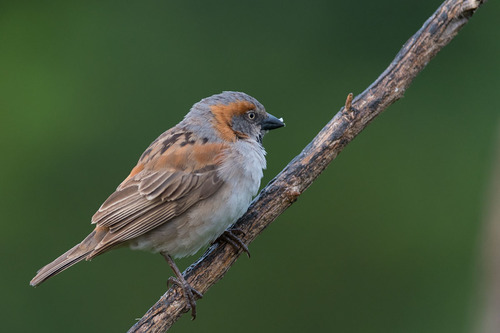
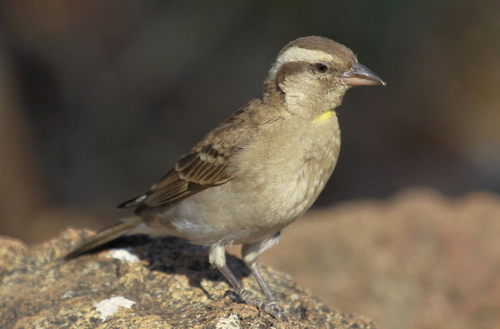
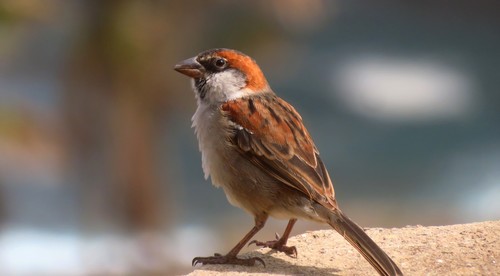
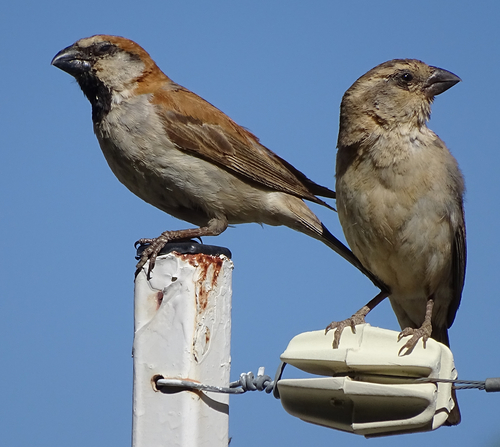
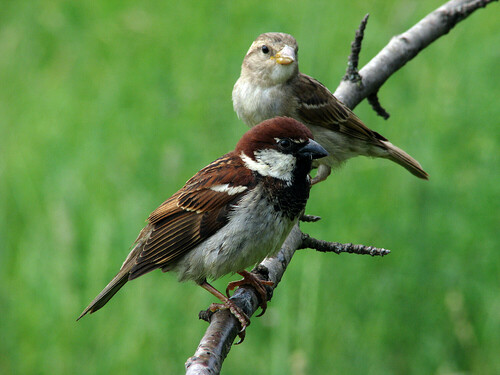
The Italian sparrow (Passer italiae, first described by Vieillot in 1817) is a small, chunky bird with grey and brown plumage. Males and females differ in plumage pattern, and are slightly different in length. The male has a head pattern matching that of the Spanish sparrow: a chestnut crown, nape, and sides of head, paired with white cheeks. Males have bright chestnut upperparts and pale grey underparts, and lack the black streaking found on Spanish sparrows. Males also have a black patch on the throat and chest called a bib or badge. Like much of the male's plumage, this patch is dull when it is in fresh non-breeding plumage, and brightens as the plumage wears and the bird preens. Females are nearly identical to female house sparrows, but can be distinguished from female Spanish sparrows by the lack of black streaks on their underparts. Occasional cases of albinism have been recorded in this species. The Italian sparrow is around the same size as the house sparrow, measuring 14–16 centimetres (5.5–6.3 in) in total length. Its tail measures 5.3–6 centimetres (2.1–2.4 in), its tarsus measures 18.6–21 millimetres (0.73–0.83 in), and male wing length falls between 7.3–8.2 centimetres (2.9–3.2 in). The species' weight varies seasonally, from an average of 30 grams (1.1 oz) in winter to 26 grams (0.92 oz) in summer. The vocalisations of the Italian sparrow are similar to the vocalisations of both the Spanish sparrow and the house sparrow. Its calls carry better in natural environments than the vocalisations of the house sparrow do. Males give a chreep call like that of the Spanish sparrow to claim ownership of a nest, and use a faster version of this call during courtship displays. Across southern Italy, male song patterns gradually transition into the song patterns of the Spanish sparrow. In the area where the ranges of the house sparrow and Italian sparrow overlap, the two species have similar vocalisations. The Italian sparrow occurs in northern and central Italy, Corsica, and small parts of France, Switzerland, Austria, and Slovenia. In 1881, Italian zoologist Enrico Hillyer Giglioli described its distribution as professing "'Conservative opinions'; for it keeps strictly within our current political frontiers". At the northernmost edge of its range in the southern Alps, there is a narrow hybrid zone 20–30 km (12–19 mi) wide where the Italian sparrow interbreeds with the house sparrow. In southern Italy, there is a gradual clinal trend with the Spanish sparrow: birds become increasingly similar to Spanish sparrows in appearance and ecology further south, extending from around Naples to western Sicily, where birds resemble pure Spanish sparrows. This trend may be superficial, and the Handbook of the Birds of the World recognises birds from Sicily and Crete as Italian sparrows. Sardinia is occupied by Spanish sparrows, while sparrows on Malta, Crete, and adjacent islands are intermediates that are similar to Italian sparrows. On Malta, sparrows resemble Spanish sparrows; urban Malta sparrows behave similarly to house sparrows, while rural Malta sparrows behave like Spanish sparrows. The situation on Malta is made more complex by house and Spanish sparrows that winter and migrate through the area. A more complex situation occurs in parts of northern Africa, where there is a highly variable mixed, interbreeding population of house sparrows and Spanish sparrows. This "hybrid swarm" shows a full range of characteristics, from nearly pure house sparrows to nearly pure Spanish sparrows, and every form in between. The Italian sparrow is associated with human habitations, and lives in towns, cities, and agricultural areas. In most Italian cities, it shares the urban environment with the Eurasian tree sparrow, and in some parts of Naples, it is entirely replaced by this species. The total breeding population of the Italian sparrow is estimated to be 5 to 10 million pairs, with 750,000 to 900,000 of these pairs estimated to live in urban areas. Its population density ranges from 58 to 160 pairs per square kilometer. Up to the mid-1990s, the Italian sparrow population increased steadily, likely due to increased urbanisation. Between 2000 and 2005, the Italian sparrow population in Italy declined by 27.1 percent, matching declines of the house sparrow across Europe. From 1998 to 2008, urban Italian sparrow populations declined by about 50 percent. A study of the species' status listed many potential causes for this decline, including shortages of insect food, agricultural intensification, and reductions in green areas. The Italian sparrow is among the most common birds in Italian cities, but other species including the European goldfinch are more common.