About Passer iagoensis (Gould, 1838)
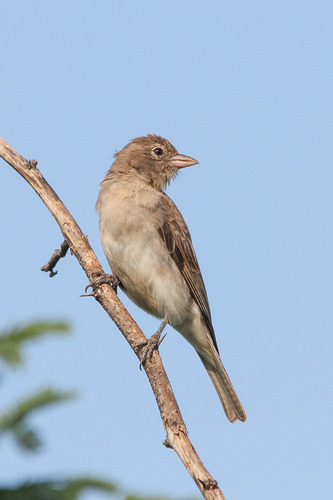
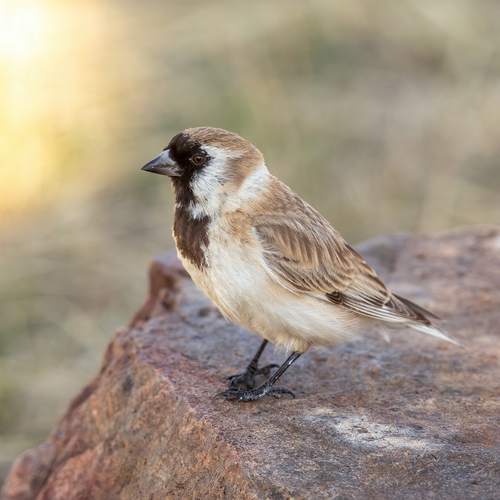
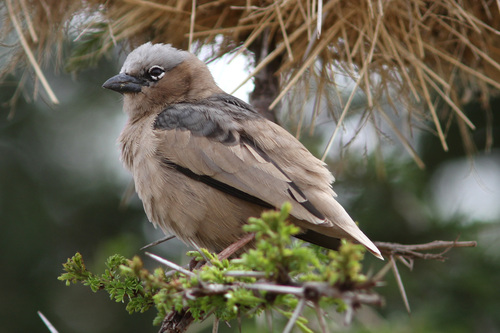
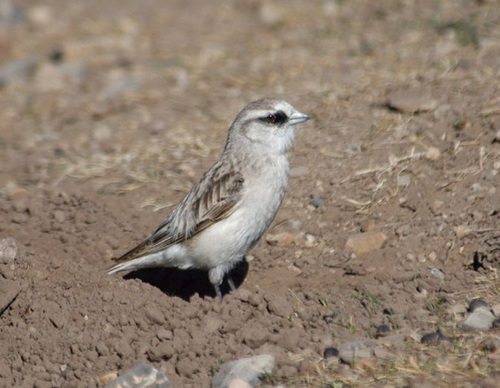
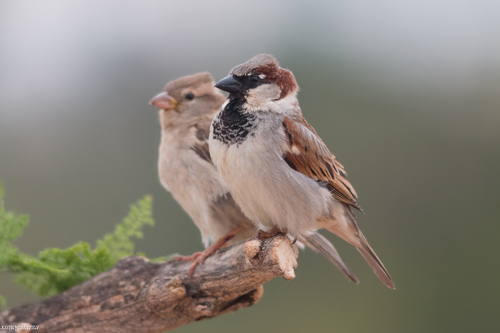
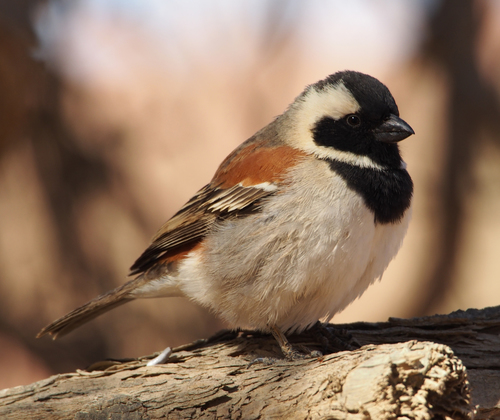
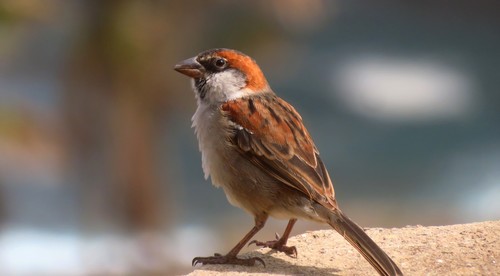
The Iago sparrow, scientifically named Passer iagoensis (Gould, 1838), is a small sparrow measuring 12.5–13 centimetres (4.9–5.1 in) in length, with a wing length of 5.5–6.9 centimetres (2.2–2.7 in). Its plumage is similar to that of the house sparrow, and like the house sparrow, it is sexually dimorphic. The male has a black or greyish-black crown and eyestripe, a grey nape, and a small white patch on the lower forehead. The sides of its head, especially the area above the eye, are a rich cinnamon colour. The scapulars are white and brown, while the rest of the upperparts are brown, streaked with black and beige. The cheeks and underparts are pale grey, and the throat and chin are marked with a small black bib. The female is grey-brown, with black-streaked wings and breast, and pale grey underparts. She is very similar to the female house sparrow but has a more noticeable pale supercilium, the stripe over the eye. Juvenile Iago sparrows resemble adult females, but young males are more chestnut from an early age, with a faint black bib on the chin. In 1898, ornithologist Boyd Alexander reported that adult Iago sparrows begin moulting in early February, and some individuals are still moulting by late May. The Iago sparrow has multiple types of vocalisations, including calls that vary between the sexes, elaborated sequences of these calls called 'songs', and an alarm call. Calls are chirps somewhat similar to those of other sparrows; the typical call made by males is described as "twangy" or "chew-weep", while the female's call is described as a "more sibilant" chisk. The song is a long, elaborated series of notes, produced by breeding males from within their nests. The species also uses an alarm call similar to that of other sparrows, transcribed as chur-chur-chur. The Iago sparrow is endemic to the archipelago of Cape Verde. It is common on most Cape Verde islands, but is absent from Fogo, and scarce on Santa Luzia, Branco and Sal. It is commonly found in a variety of habitats across its range, including flat lava plains, coastal cliffs, gorges, and the edges of farmland, at altitudes up to 1,200 metres (3,900 ft). It also occurs in settled areas and gardens, where its range may overlap somewhat with that of the house sparrow, but it usually does not overlap with the Spanish sparrow. The Spanish sparrow occupies richer cultivated land with larger trees and villages, which restricts the Iago sparrow to more arid cultivated land with smaller trees. In settlements where both the house sparrow and Iago sparrow occur, house sparrows tend to live in denser areas, while Iago sparrows are found primarily around trees and open spaces. In agricultural areas, the Iago sparrow may cause some crop damage, mostly by eating buds and shoots. The Iago sparrow is highly common within its limited range, though its exact total population is not known. While the small size of its range means it may be at risk from unforeseen changes to its environment, it is currently assessed as Least Concern on the IUCN Red List. In May 2013, four vagrant Iago sparrows were observed at Hansweert in the Netherlands; the birds had flown onto a ship as it passed the island of Raso.