About Passer hispaniolensis (Temminck, 1820)
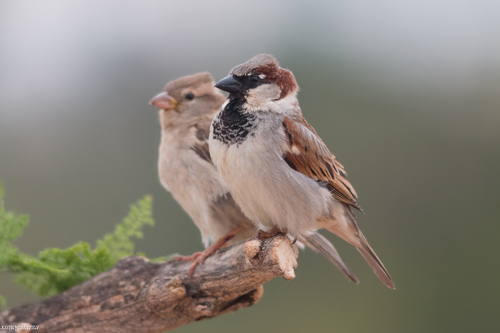
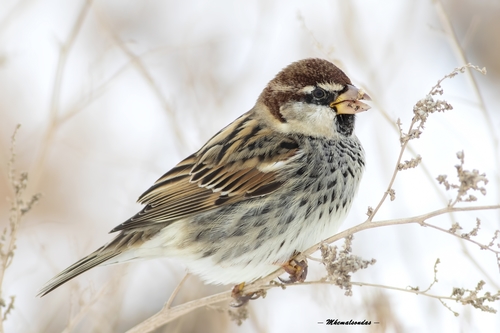
The Spanish sparrow, scientifically Passer hispaniolensis (Temminck, 1820), is a rather large sparrow. It measures 15–16 cm (6–6.5 in) in length and weighs 22–36 g (0.78–1.27 oz). It is slightly larger and heavier than house sparrows, and also has a slightly longer, stouter bill. Males share similar overall plumage with male house sparrows, but differ by having heavily black-streaked underparts, a chestnut (instead of grey) crown, and white (instead of grey) cheeks. Females cannot be reliably distinguished from female house sparrows at a glance, with an overall grey-brown basic plumage that has bolder markings. Female Spanish sparrows have light streaking on their sides, a pale cream supercilium, and broad cream streaks along their back. Two subspecies of Spanish sparrow are recognized: the western Spanish sparrow (P. h. hispaniolensis) and eastern Spanish sparrow (P. h. transcaspicus). There is almost no visible difference between the two in worn breeding plumage, but they are easier to tell apart in fresh winter plumage: the eastern subspecies P. h. transcaspicus is paler and has less chestnut coloring. The Spanish sparrow has a highly complex distribution across the Mediterranean region, Macaronesia, and southwest to central Asia. It mostly breeds within a latitude band approximately 15 degrees wide, stretching from the Danube Valley and the Aral Sea in the north to Libya and central Iran in the south. Over the last two centuries, its range has expanded greatly through natural colonisation. It spread into the Balkans, reaching Romania, Serbia, and Moldova starting in 1950. Its range expansion in Macaronesia has often been credited to introductions and ship travel, but it was more likely the result of natural colonisation by migrating birds. Vagrant Spanish sparrows have been recorded widely, as far north as Scotland and Norway. One study found that vagrant individuals of this species occur much closer to railway lines than vagrant individuals of other passerine species. This finding suggests that cargo trains may partially assist the Spanish sparrow's vagrancy and range expansion. Across most of its range, the Spanish sparrow lives alongside the house sparrow. Where both species occur, both breed in farmland and open woodland, and the Spanish sparrow prefers moister habitats. In areas with no house sparrows, the Spanish sparrow can live in urban habitats, such as the Canary Islands, Madeira, and some Mediterranean islands. In a small number of urban areas, including parts of eastern Sardinia, the Eurasian tree sparrow is the dominant sparrow species. Before the Spanish sparrow reached the Canary Islands and Madeira, the rock sparrow was the only native sparrow in these locations. In the Canaries, the Spanish sparrow now lives in most habitats, and has displaced the rock sparrow to only the driest areas. On Madeira, the Spanish sparrow is common in cultivated areas, but has not fully adapted to nest in buildings or breed in the drier northern part of the island. The Spanish sparrow is not common on most of the Cape Verde islands, because the endemic Iago sparrow is present there, and the house sparrow occurs on São Vicente. On Fogo, where the Spanish sparrow is the only sparrow species, it is common across all habitats, breeding both in the buildings of São Filipe and on the cliff walls of the volcano Pico do Fogo. The Spanish sparrow is strongly gregarious, forming flocks and breeding in groups. In winter, it mostly travels nomadically or makes regular migrations. Little research exists on the Spanish sparrow's survival rate, and the maximum recorded lifespan for the species is 11 years.