About Passer eminibey (Hartlaub, 1880)
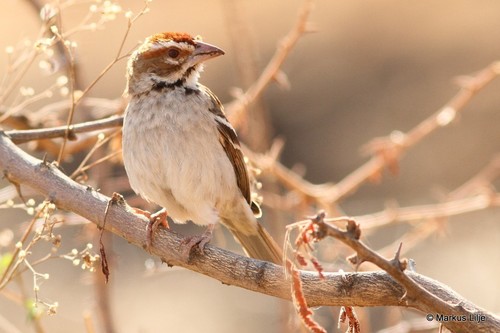
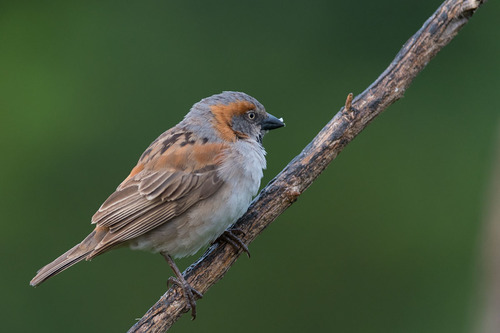
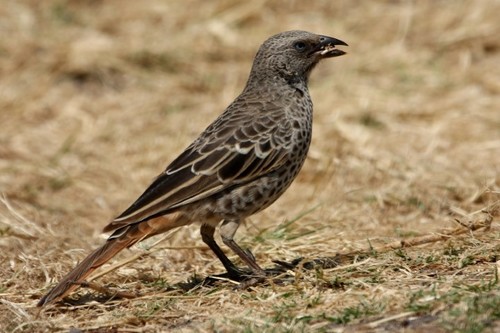
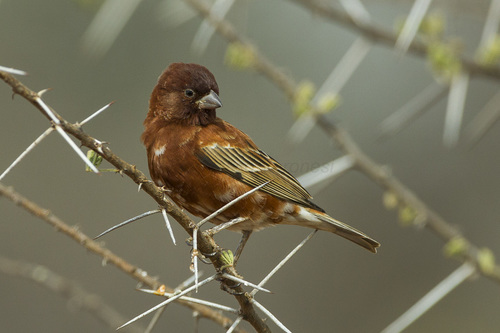
Like other members of the sparrow family, the chestnut sparrow (Passer eminibey) is a small, chunky songbird with a thick bill adapted for a seed-based diet. Measuring 10.5 to 11.5 cm (4.1–4.5 in) in length, it is the smallest species in the sparrow family. It weighs between 12 grams (0.42 oz) and 17 grams (0.60 oz). Male wing length ranges from 6.0 to 6.5 cm (2.4–2.6 in), while female wing length ranges from 5.7 to 6.0 cm (2.2–2.4 in). On average, the tail is around 4 cm (1.6 in) long, the bill around 1 cm (0.39 in) long, and the tarsus around 1.5 cm (0.59 in) long. The plumage of a breeding male is mostly a deep chestnut shade, with black markings on the face, wings, and tail. Breeding males are most easily confused with the chestnut weaver, which is substantially larger and has white markings on its wings. A breeding male's legs and feet are horn (pale grey) in colour. Non-breeding male chestnut sparrows have white flecking on their upperparts, and most of their plumage is buff or whitish with chestnut crescent markings. This plumage wears away to reveal the bright chestnut breeding plumage. A non-breeding male's bill fades to a dusky-tipped horn colour, which is similar to the female's bill, but lacks dusky tones on the cutting edge of the lower mandible. Females share the same general plumage pattern as males, but their colouration is somewhat duller. Females have a grey head, a buff supercilium, chin, and throat, black and warm brown upperparts, and off-white underparts. A female's bill is pale yellow, with a dusky tip and dusky cutting edge on the mandible. Juveniles are dull grey with a brown back, a pale yellow supercilium, and a pale horn bill. Females and juveniles have faint chestnut markings on their supercilium, shoulders, and throat, which distinguishes them from other sparrows that share much of the chestnut sparrow's range, including the Kenya sparrow, other rufous sparrows, and the house sparrow. The basic call of the chestnut sparrow is a subdued chirp, with two recorded variations: a scolding threat call transcribed as chrrrrit or chrrrrreeeerrrrrrrr, and a chew chew flight call. Displaying males produce a high twittering trill transcribed as tchiweeza tchiweeza tchi-tchi-tchi-tchi- see-see-see-seeichi. The chestnut sparrow is found in East Africa, mostly in low-elevation areas ranging from Darfur through Kordofan, South Sudan, Somalia, Uganda, and Kenya to north-central Tanzania. Its range also extends northeast into southwestern Ethiopia and the Ethiopian Great Rift Valley. Like golden sparrows, chestnut sparrows are sometimes nomadic outside of the breeding season. Vagrants have been recorded as far from the core breeding range as Dar es Salaam. The species occurs mostly in dry savanna, fields, and villages, but unlike the closely related golden sparrows, it can sometimes be found in papyrus swamps (dominated by certain Cyperus species). Its total population has not been quantified, but it appears to be common across a very large range, and the IUCN Red List assesses it as Least Concern for global extinction. Chestnut sparrows are gregarious, and are only rarely found outside of flocks. They frequently associate with queleas and other weavers. Adult chestnut sparrows feed on grass seeds, and individuals living near human settlements also eat crumbs and other household scraps. Nestlings are fed mostly softer grass seeds, and small beetles are also recorded in their diet.