About Passer domesticus (Linnaeus, 1758)
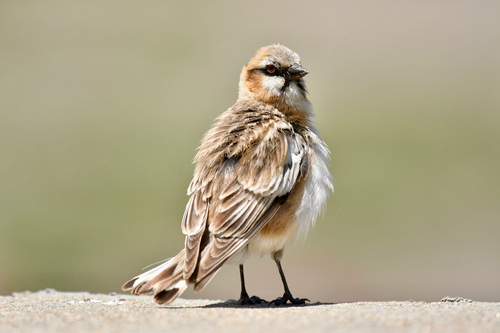
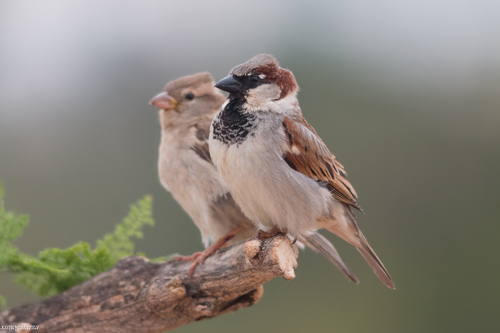
Identification: The house sparrow (Passer domesticus) can be confused with many other seed-eating birds, particularly other species in the genus Passer, its close relatives. Most of these related species are smaller, with a neater or "cuter" appearance, an example being the Dead Sea sparrow. Light brown-coloured female house sparrows often cannot be told apart from females of other Passer species, and are nearly identical to females of the Spanish sparrow and Italian sparrow. The Eurasian tree sparrow is smaller and more slender than the house sparrow, and has a chestnut crown and a black patch on each cheek. Male Spanish sparrows and male Italian sparrows can be distinguished from male house sparrows by their chestnut crowns. The Sind sparrow is very similar to the house sparrow but smaller, with less black on the male's throat and a distinct pale supercilium on the female. Distribution and habitat: The house sparrow originated in the Middle East, and spread alongside the development of agriculture to most of Eurasia and parts of North Africa. Since the mid-19th century, it has reached most regions of the world, mostly through deliberate human introductions, but also via natural dispersal and transport by ship. Its introduced range covers most of North America (including Bermuda), Central America, southern South America, southern Africa, part of West Africa, Australia, New Zealand, and islands across the globe. It has greatly expanded its range in northern Eurasia since the 1850s, and continues to do so. This ongoing expansion is demonstrated by its colonization of Iceland and Rishiri Island, Japan around 1990. The large size of its range makes it the most widely distributed wild bird on the planet. The house sparrow is closely associated with human settlements and agricultural cultivation. It is not an obligate commensal of humans as some sources have claimed: migratory individuals of the Central Asian subspecies usually breed away from humans in open country, and birds elsewhere are occasionally found living outside of human areas. The only terrestrial habitats that the house sparrow does not occupy are dense forest and tundra. It is well adapted to living close to humans, and frequently lives and even breeds indoors, especially in factories, warehouses, and zoos. It has been recorded breeding 640 m (2,100 ft) below ground in an English coal mine, and feeding at night on the observation deck of the Empire State Building. It reaches its highest population densities in urban centres, but has higher reproductive success in suburbs, where insects are more abundant. At a larger geographic scale, it is most abundant in wheat-growing regions such as the Midwestern United States. It tolerates a wide range of climates, but prefers drier conditions, especially in moist tropical climates. It has multiple adaptations that allow it to live in dry areas, including high salt tolerance and an ability to survive without drinking water by eating berries. Throughout most of eastern Asia, the house sparrow is completely absent, and is replaced by the Eurasian tree sparrow. Where the two species overlap in range, the house sparrow is usually more common than the Eurasian tree sparrow, but one species may replace the other in a pattern that ornithologist Maud Doria Haviland described as "random, or even capricious". Across most of its range, the house sparrow is extremely common, even with some recent population declines, but its distribution can be patchy in marginal habitats such as rainforests or mountain ranges.